The Cosmic Bell of Mā Candraghaṇṭā: The Scriptural Anatomy of Fear and the Solar Plexus
Drafted with the help of AI from the original texts named in the article; I read and correct every article after it is published. How we use AI
Discover how Maa Chandraghanta in Devi Bhagavata Purana unites cosmic bell resonance, the Manipura chakra, and the enteric nervous system to conquer fear.
In this article
Have you ever noticed that whenever profound, paralyzing terror strikes your life, it never begins in your logical thoughts?
Think about the last time you received a terrifying late-night phone call, faced a catastrophic financial collapse, or stood on the precipice of public ruin. Your neocortex did not freeze first. Your analytical mind did not skip a beat. Instead, a cold, sickening, violent punch landed squarely in the pit of your stomach. Your breath locked. A tight, nauseating knot seized your gut, sending shockwaves through your limbs.
Why is it that primal terror doesn't live in our brains, but in our bellies?
For years, modern self-help culture and commercialized mindfulness apps have sold us a comfortable prescription: “Just take a deep breath. Recite a calming affirmation. Think positive thoughts.” But let’s be completely honest with each other: when real existential panic grips you by the throat, a positive affirmation does not unclench your stomach. Abstract mental optimism cannot dissolve a biological knot that feels like cold iron.
If you open the conventional internet on the third day of Navratri, you will find the worship of Mā Candraghaṇṭā (माँ चन्द्रघण्टा) flattened into a pastel greeting card. She is casually presented as a ten-armed goddess riding a tiger, holding a bell, wearing grey or gold, and smiling benignly as the “giver of peace and bravery.”
This decorative, sanitized version completely obscures one of the most psychologically revolutionary and metabolically intense teachings in classical Sanatan Dharma.
Deep inside the ancient folios of the Śrīmad Devī Bhāgavata Purāṇa, the Durgā Saptaśatī, and the Śiva Purāṇa, Mā Candraghaṇṭā does not represent a timid, sentimental feeling of bravery. She represents an ontological technology of fear annihilation. She reveals why human terror is anchored directly in the solar plexus (Maṇipūra Cakra), how sound can dismantle psychic panic at the vibrational level, and how unconditioned consciousness transforms paralyzing horror into supreme spiritual sovereignty.
Let us step beyond the festival clichés and explore what the texts actually say.
What the Text Actually Says
To grasp why Mā Candraghaṇṭā manifests, we must return to a shocking and deeply uncomfortable narrative recorded principally in the Śrīmad Devī Bhāgavata Purāṇa (Skandha 3, Adhyāyas 6 & 26–30; Skandha 5, Adhyāyas 2–18; and Skandha 7 Devī Gītā, Adhyāyas 31–40), corroborated by the Śiva Purāṇa (Rudra Saṁhitā, Pārvatī Khaṇḍa, Adhyāyas 44–48) and the sacred battlefield hymn of the Durgā Saptaśatī (Devī Māhātmya, Adhyāyas 2, 4, and 8).
The manifestation of Candraghaṇṭā occurs immediately following Day 2 of Navratri, the stage of Mā Brahmacāriṇī. For thousands of years, Goddess Pārvatī endured terrifying, solitary Tapas amidst the frozen peaks of the Himalayas. By burning away all personal comfort, She compelled Lord Śiva to yield to Her consecrated will. Śiva declared Himself Her debtor and formally agreed to take Her as His bride.
The royal wedding day arrived. At the majestic palace of King Himavān, the court was decorated with pure silks, fragrant sandalwood, and golden arches. Queen Menā and the assembled aristocracy gathered eagerly on the palace balconies to welcome the illustrious bridegroom. They expected a radiant, handsome prince—an adorned cosmic monarch worthy of their exquisite daughter.
Instead, the sky darkened, and a cosmic collision occurred between civilized human conditioning and raw primordial reality.
Lord Śiva arrived at the gates of Himavān’s palace not as an aristocratic prince, but in His unvarnished, untamed Aghora / Mahā-Kāla form.
The scriptures paint an unsettling picture:
- Śiva was smeared from head to foot in gray, powdery ash gathered from cremation pyres (Bhasma).
- Living, venomous serpents coiled hissing around His throat, wrists, and chest.
- In His hand dripped a raw skull-cup (Kapāla).
- He rode upon the wild bull Nandī, smirking with the absolute detachment of the cosmic void.
- Accompanying Him was His horrifying wedding retinue (Gaṇas): howling ghosts (Bhūtas), flesh-eating vampires (Vetālas), disembodied spirits of the dead (Pretas), famished ghouls (Piśācas), and grotesque, multi-faced entities whose very presence shattered the air.
When Queen Menā and the royal court looked out over the parapets, their nervous systems suffered complete catastrophic failure. Menā did not simply gasp; the Śiva Purāṇa records that she collapsed into a clinical, paralyzed swoon of existential horror (Mūrcchā).
When she regained consciousness, she tore at her clothes, weeping hysterically. She screamed that she would rather poison herself, stab herself with a dagger, or cast her beloved daughter into a bottomless Himalayan chasm than surrender her to this horrific embodiment of death. The royal guards dropped their weapons and fled. The musicians choked. The entire court was frozen in petrifying dread: Mahā-Bhaya—The Great Fear.
The Spiritual Anatomy of Menā’s Collapse
Why did the ancient sages preserve this disturbing scene in sacred scripture?
Because Queen Menā represents you and me. She represents mortal, civilized human ego. We love spirituality as long as it is gentle, sweet, fragrant, and domestic. We love God when God gives us wealth, emotional warmth, and social status. But the moment the Divine strips away its mask and reveals its untamed, cosmic reality—the void of mortality, ego-dissolution, uncertainty, and inevitable physical death—mortal consciousness shatters in terror. We freeze.
At that exact moment of collective human paralysis, Pārvatī realized an immutable metaphysical truth: Fear is the ultimate barrier that keeps mortal consciousness from uniting with the Absolute. If human beings cannot look into the raw face of the void without collapsing, spiritual union is impossible.
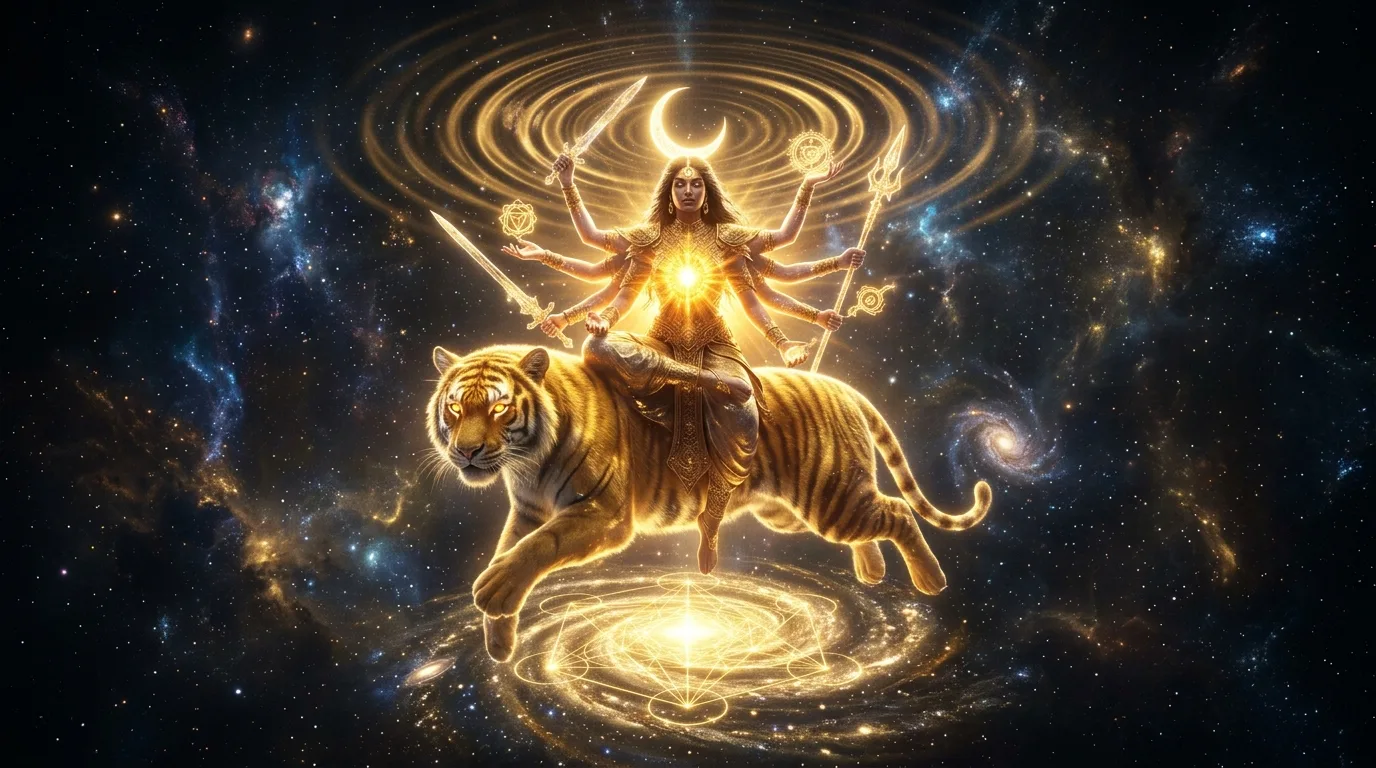
Pārvatī did not weep, plead, or negotiate. She immediately transfigured Her organism. Shedding the emaciated, fragile form of the ascetic Brahmacāriṇī, She manifested the towering, blinding, ten-armed cosmic form of Mā Candraghaṇṭā.
- Her Radiance: Glowing with the hue of incandescent, molten gold (Svarṇa-varṇā), blazing like ten million suns, She radiated the unadulterated fire of the Maṇipūra Cakra.
- Her Weaponry: In Her ten hands She displayed the complete arsenal of cosmic sovereignty and balance: the trident (Triśūla), mace (Gadā), sword (Khaḍga), celestial bow and arrow (Dhanuṣa-Bāṇa), lotus (Padma), sacred water vessel (Kamaṇḍalu), the gesture of boons (Varada Mudrā), and the gesture of radical fearlessness (Abhaya Mudrā).
- Her Mount: She did not walk; She mounted a snarling, golden tiger (Vyāghra / Siṁha), signaling absolute mastery over predatory drives.
- The Defining Symbol: Upon Her forehead, directly over the Third Eye, rested a crescent moon shaped precisely like an inverted bell (Ghaṇṭā-ākāra Candrama), emitting an unbroken, subtle, reverberating acoustic hum.
Stepping forward, Mā Candraghaṇṭā gently laid Her hand upon the petrified forehead of Her mother Menā, banishing her terror in an instantaneous flash of divine illumination. Then, with supreme maternal and warrior authority, She turned to Lord Śiva and commanded:
“O Lord of the Cosmos, I know your unconditioned truth. But my family lives in the realm of mortal forms. For their sake, withdraw this macabre apparel and assume a form they can behold without dying of fright.”
Śiva instantly obeyed. He transfigured into Candraśekhara / Kāmasundara—the most enchanting, dazzling bridegroom the universe had ever witnessed.
This scripture reveals that Candraghaṇṭā is the bridge between absolute terror and supreme beauty. She is the only force capable of metabolizing horror into harmony, because She does not run from death—She wears its frequency and commands it.
The Battlefield Cannon: The Bell That Dissolves Demonic Coherence
The second major appearance of Her bell occurs in the Durgā Saptaśatī (Chapter 2, Verse 22) during the cosmic war against Mahiṣāsura. When the gods offer their divine implements to the Mother, Indra steps forward and gifts Her the celestial bell taken from the neck of his royal elephant Airāvata:
“वज्रम् इन्द्रः समुत्पाद्य कुलिशाद् अमराधिपः । ददौ तस्यै सहस्राक्षो घण्टाम् ऐरावताद् गजात्
vajram indraḥ samutpādya kuliśād amarādhipaḥ / dadau tasyai sahasrākṣo ghaṇṭām airāvatād gajāt”
After the battle the gods praise Her, and their hymn in Chapter 11, Verse 27 (Markandeya Purana 91.27) says what that bell does:
“हिनस्ति दैत्यतेजांसि स्वनेनापूर्य या जगत्।
सा घण्टा पातु नो देवि पापेभ्योऽनः सुतानिव॥”
(Hinasti daitya-tejāṃsi svanenāpūrya yā jagat | sā ghaṇṭā pātu no devi pāpebhyo naḥ sutān iva ||)
“The bell that fills the world with its sound and destroys the power of the demons: may that bell protect us from evil, O Devi, as a mother protects her children.”
In Vedic warfare, a conch (Śaṅkha) is blown to herald battle. But a consecrated bell (Ghaṇṭā) is rung for an entirely different purpose: it is a standing acoustic wave that de-coheres the subtle vibrational structures of psychic darkness.
Physical weapons sever mortal flesh, but an asuric force is driven by an energetic matrix of pride, malice, and chaotic vibration (Tejas). When Candraghaṇṭā strikes Her bell, the standing wave shatters their energetic coherence at the root, rendering demonic forces powerless before a single blade is swung.
In Skandha 3, Adhyāya 6 of the Devī Bhāgavata Purāṇa, King Janamejaya questions Maharṣi Vyāsa: “If the Supreme Mother is pure compassion (Karuṇā-Mayī), why does She carry a deafening war-bell, weapons, and ride a ferocious beast?”
Vyāsa responds with the famous parable of the mother tigress: when she nurses her cubs, her jaws are gentler than silk; but when a predator approaches those same cubs, those identical jaws snap shut with bone-crushing ferocity. The violence against the predator is not the negation of maternal love—it is its ultimate, uncompromising expression.
Key Terms Explained
To understand the metaphysical mechanics at work, we must unpack the exact Sanskrit vocabulary used in the texts:
- Candraghaṇṭā (चन्द्रघण्टा): A compound of Candra (from the verbal root cand, meaning to shine, to gladden, to radiate serene lunar delight) and Ghaṇṭā (from the root ghaṇṭ, meaning to sound, to strike, to reverberate continuously). It does not mean a mere decorative goddess with a bell. It literally translates to: “She on whose brow the crescent moon has assumed the form and acoustic resonance of a bell.” It represents the alchemical union of lunar coolness (Soma) and continuous acoustic shockwave (Nāda).
- Maṇipūra (मणिपूर): Formed from Maṇi (gem, crystal, radiant jewel) and Pūra (city, flooding reservoir). Located at the navel and solar plexus, it is esoterically called “The City of Jewels” because it is the cosmic furnace of the Fire Element (Agni-Tattva). When blocked, it produces cowardice, panic, gut-wrenching anxiety, and subservience. When ignited by Candraghaṇṭā, it radiates the unshakeable golden courage (Svarṇa-Kānti) of spiritual sovereignty.
- Ghaṇṭā-Nāda (घण्टानाद): The continuous acoustic resonance generated by a struck bell. Unlike a sudden explosion or clap, a bell produces an initial strike transient followed by a long, multi-tonal harmonic decay. In Tantra, this sound mirrors the internal unstruck sound (Anāhata-Dhvani), guiding awareness from coarse audible speech (Vaikharī) through mental chatter (Madhyamā) into intuitive vision (Paśyantī) and transcendent non-dual silence (Parā).
- Daitya-Tejo-Hānī (दैत्यतेजोहानी / हिनस्ति दैत्यतेजांसि): Derived from Durgā Saptaśatī 11.27: Daitya (entropic/demonic forces) + Tejas (vital bio-electric coherence, radiant power) + Hānī/Hinasti (draining, nullifying, dismantling). The text recognizes that demonic states are sustained by subtle, coherent energetic patterns; the bell’s frequency literally disassembles their energetic matrix.
- Samāna Vāyu (समान वायु): From Sam (balanced, unified) and An (to breathe, to vitalize). The vital sub-prāṇa centered at the navel. While Prāṇa Vāyu moves upward and Apāna Vāyu moves downward, Samāna is the central metabolic whirlpool that assimilates food, sensory inputs, and emotional trauma. When fear attacks, Samāna collapses, knotting the stomach. When aligned with Candraghaṇṭā, it digests terror into spiritual fire.
- Abhaya-Mudrā (अभयमुद्रा): From A- (without) + Bhaya (fear) + Mudrā (energetic seal). The raised right palm signaling fearlessness. In the Upaniṣads, Abhaya is not merely an emotional adrenaline rush. It is the ontological recognition of non-duality. When you realize you are not separate from the cosmos, there is no “other” left to fear.
- Kṣātra-Tejas (क्षात्रतेजस्): The warrior spiritual radiance. Distinct from egotistical aggression or worldly violence, it is the uncompromising spiritual readiness to wield weapons against internal spiritual enemies (ṣaḍ-ripu: lust, anger, greed, delusion, pride, and envy) and cosmic injustice.
Traditional Interpretation
Classical commentators across the major Indian philosophical systems (Darśanas) analyzed Mā Candraghaṇṭā through distinct, profound lenses.
| SCHOOL Śākta Tantra Advaita Vedānta Kashmir Shaivism | ESOTERIC REALIZATION Maṇipūra activation; 10 weapons master 10 negative vṛttis; Agni-Soma dynamic balance; tiger mastery Dissolution of duality; Bṛhadāraṇyaka Upaniṣad 1.4.2 "Dvitīyād vai bhayaṁ bhavati"; Bell = pure Abheda Universe as Spanda; Fear as Saṅkoca (contraction); Ghaṇṭā = Anuttara-Spanda triggering cosmic Vikāsa |
|---|
1. The Śākta Tantra School (Nīlakaṇṭha Caturdhara & Bhāskararāya Makhin)
In his commentary Tilaka on the Devī Bhāgavata Purāṇa, scholar-sage Nīlakaṇṭha Caturdhara, alongside Bhāskararāya in the Saubhāgya-Bhāskara, unlocks the esoteric yogic physiology of Candraghaṇṭā:
- The Ten Arms and the Ten Petals: Day 1 (Śailaputrī) awakened the root (Mūlādhāra). Day 2 (Brahmacāriṇī) sublimated the sacral fluid (Svādhiṣṭhāna). Day 3 (Candraghaṇṭā) pierces the Maṇipūra Cakra. The Maṇipūra cakra possesses exactly ten psychic nadis or petals, associated with the syllables ḍaṁ through phaṁ. These ten petals govern ten negative psychological modifications (Vṛttis): spiritual ignorance (avidyā), craving (tṛṣṇā), jealousy (īrṣyā), treachery (piśunatā), shame (lajjā), fear (bhaya), disgust (ghṛṇā), delusion (moha), foolishness (viṣāda), and sadness (dainya). Her ten weapons represent the total subjugation and transmutation of these ten mental afflictions into spiritual power.
- The Agni-Soma Equilibrium: The navel is a blazing furnace of Fire (Agni). If an unguided practitioner awakens the raw fire of the navel without lunar grace, they become arrogant, wrathful, aggressive, and consumed by egotistical heat—the classic asuric trap exemplified by characters like Rāvaṇa. Candraghaṇṭā wears the Moon (Candra) on Her brow. The Moon drips the cooling nectar of Soma downward from the crown (Sahasrāra), perfectly balancing the blazing solar fire rising from the navel. The result is a seeker who is fiercely uncompromising in defending righteousness, yet infinitely tranquil in their inner soul.
- The Tiger Mount (Vyāghra-Vāhanā): In Tantra, the tiger represents Krodha (wrath), predatory hunger, and primal animal ferocity. Candraghaṇṭā does not execute the tiger; She sits upon its spine in relaxed mastery. This symbolizes that spiritual liberation does not mutilate our primal animal vitality—it domesticates and harnesses it as an engine of divine action.
2. The Advaita Vedānta View: The Annihilation of Duality
In the Bṛhadāraṇyaka Upaniṣad (1.4.2), the foundational epistemological truth of fear is stated:
“द्वितीयाद् वै भयं भवति।”
(Dvitīyād vai bhayaṁ bhavati.)
“Verily, fear arises only where there is an apprehension of a second (duality).”
Ādi Śaṅkarācārya explains that fear is not an accidental biological glitch; it is the inevitable symptom of Bheda-Dṛṣṭi (the illusion of separation). As long as you believe, “I am a fragile, mortal body, and the vast universe outside is an alien, threatening reality that can crush me,” fear is mathematically permanent.
Candraghaṇṭā’s Bell is the sonic revelation of Abheda (Non-Duality). When a consecrated bell sounds, its tone radiates outward into space without boundaries. The seeker meditating on Candraghaṇṭā realizes: The terrifying form of Śiva is not an external monster—it is my own transcendent Self. The demon outside is merely my own fragmented ignorance. When the illusion of a “second” dissolves, fear vanishes at the root.
3. Kashmir Shaivism: Spanda and the Dissolution of Contraction
In the non-dual Śaiva-Śākta philosophy of Utpaladeva and Abhinavagupta (Spanda-Kārikā & Tantrāloka):
- The cosmos is not inert dead matter; it is Spanda—the self-aware, pulsating acoustic vibration of Supreme Consciousness.
- Fear is defined as Saṅkoca (contraction). When terror strikes, human nadis, breath, and awareness snap shut into a defensive, terrified knot in the solar plexus.
- Candraghaṇṭā’s bell represents Anuttara-Spanda—the unconditioned, sovereign cosmic pulse. Its harmonic shockwave shatters Saṅkoca, forcing the contracted individual soul (Aṇu) to expand back into cosmic fullness (Vikāsa).
How This Connects
The teaching of Candraghaṇṭā does not stand in isolation. It forms the crucial third step in the nine-stage initiation continuum of the Nava-Durgā:
- Center: Maṇipūra Cakra (Solar Plexus)
- Element: Agni (Fire) tempered by Soma (Moon)
- State: Annihilation of Fear & Sovereign Action
- Vehicle: Mastered Golden Tiger
- Center: Svādhiṣṭhāna Cakra (Sacral)
- Element: Jala (Water)
- State: Sublimation of Craving & Containment
- Center: Mūlādhāra Cakra (Root)
- Element: Pṛthvī (Earth)
- State: Lithic Grounding & Nervous Stability
- Day 1 (Śailaputrī / Mūlādhāra): The task was grounding—piercing the Brahmā-Granthi and stabilizing the nervous system in the earth element.
- Day 2 (Brahmacāriṇī / Svādhiṣṭhāna): The task was containment—sublimating the downward leak of emotional cravings through the heat of solitary Tapas.
- Day 3 (Candraghaṇṭā / Maṇipūra): Now, the contained energy is unleashed into external cosmic sovereignty. The seeker leaves the solitary mountain cave and enters the battle of life. But they do not enter as a trembling, reactive victim; they enter mounted on a tiger, ringing the bell of truth, armed to the teeth, completely immune to intimidation.
The Vedic Agnī-Ṣoma Principle
Agni and Soma are paired again and again in the Vedic hymns, and the Puranas sum up the principle in one line (Brahmanda Purana 2.72.50, and the Brahma Purana):
“अग्नीषोमात्मकं जगत्।”
(Agnī-ṣomātmakaṁ jagat.)
“The entire manifest universe is the eternal dance and balance of Agni (Fire) and Soma (Cooling Nectar).”
- Agni is the consumer, the upward-blazing flame, metabolism, crisis, battle, the solar force.
- Soma is the consumed, the cooling fluid, rest, nourishment, contemplation, the lunar force.
- When a human being has only Agni, they burn out into rage, hypertension, digestive ulcers, and aggressive tyranny. When a human being has only Soma, they become passive, fragile, cowardly, and easily dominated.
- Candraghaṇṭā is the living embodiment of the Agnī-Ṣoma balance: She holds the roaring solar fire of the belly, crowned by the cooling crescent moon of the mind.
The Inner Bell of the Haṭha Yoga Pradīpikā
In Chapter 4 of the Haṭha Yoga Pradīpikā (Verses 82–89), Yogi Svātmārāma describes the systematic practice of Nādānusandhāna (absorption in inner mystical sounds):
“आदौ जलधि-जीमूत-भेरी-झर्झरसम्भवाः ।
ādau jaladhi-jīmūta-bherī-jharjharasambhavāḥ |
मध्ये मर्दल-शङ्खोत्था घण्टा-काहलजास्तथा ॥
madhye mardala-śaṅkhotthā ghaṇṭā-kāhalajāstathā ||”
(In the initial stages, the practitioner hears the sound of the ocean, thunder, and drums. In the intermediate stage, there arises the sound of the conch and the BELL—Ghaṇṭā.)
Svātmārāma records in Verse 89 that just as a bee drinking sweet nectar ignores the scent of flowers, a mind absorbed in the internal bell sound loses all interest in external sensory agitation and becomes utterly motionless and fearless. Candraghaṇṭā represents this exact acoustic threshold in yogic practice.
Modern Research or Science
As researchers for the Sanatan Platform, we maintain strict factual integrity. We do not manufacture pseudo-scientific claims or falsely assert that ancient sages used modern ultrasound weapons. Instead, we examine where classical yogic insights genuinely resonate with modern clinical science, and where they fundamentally diverge.
| ANCIENT SĀDHANĀ (Candraghaṇṭā) Maṇipūra Cakra (Solar Plexus) Ghaṇṭā-Nāda (Bell Resonance) Samāna Vāyu Derangement (Gut knotting under dread) Agni-Soma Balance | MODERN CLINICAL SCIENCE (Empirical) Enteric Nervous System (ENS) & Celiac / Solar Plexus Ganglia Acoustic Vagal Entrainment & Bessel Harmonic Standing Waves Sympathetic Fight-or-Flight Freeze (Splanchnic vasoconstriction) Autonomic Homeostasis (Sympathetic / Parasympathetic) |
|---|
1. Neuro-Gastroenterology and the Enteric Nervous System (ENS)
Where does fear physically manifest in the human organism? Modern medicine confirms that acute fear does not begin as an intellectual puzzle in the cerebral cortex. It strikes immediately in the gut and solar plexus:
- The “Second Brain”: The Enteric Nervous System (ENS) contains over 500 million neurons embedded in the lining of the gastrointestinal tract—more neurons than exist in the entire spinal cord.
- Neurotransmitter Synthesis: Over 90% of the body’s serotonin (the primary neurotransmitter regulating mood, confidence, and social security) and 50% of its dopamine are synthesized and stored in the gut, not the cranial brain.
- The Biology of the “Gut Knot”: When a human perceives an existential threat (mirroring Menā beholding Śiva’s Aghora form), the sympathetic nervous system triggers an intense adrenaline and noradrenaline cascade:
- Blood is violently diverted away from the visceral organs and mesenteric arteries toward skeletal muscles.
- Digestion ceases instantly—what Ayurveda describes as the extinguishing of Jaṭharāgni.
- The massive nerve bundle known as the Celiac (Solar) Plexus spasms into an ischemic knot, producing the physical sensation of dread and nausea.
Millennia before Dr. Michael Gershon published The Second Brain in 1998, classical Śākta Tantra mapped the Maṇipūra Cakra (located at the solar plexus/navel) as the biological headquarters of fear, cowardice, metabolic fire, and sovereign courage. When the scripture states that Candraghaṇṭā governs the Maṇipūra, it identifies the exact neuromuscular epicenter where human trauma and panic are locked.
2. Acoustic Physics and Vagal Entrainment
Why does scripture prescribe a Bell (Ghaṇṭā) rather than silence or an explosion?
- Bessel Function Vibrational Modes: When a consecrated metal bell (traditionally cast from Pañcaloha—a sacred alloy of copper, zinc, tin, iron, and silver) is struck, it does not vibrate along simple one-dimensional harmonic modes like a guitar string. It produces complex, two-dimensional circular standing waves governed mathematically by Bessel functions.
- Harmonic Decay and Neural Phase-Locking: A consecrated bell produces a rich fundamental tone accompanied by long-decaying harmonic overtones. In auditory neuroscience, sustained multi-tonal harmonic resonance has been documented to induce neural phase-locking:
- It disrupts the fragmented, rapid High-Beta brainwave patterns (18–30 Hz) characteristic of acute anxiety, panic attacks, and hyper-vigilance.
- It shifts cortical activity toward coherent Alpha (8–12 Hz) and Theta (4–8 Hz) rhythms, activating parasympathetic pathways via the auricular branch of the vagus nerve.
This real acoustic phenomenon mirrors the scriptural statement of Durgā Saptaśatī 4.27: the bell’s resonance dissolves the jagged, chaotic energetic interference of demonic or anxious states (hinasti daitya-tejāṁsi).
Where the Comparison Holds, and Where It Doesn't
To maintain our credibility as a fact-safe platform, we must clearly draw the boundary between classical philosophy and modern empirical science.
Where the Comparison Holds
- Somatic Localization: Both ancient Śākta physiology and modern neuro-gastroenterology agree that fear, anxiety, and primal courage are visceral, somatic phenomena rooted directly in the solar plexus and gut, rather than purely abstract mental concepts.
- Acoustic Calming: The rich harmonic standing waves produced by multi-alloy bells genuinely induce measurable neuro-acoustic phase-locking, shifting brain states away from sympathetic panic toward parasympathetic vagal recovery.
Where the Comparison Diverges
- Materialist vs. Idealist Paradigm: Modern neuro-gastroenterology operates within a strictly reductionist, materialist framework. It views the Enteric Nervous System purely as biochemical wiring evolved by Darwinian natural selection to help an organism flee predators. To modern medicine, fear is merely an evolutionary chemical alert.
The Śrīmad Devī Bhāgavata Purāṇa operates within an idealist, non-dual Śākta framework. The physical body and the enteric nervous system are not the accidental originators of consciousness; they are dense crystallizations of Supreme Consciousness (Cit-Śakti).
- The Nature of Fear: In modern psychiatry, anxiety is a neurochemical dysfunction to be managed with pharmaceuticals or cognitive reframing. In Sanatan Dharma, fear (Bhaya) is an existential metaphysical error born of Avidyā (the spiritual ignorance of perceiving separation).
- Debunking Popular Exaggerations: Popular internet content often claims that ancient temple bells produced “ultrasound frequencies that destroy physical bacteria” or that the rishis had “invented neuroscience laboratories.” The classical texts make no such claims. Mā Candraghaṇṭā is not an ancient metaphor for a relaxation audio track; She is the primordial intelligence of cosmic will. Her bell does not merely lower your heart rate—it challenges you to recognize the non-dual reality of existence.
Frequently Asked Questions
1. Why does Mā Candraghaṇṭā carry a bell instead of only conventional weapons?
Conventional weapons like the sword and spear neutralize physical adversaries, but in Vedic metaphysics, negative forces (Asuras) operate primarily as subtle, dissonant energetic structures (Tejas). The bell produces a standing acoustic wave (Ghaṇṭā-Nāda) that shatters this subtle coherence at the root, disorienting psychic darkness before physical action is required.
2. How is Mā Candraghaṇṭā connected to the Solar Plexus (Maṇipūra Cakra)?
The Maṇipūra cakra at the navel is the seat of the Fire Element (Agni-Tattva), governing personal power, digestion, and fear. Its ten petals correspond to ten negative mental modifications (Vṛttis), including fear, shame, and delusion. Candraghaṇṭā’s ten arms symbolize the complete mastery and transformation of these ten afflictions into sovereign spiritual courage.
3. Does ringing a consecrated bell actually reduce anxiety according to science?
Yes, within documented limits. Acoustic studies show that multi-tonal metal bells generate Bessel-mode vibrational waves with rich harmonic overtones. These frequencies promote neural phase-locking, helping shift brainwaves from frantic High-Beta states (panic/anxiety) into coherent Alpha and Theta states, which stimulate parasympathetic vagal pathways.
4. What is the deeper spiritual lesson of Lord Śiva’s terrifying wedding appearance?
Śiva’s raw Aghora form represents unconditioned reality: death, impermanence, and the dissolution of the ego. The human ego collapses in dread when confronted with this void, just as Queen Menā did. Mā Candraghaṇṭā teaches that true spiritual maturity does not run away from life’s terrifying face, but faces it with non-dual awareness, transforming existential dread into radiant peace.
Sources
Classical Canons
- Śrīmad Devī Bhāgavata Purāṇa: Skandha 3 (Adhyāyas 6 & 26–30), Skandha 5 (Adhyāyas 2–18), Skandha 7 (Devī Gītā, Adhyāyas 31–40).
- Durgā Saptaśatī / Devī Māhātmya (Mārkaṇḍeya Purāṇa): Chapter 2 (Verse 22), Chapter 8, Chapter 11 (Verse 27).
- Śiva Purāṇa: Rudra Saṁhitā, Pārvatī Khaṇḍa (Adhyāyas 44–48).
- Bṛhadāraṇyaka Upaniṣad: Adhyāya 1, Brāhmaṇa 4, Verse 2 (Dvitīyād vai bhayaṁ bhavati).
- Haṭha Yoga Pradīpikā: Chapter 4 (Verses 82–89 on Nādānusandhāna).
- Spanda-Kārikā & Tantrāloka: Utpaladeva and Abhinavagupta (Kashmir Shaivism).
- Ṣaṭ-Cakra-Nirūpaṇa: Verses 19–21 (The anatomy of the Maṇipūra Cakra).
- Brahmanda Purana 2.72.50 (also the Brahma Purana): Agnī-ṣomātmakaṁ jagat.
Modern Scientific Disciplines
- Enteric Neuroscience: Research on the Enteric Nervous System (ENS), Celiac/Solar Plexus ganglia, and gut-brain neurotransmitter synthesis (Dr. Michael Gershon, The Second Brain, 1998).
- Auditory Neuroscience & Acoustic Physics: Studies on Bessel function vibrational modes in Pañcaloha metallurgy, harmonic overtones, brainwave entrainment, and parasympathetic vagal nerve stimulation.
This reflects what the text itself says; the modern-science comparisons above are interpretation, not an established finding.