Maa Skandamata and Shiva's Fire: The Vishuddha Chakra in Navratri
Drafted with the help of AI from the original texts named in the article; I read and correct every article after it is published. How we use AI
Explore the Devi Bhagavata Purana on Maa Skandamata, the cosmic containment of Shiva's thermonuclear fire, Vishuddha chakra alchemy, and honest modern science.
In this article
- What the Text Actually Says: The Cosmic Fire and the Maternal Matrix
- Key Terms Explained: Deconstructing the Sanskrit Formulae
- Traditional Interpretation: Classical Hermeneutics Across Three Schools
- How This Connects: The Golden Thread Across Sanatan Dharma
- Modern Research or Science: Magnetic Fusion, Neurobiology, and Perception
- Where the Comparison Holds, and Where It Doesn't: An Honest Epistemological Audit
- Frequently Asked Questions
- Sources
What if I told you that the single most dangerous, destructive, and terrifying force in the universe is not an exploding supernova, a rogue black hole, or an asteroid hurtling toward Earth?
What if ancient Sanskrit texts describe a cosmic event so ferocious that even the god of fire himself began to disintegrate, the most sacred river in the cosmos boiled into violent steam, and the entire universe teetered on the razor's edge of total thermal collapse—not because of an evil demon, but because of God's own raw, unshielded consciousness?
If you spend any time browsing spiritual social media, you are constantly bombarded with soothing, feel-good promises. You hear influencers and gurus whispering: "Just awaken your dormant energy," "open your third eye," or "surrender to the divine light."
It sounds poetic, doesn't it? It sounds safe.
But when you open the Sanskrit folios of the Śrīmad Devī Bhāgavata Purāṇa, you are immediately confronted with a chilling reality that modern pop-spirituality completely sweeps under the rug: raw, unmodulated divine power does not automatically enlighten you. If it touches your physical or psychological vessel before that vessel is prepared, it will burn you to absolute ash.
Today, on the fifth day of Navratri, millions of devotees light lamps and offer flowers to Mā Skandamātā. If you do a quick internet search, you will find generic, cookie-cutter articles reducing her to a cozy, sentimental trope: "She is the loving mother of Lord Kartikeya (Skanda), the commander of the gods; worship her for domestic harmony, fertility, or courage."
I want you to stop right there.
That surface-level reading is not just incomplete—it practically erases one of the most intellectually staggering, metaphysically sophisticated principles in all of Indian philosophy. In the classical Shakta-Tantric canons—from the Devī Bhāgavata Purāṇa to the Lalitā Sahasranāma and Abhinavagupta’s Tantrāloka—Mā Skandamātā represents something monumental: The Maternal Containment and Cognitive Modulation of Raw Thermonuclear Consciousness.
Let’s strip away centuries of superficial folklore. In this deep investigation, we are going to explore why Shiva’s fiery seed nearly exterminated the gods, how your throat center (Viśuddha Chakra) acts as the supreme alchemical refinery of poison, and why your spiritual evolution requires a solar matrix—an enveloping maternal field—before your intellect can pierce the illusions of reality.
What the Text Actually Says: The Cosmic Fire and the Maternal Matrix
To understand the metaphysical necessity of Mā Skandamātā, we have to bypass popular retellings and turn directly to the primary scriptures: the Śrīmad Devī Bhāgavata Purāṇa (specifically Skandhas 5 and 6, along with the profound philosophical treatise in Skandha 7 known as the Devī Gītā), corroborated by the Mahābhārata (Vana Parva, Chapters 223–232).
The narrative begins with an existential crisis that brought the celestial realms to their knees: the reign of the demon Tārakāsura (Devī Bhāgavata Purāṇa, Skandha 6, Chapters 1–5).
The Existential Crisis of Tārakāsura
Tārakāsura was not merely a brutish monster swinging a mace; he was a cosmic strategist. He performed monumental tapasya (ascetic penance) directed toward Brahmā. When Brahmā appeared to grant a boon, Tārakāsura calculated a cosmic loophole: he asked that he could only be slain by a seven-day-old biological child born of the ascetic seed of Lord Shiva.
To Tārakāsura's razor-sharp logical intellect, this was ironclad immortality. Why? Because Shiva was the supreme ascetic, permanently submerged in Nirvikalpa Samādhi—the state of transcendent, undifferentiated, static consciousness (Nirguṇa Brahman). Shiva was utterly detached from the manifest universe. He had no desire (Kāma), no domestic inclination, and no biological impulse to procreate. The gods were paralyzed.
Desperate to break Shiva’s ascetic withdrawal, the Devas deployed Kāmadeva (the personification of erotic desire). But the moment Kāmadeva fired his flowery arrow to disturb the supreme ascetic, Shiva opened his third eye—the aperture of pure, non-dual dissolution—and incinerated Kāmadeva to a pile of lifeless ash (Bhasma). Brute force desire could not move the Absolute.
It was only through the unyielding, heroic Tapas of Pārvatī—the incarnate Saguṇa Śakti (Dynamic Divine Nature)—that Shiva was drawn out of his transcendent absorption. Shiva recognized his own dynamic counterpart, and their cosmic union occurred.
The Catastrophe of Shiva-Tejas: When Fire Burns Agni
Yet, the real cosmic crisis began precisely when the ascetic energy of Shiva was released. The text terms this emission Rudra-Tejas or Śiva-Vīrya—the primordial, concentrated thermonuclear plasma of unconditioned cosmic consciousness.
Because of an untimely interruption by the Devas, who feared the sheer dimensional weight of this power, Shiva's seed was not deposited within the womb of Pārvatī, but was cast out into the manifest universe.
What happened next reads like an ancient manual on cosmic radiation hazard:
- Agni Vaporizes: The Devas begged Agni, the god of fire and the cosmic carrier of all sacrificial offerings, to catch and hold the seed. Agni stepped forward, but the moment the Rudra-Tejas entered him, Agni’s own elemental, molecular structure began to disintegrate. The god who burns everything in creation was himself being burned alive. Agni cried out in excruciating agony: he could not contain it.
- Ganga Fractures and Boils: Desperate to rid himself of the unbearable heat, Agni cast the scorching plasma into the celestial waters of the sacred river Gangā. But the moment the cosmic seed touched her currents, Gangā’s waters began to violently boil. Her sacred streams fractured into scalding steam and turbulent torrents, threatening to dry up the liquid matrix of the earth.
- The Scorched Krittikās: Unable to bear the agonizing thermal shock, Gangā threw the blazing emissions onto Mount Himavat, into a dense forest of golden reeds known as the Śaravaṇa. There, the incandescent seed divided into six distinct, radiant, scorching sparks. The six Kṛttikās (the celestial nymphs identified with the Pleiades star cluster) approached the clearing. Seeing six crying infants of blinding luminescence, maternal affection compelled them to nurse the sparks. But the moment they drew near, their celestial bodies were painfully scorched by the ambient radiation.
The entire manifest cosmos stood on the precipice of total thermal dissolution (Pralaya). The primary text makes a chilling, undeniable philosophical point: raw, unmodulated spiritual consciousness (Purusha-Tejas), completely divorced from the maternal, biological, organizing field of Nature (Prakriti), is a lethal cosmic catastrophe.
- (Infinite, Static, Undifferentiated Potential)
- (Uncontainable, Lethal Thermonuclear Seed)
- Cosmic Crisis: The Solitary Matrix:
- Agni cannot bear it; SKANDAMATA
- Ganga boils & fractures; (Surya-Mandala)
- Absorbs, Cools, Synthesizes &
- Feeds Jnana-Dugdha (Milk)
- (The Piercing Intellect / Vel:
- Conquest of Tarakasura/Ego-Logic)
- Akasha Tattva: Transmutation of
- Biological Poison to Amrita
The Emergence of Skandamātā: The Alchemical Matrix
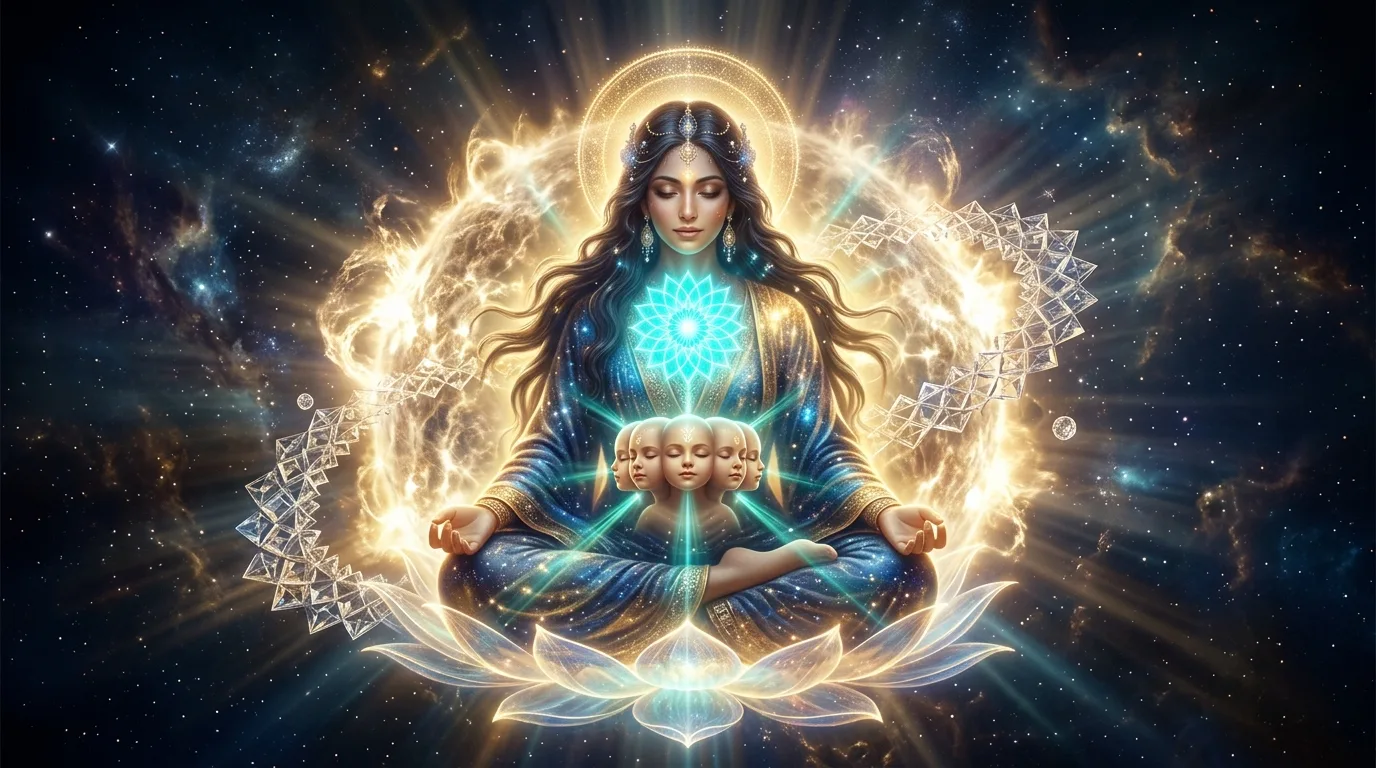
It is at this terrifying juncture that the Divine Mother assumes the form of Skandamātā—literally "The Mother of that which has exploded or burst forth."
She steps into the burning reed forest. Where Agni failed, where Gangā boiled, and where the stars were scorched, Skandamātā simply gathers the six scattered, incandescent sparks into her embrace. She sits down, placing the fragmented, chaotic emissions onto her lap.
Through her cool, radiant, solar-nurturing bio-field—celebrated in the texts as Sūrya-Maṇḍala-Madhyavartinī—she absorbs the lethal thermal radiation. She does not extinguish the fire; she modulates it. She places her breast to the infants, nursing them with Jñāna-Dugdha—the milk of supreme, non-dual wisdom.
Under her steady, compassionate gaze, the six fragmented sparks synthesize into a unified, harmonious divine organism: the six-headed boy Ṣaṇmukha (Lord Skanda or Kārttikeya). She equips him with the Vel—the golden spear of razor-sharp discernment—transforming what was once an uncontainable, radioactive disaster into the Supreme Commander of Light (Deva Senāpati), who slays the demon Tārakāsura on the seventh day of his life.
The Internalized Anatomy: The Viśuddha Chakra
In Book 7 of the Devī Bhāgavata Purāṇa, in the sacred text known as the Devī Gītā (Chapter 35, Verses 1–45), the Goddess reveals her internal yogic anatomy to King Himavat. She explains that the nine forms of Durgā are not merely external historical apparitions; they are living dimensional stations along the human central subtle spinal channel, the Suṣumnā Nādī.
Mā Skandamātā is explicitly the governing sovereign deity of the Viśuddha Chakra—the sixteen-petaled subtle lotus situated at the base of the throat, commanding the element of Ākāśa (Space or Ether):
- The Great Elemental Threshold: The lower three chakras (Mūlādhāra, Svādhiṣṭhāna, Maṇipūra) govern the dense, animal, survival-oriented elements: Earth (Pṛthivī), Water (Jala), and Fire (Agni). The heart center (Anāhata) governs Air (Vāyu). But the throat (Viśuddha) is the radical ontological gateway where physical, biological density dissolves into pure, weightless spatial vibration (Śabda-Brahman).
- The Crucible of Poison (Viṣakaṇṭha): Think back to the churning of the cosmic ocean (Samudra Manthan). When the lethal cosmic poison Hālāhala emerged—a toxin so volatile it threatened to burn through all three worlds—neither the gods nor the demons could face it. Shiva drank the poison to save creation. But where did he hold it? He held it in his throat. Parvati placed her hand upon Shiva's neck, preventing the venom from descending into his belly (which would destroy the universe within) or ascending to his third eye (which would trigger premature Pralaya). By stabilizing the poison at the throat, the deadly toxicity was transmuted into a radiant ornament, earning him the name Nīlakaṇṭha (the Blue-Throated One). Mā Skandamātā at the Viśuddha is that exact somatic enzyme: the motherly matrix that takes the raw, burning toxins of life and transmutes them into celestial nectar (Amṛta).
- Simhāsana and Padmāsana: In her classical Dhyāna Śloka:
"सिंहासनगता नित्यं पद्माश्रितकरद्वया । शुभदास्तु सदा देवी स्कन्दमाता यशस्विनी ॥"
(“Ever seated upon the lion, her two hands holding pristine lotuses, bestowing auspiciousness, may the glorious Goddess Skandamātā be our protector.”)
Notice the breathtaking paradox: she sits upon a lion (Siṁhāsana), the fiercest predator, representing raw biological willpower, wild animal instinct, and untamed kinetic energy. Yet, she holds lotuses (Padmāsana), symbolizing absolute serenity, unruffled equanimity, and pure spiritual transcendence. Furthermore, she balances the divine child on her thighs. The text is shouting a secret to the practitioner: spiritual liberation is not the violent suppression of your biological beast; it is the conscious cradling, parenting, and refinement of your own awakened powers.
Key Terms Explained: Deconstructing the Sanskrit Formulae
In Sanatan philosophy, Sanskrit is not merely a linguistic tool for communication; it is a science of vibrational architecture. Every term chosen by the authors of the Purāṇas is an exact conceptual formula.
| TERM Skanda (स्कन्द) Viśuddha (विशुद्ध) Ṣaṇmukha (षण्मुख) Jñāna-Śakti-Dhara (ज्ञानशक्तिधर) Sūryamaṇḍala- Madhyasthā | PRECISE METAPHYSICAL SIGNIFICANCE From √skand: To erupt, jump upward, or burst with velocity. Kinetic spiritual plasma without a gross womb. Vi (transcendence/intensification) + Shuddha (purified). Radical ontological purification into pure Akasha space. Six faces: The 5 outward sensory organs (Jnanendriyas) + conditioned mind (Manas) unified into 360° awareness. Bearer of the Vel (spear) of Viveka: Broad (Agalam), Deep (Aazham), and Sharp (Kooram) non-dual insight. "Residing at the core of the solar orb." The maternal consciousness fueling the thermonuclear furnace of stars. |
|---|
1. Skanda (स्कन्द)
- Root Analysis: Derived from the verbal root √स्कन्द् (skand), which means to jump upward, to burst forth with high velocity, to emit, or to spill.
- Metaphysical Reality: Skanda is literally "that which has erupted." It represents the sudden, non-linear kinetic release of cosmic energy. In the realm of physics, it mirrors the phase-transition from cold potential energy to incandescent kinetic plasma. Because this divine seed was released without the conventional containment of a physical womb, it represents pure, wild, untamed life-force (Prāṇa-Kuṇḍalinī). Skandamātā is the Mātṛkā—the cosmic measuring matrix—that provides morphological structure, stability, and ethical direction to this explosive eruption.
2. Viśuddha (विशुद्ध)
- Root Analysis: The prefix Vi- (वि) signifies distinction, intensification, or transcendence; Śuddha (शुद्ध) means cleansed, clarified, or purified.
- Metaphysical Reality: In ordinary parlance, people think "Vishuddha" simply means being morally clean or polite in speech. That is a weak, watered-down reading. In Tantric metaphysics, Viśuddha signifies radical ontological purification. It marks the dimensional jump where individual consciousness leaves behind the turbulent interactions of the five gross physical elements (Pañca Mahābhūtas) and stabilizes in the unconditioned spatial field of Ākāśa. At the Viśuddha, duality loses its sting: pleasure and pain, praise and blame, even poison (Viṣa) and nectar (Amṛta), are seen as mere frequency modulations of the same non-dual awareness.
3. Ṣaṇmukha (षण्मुख)
- Root Analysis: Ṣaṭ (षट्—six) + Mukha (मुख—faces, mouths, or apertures of perception).
- Metaphysical Reality: Why does Lord Skanda possess six heads? Is this primitive mythological surrealism? Not at all. In Tantric cognitive psychology, the human being is trapped in perpetual sensory fragmentation by the five organs of perception (Pañca Jñānendriyas: eyes, ears, nose, tongue, skin) coordinated by a restless, conditioned sixth faculty: the analytical sensory mind (Manas). When you are an ordinary mortal, these six faculties face outward, constantly chasing sensory stimuli, generating chronic anxiety, distraction, and division. But when seated upon the lap of Mā Skandamātā, these six outward-facing apertures are drawn inward, synchronized, and unified. They become an omnidirectional, 360-degree cognitive instrument capable of perceiving reality without the distortion of conditioned bias.
4. Jñāna-Śakti-Dhara (ज्ञानशक्तिधर)
- Root Analysis: Jñāna (direct experiential gnosis) + Śakti (primordial dynamic power) + Dhara (the bearer or channel).
- Metaphysical Reality: This is the classical scriptural epithet of Lord Kārttikeya. His supreme weapon, the Vel (spear), is not a physical blade of copper or iron. In classical Shakta and Tamil Shaiva commentaries, the Vel is defined explicitly as the embodiment of Jñāna Śakti. The Vel has three distinct anatomical attributes:
- It is Broad (Agalam) — signifying expansive, universal, holistic perspective.
- It is Deep (Aazham) — signifying profound, penetrating insight that sees past appearances into the root cause.
- It is Sharp (Kooram) — signifying razor-like non-dual discrimination (Viveka) that slices through the subtlest deceptions of the ego.
5. Sūryamaṇḍala-Madhyasthā (सूर्य订डलमध्यस्था)
- Locus: Found prominently in the Lalitā Sahasranāma (Name 275) and applied directly to Skandamātā in the Devī Bhāgavata Purāṇa.
- Metaphysical Reality: Literally, "She who resides at the exact geometric, energetic, and spiritual center of the solar orb." In Vedic cosmology (Sūrya Ātmā Jagatas Tasthuṣaśca — Rig Veda 1.115.1), the Sun is not merely a burning ball of hydrogen and helium gas drifting in space. The Sun is the physical eye of the cosmic being (Virāṭ Puruṣa) and the dispenser of vitality (Prāṇa). Mā Skandamātā is depicted with a brilliant golden effulgence (Śubhra-Varṇā) because she represents the hidden, conscious maternal matrix that sustains the thermodynamic furnaces of every star in the cosmos.
Traditional Interpretation: Classical Hermeneutics Across Three Schools
The mystery of Skandamātā’s containment of Shiva’s fire was not treated as mere folklore by the greatest philosophical minds of Sanatan Dharma. The classical schools analyzed this event through their most rigorous epistemological frameworks.
| KASHMIR SHAIVISM (Abhinavagupta) Spanda-Tattva: Skanda is the kinetic vibration (Spanda) of Shiva's self-awareness; Skandamata is the Vimarsha-Shakti that holds and patterns it. | SHAKTA SRIVIDYA (Bhaskararaya) Surya-Mandala & Matritva: The Devi as the hidden core of the 12 Adityas. Nursing Skanda represents the continuous secret transmission of Sri Vidya (Para-Samvit). | ADVAITA VEDANTA (Adi Shankaracharya) Vishuddha Transmutation: In Saundarya Lahari (v37), the throat is the center of Akasha where dynamic energy sheds gross form and resolves into the non-dual Shabda-Brahman. |
|---|
1. Kashmir Shaivism: The Dynamic of Prakāśa and Vimarśa
In the non-dual Shaivism of Kashmir, articulated with breathtaking precision by the tenth-century polymath Abhinavagupta in his Tantrāloka and Parātrīśikā Vivaraṇa:
- Supreme reality is composed of two inseparable facets: Prakāśa (the self-luminous, static light of pure consciousness, personified as Shiva) and Vimarśa (the dynamic, vibrating, self-reflective awareness of that light, personified as Shakti).
- If Shiva had only Prakāśa without Vimarśa, he would be inert (Jaḍa), like a mirror incapable of reflecting anything, or a blazing light that doesn't know it shines (Śivo'śaktaḥ śaśvat).
- When Shiva emits his creative surge (Rudra-Tejas), it is an explosive, uncontained pulse of Spanda (primordial kinetic vibration). If that pulse is not instantly received and mirrored by Vimarśa, it acts like an uncontrolled electrical surge that blows out the delicate circuitry of creation.
- Mā Skandamātā holding the infant Skanda is the supreme visual depiction of Vimarśa-Śakti: she seizes the terrifying kinetic light of Prakāśa, internalizes it without getting scorched, patterns it into coherent cognitive architecture, and deploys it as the spear of liberation.
2. Shakta Sri Vidya: Bhāskararāya’s Exegesis in Saubhāgya Bhāskara
In the eighteenth century, the great Shakta philosopher Bhāskararāya Makhin, commenting on the chakra deities in his Saubhāgya Bhāskara, linked Skandamātā directly to the highest esoteric secrets of Śrī Vidyā:
- Skandamātā is identified as the living embodiment of the Sāvitrī-Rahasya—the solar mystery embedded in the Gāyatrī Mantra.
- The six heads of Skanda correspond to the six limbs (Ṣaḍaṅga) of the supreme sixteen-syllabled mantra, the Ṣoḍaśī Vidyā.
- When Skandamātā nurses the child upon her lap, she is engaging in Karṇa-Paramparā—the direct, unspoken, transmission of Parā-Saṁvit (supreme non-dual illumination). The infant on the lap represents the sincere initiate (Sādhaka); the Mother represents the ultimate primordial Guru. By resting upon her lap, the initiate skips lifetimes of dry intellectual hair-splitting and is flooded with direct gnosis through the unblocked channels of the Viśuddha Chakra.
3. Advaita Vedanta: Adi Shankaracharya’s Saundarya Laharī
In the celebrated devotional and philosophical hymn Saundarya Laharī, traditionally attributed to Ādi Śaṅkarācārya, Verse 37 speaks directly to the alchemical station of the Viśuddha Chakra:
"विशुद्धौ ते शुद्धस्फटिकविशदं व्योमजनकं"
"शिवं सेवे देवीमपि शिवसमानप्रणयिनीम् ।"
"ययोः कान्त्या यान्त्याः शशिकिरणसारूप्यसरणे-"
"र्विधूतान्तर्ध्वान्ता विलसति चकोरीव जगती ॥"
(“In your Viśuddha chakra, I worship the crystal-pure Shiva, the originator of the subtle element of space (Akasha), alongside the Goddess who shares an identical love and sovereign status with Him. From the luminous, cool radiance of both—resembling the tranquil rays of the full moon—the inner intellectual darkness of the entire universe is completely dispelled, delighting like the Chakora bird in the nectar of moonlight.”)
Notice Śaṅkarācārya's choice of words: at the Viśuddha, Shiva and Shakti exist in absolute, flawless equality (Śiva-Samāna-Praṇayinīm). The searing, uncontainable fire of Shiva has been transformed into a soothing, moon-like luminescence (Śaśi-Kiraṇa-Sārūpya). Skandamātā at the throat is the dispeller of all inner cognitive ignorance (Vidhūtāntardhvāntā).
How This Connects: The Golden Thread Across Sanatan Dharma
The narrative of Skandamātā is not an isolated story tucked away in a Purāṇic corner; it is a vital node in a continuous philosophical web stretching from the earliest Vedic saṁhitās to esoteric Kundalini yoga manuals.
- "I string the bow for Rudra so his arrow
- may strike down the hater of truth."
- Yakshaprashna: Agni & Vayu fail to burn
- or blow a single blade of grass. Uma
- Haimavati appears to reveal the Supreme Brahman.
- DEVI GITA: Devi reveals Her Vishwarupa;
- maps the 72,000 Nadis, Sushumna, and the
- Vishuddha's transformation of sound (Para -> Vaikhari).
- Vishuddha as the crucial alchemical crucible
- between Vishnu Granthi (Heart) and Rudra Granthi (Ajna).
1. The Rigvedic Vāk Sūktam (RV 10.125)
In the renowned Vāk Sūktam of the Rig Veda, Goddess Vāk (the primordial Logos, the conscious Speech that structures reality) roars in the first person:
"अ॒हं रु॒द्राय॒ धनु॒रा त॑नोमि ब्रह्म॒द्विषे॒ शर॑वे॒ हन्त॒वा उ॑ ।"
(“I bend and string the bow for Rudra, so that his incandescent arrow may strike down the hater of truth!”)
Think about that metaphor for a moment. Rudra (Shiva) possesses the destructive, blazing arrow. But Rudra cannot aim or release the arrow on his own: it is the Mother (Vāk / Śakti) who must string the bow, establish the tension, calculate the wind resistance, and provide the arrow with its flight path.
In the Skandamātā paradigm, Shiva provides the unconditioned energy (Tejas), but it is Skandamātā who strings the bow of manifest structure, shaping that raw energy into the piercing spear (Vel) that strikes down demonic deception.
2. The Kena Upaniṣad: The Yakṣa-Praśna and Umā Haimavatī
In the third and fourth chapters of the Kena Upaniṣad, an extraordinary drama unfolds. The gods, having won a battle against the demons, fall into immense egoic pride, believing their own individual power achieved the victory.
To teach them a lesson, the unmanifest Absolute (Brahman) manifests as a mysterious, dazzling apparition: a Yakṣa.
- The gods send Agni (the god of fire) to investigate. The Yakṣa places a solitary, dry blade of grass on the ground and says: "Burn this." Agni unleashes his absolute, all-consuming fury, but he cannot scorch even an atom of that dry blade of grass. He slinks back in shame.
- Next, the gods send Vāyu (the god of wind). The Yakṣa says: "Blow this away." Vāyu unleashes a cosmic hurricane, but the blade of grass does not move by a fraction of a millimeter.
- Finally, Indra approaches. But before Indra can speak, the Yakṣa vanishes into thin air. In that exact spatial coordinate of the sky (Ākāśa), there appears a breathtaking woman adorned in pure gold: Umā Haimavatī (Pārvatī).
Indra asks her: "Who was that Yakṣa?" Umā teaches him that the apparition was Brahman, and that the gods are completely powerless without Her mediating grace.
Notice the continuity: both in the Kena Upaniṣad and in the birth of Skanda, Agni is rendered utterly impotent when confronting raw unmanifest power. Only the Divine Mother understands how to mediate between the infinite void of Brahman and the finite realm of manifest nature.
3. The Triad of Granthi Bhedana (Piercing the Spiritual Knots)
In classical Kundalini yoga (Haṭha Yoga Pradīpikā, Śiva Saṁhitā, and the Ṣaṭ-Cakra-Nirūpaṇa), a spiritual aspirant’s energy is locked by three fundamental psychic knots (Granthis):
- Brahmā Granthi (at the base, Mūlādhāra/Svādhiṣṭhāna) — The knot of physical survival, material attachment, and biological fear.
- Viṣṇu Granthi (at the heart, Anāhata) — The knot of emotional codependency, personal ego-identity, and the craving for sentimental validation.
- Rudra Granthi (at the third eye, Ājñā) — The knot of the spiritual ego, the arrogance of intellectual knowledge, and the final barrier of duality.
Where does the Viśuddha Chakra sit? It sits in the critical, narrow corridor directly between the Viṣṇu Granthi and the Rudra Granthi.
It is the great alchemical testing ground. If an aspirant attempts to force energy up into the third eye (Ājñā) to attain psychic powers and visionary experiences without thoroughly purifying the throat center through Skandamātā’s grace, they inevitably fall victim to intellectual megalomania. They weaponize their intellect, become intoxicated by their own brilliance, and trap themselves in spiritual arrogance.
That is the precise scriptural definition of Tārakāsura! Tārakāsura had enormous tapasya, brilliant intellect, and mastery of universal rules—but zero maternal humility. He is what happens when power bypasses the purification of the Viśuddha.
Modern Research or Science: Magnetic Fusion, Neurobiology, and Perception
On the Sanatan Platform, our mission is to explore these teachings with complete factual integrity. We do not manufacture cheap pseudoscience, nor do we insult your intelligence with claims that "ancient sages built nuclear power plants."
Instead, we look at the fascinating ways that ancient metaphysical insights structurally rhyme with real, peer-reviewed modern science.
| SCRIPTURAL CONCEPT The Uncontainable Shiva-Tejas vs. The Maternal Field (Skandamata) Vishuddha Chakra as the Alchemical Filter of Poison/Vocal Voice Shanmukha (6 Faces) on the Mother's Lap | SCIENTIFIC CORRESPONDENCE Thermonuclear Plasma & Magnetic Confinement (Tokamak Magnetic Bottling) The Vagus Nerve, Laryngeal Complex, and Polyvagal Neurobiology (Porges) Sensory Integration & Multi-Modal Perceptual Binding (Neuroscience) | HONEST EPISTEMOLOGICAL BOUNDARY Pure Physical Analogy: Vedic text describes conscious metaphysics; modern physics describes non-conscious matter. Biological Substrate: Real neurological overlap in somatic vocalization and stress downregulation (throat bridge). Cognitive Architecture: The mind synthesizes multi- sensory inputs into a singular coherent cognitive field. |
|---|
1. High-Energy Plasma Confinement: The Tokamak Magnetic Bottle Analogy
In modern theoretical and experimental physics, humanity is attempting to recreate the power of the stars on Earth through controlled nuclear fusion (such as the ITER project in France).
The fundamental physics challenge of fusion is identical to the narrative tension in the Devī Bhāgavata Purāṇa:
- In a fusion reactor, a mixture of deuterium and tritium is heated until it transitions into the fourth state of matter: a boiling, turbulent soup of charged ions and electrons known as thermonuclear plasma.
- To achieve fusion, this plasma must reach temperatures exceeding 100 to 150 million degrees Celsius—roughly ten times hotter than the core of our Sun.
- Here is the catch: no physical container on Earth can hold it. If that plasma touches the steel walls, tungsten tiles, or carbon composites of the reactor vessel, two disastrous things happen simultaneously: the physical wall instantly melts and vaporizes, and the plasma immediately cools down, killing the fusion reaction.
How do nuclear engineers solve this impossible problem? They use a magnetic bottle. In a toroidal chamber called a Tokamak, powerful superconducting magnetic coils generate an invisible, enveloping, geometric magnetic field (utilizing the Lorentz force). The blazing plasma never touches physical matter; it is cradled, suspended, and insulated in mid-air by an invisible geometric matrix.
Now, look back at the ancient story:
- Shiva's ascetic seed is described as an uncontainable, blinding plasma of infinite thermal density.
- Physical elements like Agni (fire) and Gangā (water) attempt to act as material vessels, and both undergo catastrophic breakdown. Material structures cannot touch pure celestial fire without being destroyed.
- Only Mā Skandamātā—the radiant, enveloping field of the Sūrya-Maṇḍala—can hold the incandescent fire in her lap without being scorched, modulating its intensity until it takes functional form.
This is a breathtaking conceptual isomorphism. What the magnetic field is to thermonuclear plasma in modern physics, the maternal feminine matrix (Prakriti) is to pure transcendent consciousness (Purusha) in ancient metaphysics: extreme energy cannot exist constructively in creation without an enveloping, non-material structural field.
2. The Polyvagal System and Laryngeal Axis: The Throat as the Biological Brake
Let's move from outer astrophysics into inner human neurobiology. The Purāṇa asserts that the Viśuddha Chakra at the throat is the biological filter where emotional toxicity, psychological poison, and high-voltage stress are neutralized.
Does modern medicine show any unique biological connection to this? Yes—in the field of Autonomic Neuroscience and Polyvagal Theory, developed by Dr. Stephen Porges.
Consider the following neurological facts:
- The Vagus Nerve (Cranial Nerve X) is the longest and most complex cranial nerve in the human body, serving as the master highway of the parasympathetic nervous system (the "rest, digest, and heal" system).
- The evolutionary newer branch of this system—the Ventral Vagal Complex—specifically innervates and coordinates the muscles of the larynx, pharynx, soft palate, and vocal cords (the anatomical throat).
- When you experience severe chronic stress, emotional trauma, or rage, your sympathetic nervous system triggers the "fight-or-flight" response, or worse, the dorsal vagal "freeze" response. Where does this register somatically? In the constriction of the throat. The vocal cords tighten, swallowing becomes difficult (the sensation of a "lump in the throat"), and the body begins to bathe its tissues in toxic levels of cortisol and pro-inflammatory cytokines.
- Conversely, neuroscientists have discovered that the most direct, somatic way to stimulate the ventral vagus nerve and downregulate systemic inflammation is through the conscious manipulation of the throat complex: rhythmic vocal toning, deep humming, chanting, and resonant diaphragmatic breathing (which ancient yogis practiced as Bhrāmarī Prāṇāyāma and Ujjāyī Prāṇāyāma).
When you hum or chant sacred syllables from the throat, you mechanically stimulate the vagal nerve endings in the larynx, sending an immediate signal to the sinoatrial node of the heart to slow down, reducing blood pressure, and halting the biochemical flood of stress hormones.
The ancient yogis did not possess electron microscopes, nor did they know about acetylcholine receptors. But through deep, first-person phenomenological observation (Antar-Darśana), they identified the precise biological nexus where emotional and physiological poison is intercepted and transmuted: the throat.
3. Cognitive Multisensory Binding: The Architecture of Ṣaṇmukha
In modern cognitive neuroscience, one of the deepest puzzles of human consciousness is the Multisensory Binding Problem.
- Your brain receives visual photons through the eyes, acoustic soundwaves through the ears, chemical molecules through the nose and tongue, and mechanical pressure through the skin.
- Each of these sensory streams is processed in completely different cortical zones at different processing speeds (light is processed slower in the retina than sound is in the cochlea).
- How does your conscious mind instantly "bind" these five fragmented, delayed inputs into a single, seamless, real-time 3D simulation of reality? Neuroscience attributes this to complex central executive networks and temporal synchrony across neural oscillations.
When the Purāṇa depicts Lord Skanda with six heads (the five senses plus the analytical mind) seated upon the lap of the Mother, it provides a stunning visual metaphor for the resolution of this binding problem. When your senses are ungrounded, they pull your attention in six different directions, creating psychological chaos. But when aligned by the grounding, motherly presence of conscious awareness, sensory fragmentation dissolves into a singular, unified, razor-sharp cognitive field.
Where the Comparison Holds, and Where It Doesn't: An Honest Epistemological Audit
As researchers writing for the Sanatan Platform, our highest commitment is to the truth. We refuse to indulge in the sensationalism that plagues internet apologetics. Let us draw a clean, uncompromising line between genuine intellectual resonance and cheap overreach.
| MODERN PHYSICAL SCIENCE • Materialist / Physicalist • Mind is a byproduct of matter • Mathematical & Quantifiable • Blind, accidental laws of physics • Impersonal energy fields | SANATAN METAPHYSICAL TRADITION • Idealist / Panpsychist • Matter is a condensation of Mind • Experiential & Phenomenological • Conscious, purposeful play (Lila • Divine maternal intelligence |
|---|
Where the Comparison Holds (The Structural Resonances)
- The Principle of Non-Physical Containment: Both modern plasma physics and the Devī Bhāgavata Purāṇa independently arrive at the same structural insight: extreme energetic intensity cannot be held by solid, gross physical containers. It requires a non-material, geometric, or radiant field.
- The Throat as the Stress Refinery: Both polyvagal neuroscience and Tantric subtle anatomy identify the laryngeal-pharyngeal axis as the primary somatic switchboard where psychological distress is either locked into the body as chronic disease or released through vocalization and breath regulation.
- The Unification of Perception: Both modern cognitive science and the symbolism of Ṣaṇmukha recognize that sensory perception is inherently fragmented and must be actively bound together by a higher unifying substrate to produce clear, actionable intelligence.
Where the Comparison Breaks Down (The Non-Negotiable Differences)
- The Devi Bhagavata is NOT a Physics Manual: The ancient authors were not trying to build a fusion reactor to generate electricity for an electrical grid. To say that "ancient India invented the Tokamak" is historically absurd and intellectually dishonest. The Purāṇa is exploring the architecture of cosmic and psychological consciousness. The Tokamak is a mechanical analogy that helps us visualize a metaphysical truth, not a literal blueprint.
- Consciousness vs. Dead Particles: Modern astrophysics operates under a strict physicalist assumption: the universe is made of dead matter, and consciousness is merely an accidental byproduct of brain chemistry. In Sanatan Dharma, consciousness (Cit) is the primary, fundamental ground of all existence. Matter, gravity, and stars are simply the dense expressions of divine will.
- Empirical Instruments vs. Meditative Absorption: Modern science verifies claims through external instruments: particle accelerators, radio telescopes, and fMRI scanners. Ancient rishis verified their insights through rigorous, internal, first-person subjective experimentation (Samādhi). These are two fundamentally different epistemological tools. Conflating them cheapens both.
When we appreciate the scriptures for what they actually are—profound treatises on consciousness, ethics, and subtle anatomy—we do not need to invent fake scientific claims to make them valuable. Their depth speaks for itself.
Frequently Asked Questions
1. Why did Shiva's ascetic fire burn the gods instead of blessing them?
In the Devī Bhāgavata Purāṇa, Shiva’s ascetic seed (Rudra-Tejas) represents infinite, unmodulated, non-dual consciousness (Nirguṇa Brahman). In its pure, transcendent state, divine power is completely incompatible with the conditioned, finite structures of the manifest world. Just as high-voltage electricity will destroy a domestic appliance that lacks a step-down transformer, unmodulated divine consciousness burns away finite mental and physical vessels. It requires the maternal organizing matrix of the Goddess (Prakriti) to cool, modulate, and channel that power safely into manifest life.
2. Is Mā Skandamātā connected to modern nuclear fusion?
Not as a literal historical blueprint. The connection is a philosophical and structural isomorphism (a resonance of universal principles). In modern physics, thermonuclear fusion plasma reaching over 100 million degrees Celsius melts any physical container and can only be held by an enveloping magnetic field (a "magnetic bottle"). Similarly, in ancient scripture, Shiva's infinite celestial fire melted physical carriers like Agni and Ganga, and could only be safely cradled by the radiant solar field (Sūrya-Maṇḍala) of Mā Skandamātā. Both illustrate the universal truth that immense energetic force requires a non-material organizing field to exist constructively.
3. What does it practically mean to "purify poison" at the Viśuddha Chakra?
In internal yogic practice, the Viśuddha Chakra at the throat is the center of speech (Vāk), space (Ākāśa), and somatic emotional regulation. During life, we constantly absorb "poison" in the form of emotional trauma, insults, unresolved grief, and toxic social conditioning. If we swallow this poison into the stomach, it causes physical ulcers and disease; if we project it upward in blind rage, it destroys our relationships and sanity. Purifying poison at the throat means holding space for difficult emotions, processing them without reactivity, and using conscious vocalization, truth (Satya), and meditation to transmute suffering into creative wisdom.
4. Why does Lord Skanda have six faces and carry a spear (Vel)?
The six faces (Ṣaṇmukha) represent the five sensory faculties (seeing, hearing, smelling, tasting, feeling) plus the analytical thinking mind (Manas). In ordinary humans, these six faculties face outward, scattering our attention and creating mental turbulence. When gathered in the presence of the Divine Mother, they turn inward and unify into an omnidirectional 360-degree awareness. The Vel (spear) represents Jñāna Śakti—the spear of piercing, non-dual wisdom that is broad (Agalam), deep (Aazham), and razor-sharp (Kooram), designed to slice through the deceptive ego-illusions of the demon Tārakāsura.
Sources
Classical Sanskrit Texts
- Śrīmad Devī Bhāgavata Purāṇa — Skandha 6 (Chapters 1–5: The tyranny of Tārakāsura and the birth of Skanda); Skandha 7 (Devī Gītā, Chapter 35: The yogic anatomy of the subtle spinal chakras).
- Rig Veda Saṁhitā — Maṇḍala 10, Sūkta 125 (Vāk Sūktam: Goddess Vāk stringing the bow for Rudra).
- Kena Upaniṣad — Chapters 3 and 4 (Yakṣa-Praśna and the revelation of Umā Haimavatī).
- Saundarya Laharī — Attributed to Ādi Śaṅkarācārya, Verse 37 (Meditation on the crystal-pure Shiva and Shakti at the Viśuddha Chakra).
- Tantrāloka & Parātrīśikā Vivaraṇa — Ācārya Abhinavagupta (The non-dual dynamics of Prakāśa, Vimarśa, and Spanda).
- Lalitā Sahasranāma — With the commentary Saubhāgya Bhāskara by Bhāskararāya Makhin (Name 275: Sūryamaṇḍala-Madhyasthā).
- Mahābhārata — Vana Parva, Chapters 223–232 (The Markandeya narration of the birth and glorification of Kārttikeya).
Modern Scientific Fields & Documented Phenomena
- Plasma Physics & Controlled Magnetic Confinement Fusion — The Tokamak magnetic geometry, magnetic bottling, and the International Thermonuclear Experimental Reactor (ITER) research documentation.
- Autonomic Neuroscience & Somatic Psychology — Polyvagal Theory, the Ventral Vagal Complex, and laryngeal innervation (Dr. Stephen Porges, The Polyvagal Theory: Neurophysiological Foundations of Emotions, Attachment, Communication, and Self-regulation).
- Cognitive Neuroscience — The Multisensory Binding Problem and cortical integration of sensory modalities.
This reflects what the text itself says; the modern-science comparisons above are interpretation, not an established finding.