Maa Katyayani and the Samaṣṭi-Tejas Singularity: Piercing Rudra-Granthi and Slaying the Shape-Shifting Ego
Drafted with the help of AI from the original texts named in the article; I read and correct every article after it is published. How we use AI
Explore Maa Katyayani in Devi Bhagavata Purana: the Samashti-Tejas singularity, piercing the Rudra-Granthi at Ajna Chakra, and slaying shape-shifting ego.
In this article
- 1. Introduction & Metaphysical Narrative: The Cosmic Field Collapse
- 2. The Classical Sanskrit & Textual Analysis
- 3. Philosophical & Esoteric Meaning: Piercing the Knot of Duality
- 4. Neuro-Phenomenology & Real Modern Parallels
- 5. Where the Comparison Holds, and Where It Doesn't
- 6. Frequently Asked Questions
- 7. Sources and Canonical Literature
Why did the combined divine forces of the cosmos—Indra, Agni, Vāyu, Varuṇa, and Sūrya—suffer total, humiliating defeat against a single demon?
In the Fifth Skandha of the Devi Bhagavata Purana, Maharṣi Veda Vyāsa unveils an unsettling cosmic crisis: Agni, the universal fire of transformation, flees for his life. Vāyu, the vital breath sustaining all animated existence, is rendered completely impotent. Indra, the sovereign of the gods, wanders as a destitute exile in the mountain forests.
These were not minor entities; they were the cosmic archetypes of nature's fundamental forces. Yet, each was systematically overpowered by Mahiṣāsura.
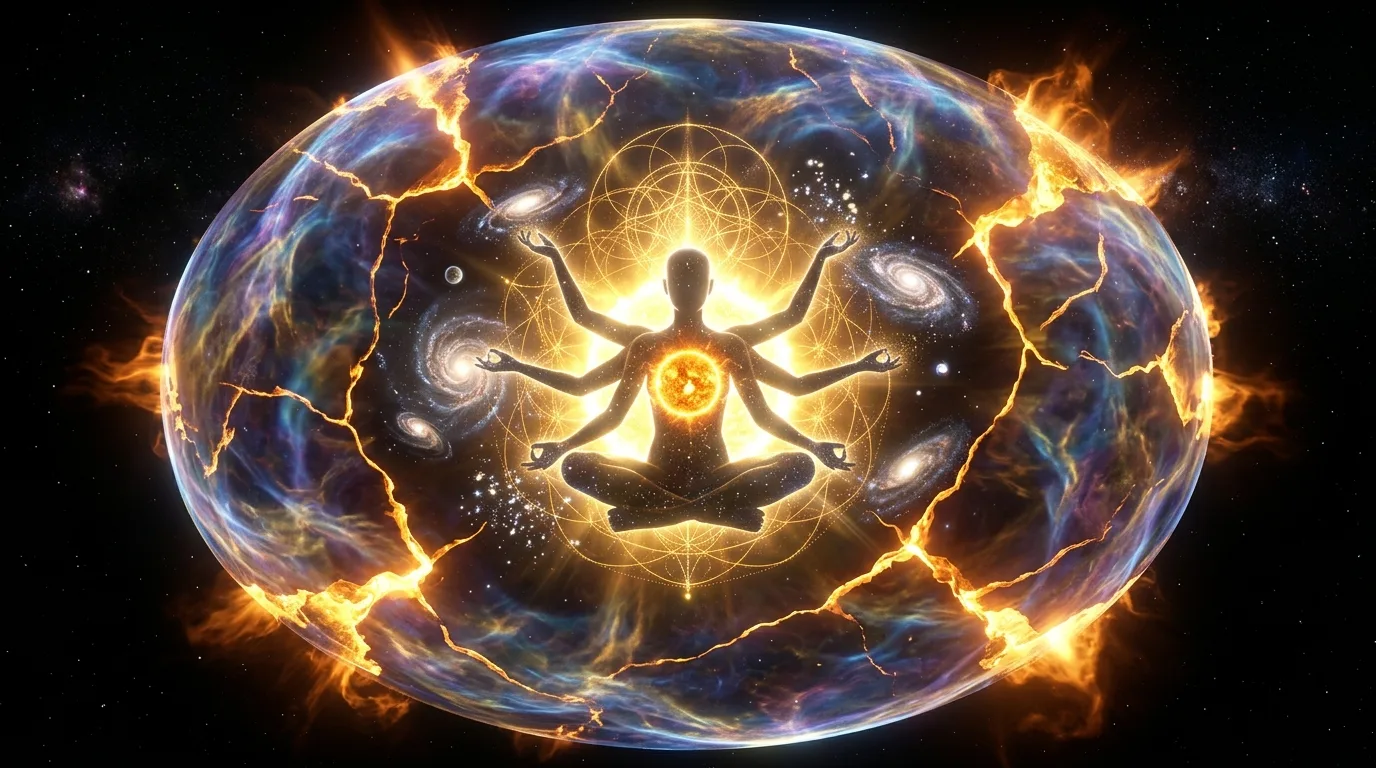
The sacred narrative reveals an inexorable metaphysical law: fragmented willpower (Vyaṣṭi-Tejas) can never conquer deeply entrenched, organized subconscious inertia (Māhiṣa-Bhāva). Only when individual faculties collapse their isolated identities back into a unified, coherent field—generating the Samaṣṭi-Tejas Singularity—does the Divine Mother manifest as Mā Kātyāyanī. Presiding over the Ājñā Cakra on the sixth day of Navarātri, She wields the razor-sharp intellect (Tīkṣṇa-Buddhi) required to sever the final knot of cognitive duality: the Rudra-Granthi.
1. Introduction & Metaphysical Narrative: The Cosmic Field Collapse
The Fatal Blind Spot of Mahiṣāsura
The crisis begins in Devi Bhagavata Purana (Skandha 5, Adhyāyas 8–18). Mahiṣāsura, king of the Asuras, performs excruciating austerities directed toward Lord Brahmā. When the Creator grants him a boon, Mahiṣāsura meticulously engineers an apparent loophole of absolute invulnerability: he requests that no man, deva, yakṣa, beast, or celestial weapon be capable of killing him.
Crucially, he disdains femininity. Perceiving womanhood as inherently fragile, passive, and inconsequential, he omits women entirely from his petition. This hubristic contempt is not merely a social prejudice; in the metaphysical architecture of Śākta philosophy, it represents the fatal blind spot of the masculine ego: the delusion that active, outward-projecting force (Puruṣa) can dominate reality while ignoring the primordial energetic ground (Prakṛti) that sustains it.
Armed with this immunity, Mahiṣāsura overthrows the cosmic order (ṛta). He expels Indra and the Ādityas from Svarga, usurps the sacrificial offerings (yajñabhāga), and blankets the triple worlds in a dense, suffocating reign of Tamas—brute material inertia and ignorance.
The Retreat to the Himalayas and the Blazing Assembly
Stripped of their offices, the defeated devas retreat to the foothills of the Himalayas, petitioning the Trimūrti: Brahmā, Viṣṇu, and Śiva. As the devas recount their subjugation, an extraordinary cosmic event occurs—not an act of manual fabrication, but an unprecedented field collapse and energetic crystallization:
- Hearing of the cosmic desecration, an uncontrollable, blazing wrath (krodha) erupts from the brow of Lord Śiva.
- Simultaneously, an unbearable effulgence streams forth from the countenances of Lord Viṣṇu and Lord Brahmā.
- Spontaneously, brilliant energetic currents burst forth from the bodies of Indra, Varuṇa, Agni, Yama, and all thirty-three koṭi devas.
These isolated, dispersed streams do not collide in chaos. In mid-air, they coalesce into a vast, luminous phenomenon described in the text as a blazing mountain of light: The Tejorāśi (तेजोराशि).
- Śiva: Brow of Wrath — Viṣṇu: Radiance — Brahmā: Effulgence
- 33 Koṭi Devas: Individual Specialized Frequencies (Vyaṣṭi)
- THE TEJORĀŚI SINGULARITY
- (Mountain of Coherent Coalesced Light)
- (Descends at Hermitage)
- MĀ KĀTYĀYANĪ (Samaṣṭi-Tejas)
- Eighteen-Armed Sovereign of Ājñā Cakra
This mountainous ocean of coherent fire descends upon the secluded hermitage of Maharṣi Kātyāyana. The venerable sage had performed severe penance for generations, yearning for the Supreme Mother to manifest as his daughter. Receiving this blazing cosmic singularity through guileless meditative absorption, the formless field crystallizes into an anthropomorphic form: Mā Kātyāyanī—dazzling like molten gold, adorned with eighteen arms, holding the supreme weapons of the cosmos, and seated atop a ferocious, roaring lion.
2. The Classical Sanskrit & Textual Analysis
To comprehend the depth of this episode, we must unpack the precise Sanskrit hermeneutics embedded within the text:
Key Sanskrit Terms
- Tejorāśi (तेजोराशि): Formed from Tejas (spiritual radiance, subtle fire-element carrying pure consciousness) and Rāśi (a continuous heap, constellation, aggregate mass). It denotes a non-particulate, unbroken ocean of coherent light. Unlike matter, which consists of fragmented parts, Tejorāśi is a continuous phase where distinct boundaries dissolve.
- Kātyāyanī (कात्यायनी): Etymologically derived as the patronymic of Sage Kata / Kātya ("daughter of Kātyāyana"). Esoterically, the verbal root Kat signifies nirmūlana (uprooting) and cheda (discriminative severing). Mā Kātyāyanī is the Asura-nāśinī—the cutting intellect (Tīkṣṇa-Buddhi) that severs the root of existential ignorance.
- Ājñā (आज्ञा): Literally "Command" or "Authority." Located at the Bhrūmadhya (eyebrow center), the Ājñā Cakra is where the inner command of the Guru (guru-ādeśa) is perceived, exercising sovereign executive command over the five lower elemental cakras (Earth, Water, Fire, Air, Space).
- Māhiṣa-Bhāva (माहिष-भाव): The buffalo-archetype of consciousness. A buffalo is notorious for wallowing in muddy water, exhibiting stubborn resistance to change, moving with heavy inertia (Tamas), and wielding colossal physical strength completely divorced from discriminative wisdom (Viveka).
- Rudra-Granthi (रुद्रग्रन्थि): The "Knot of Śiva." The third and final spiritual knot in Kuṇḍalinī Yoga, situated at the Ājñā Cakra. While Brahmā-Granthi binds the soul to physical survival and Viṣṇu-Granthi binds it to emotional attachment, Rudra-Granthi is the knot of subtle cognitive duality—the lingering illusion of separation between the observer (sākṣī) and the observed (dṛśya).
- Mukta-Triveṇī (मुक्त-त्रिवेણી): At the Mūlādhāra Cakra, the three primary nāḍīs (Iḍā, Piṅgalā, and Suṣumṇā) form the Yukta-Triveṇī (the bound confluence), tying the soul to dualistic worldly experience. At the Ājñā Cakra, they untie into the Mukta-Triveṇī (the liberated confluence), dissolving the dualities of solar action and lunar mentation into non-dual illumination.
The Text’s Own Dialectic: Sage Vyāsa's Resolution
In Devi Bhagavata Purana (Skandha 5, Chapters 15–16), King Janamejaya poses a profound philosophical objection to Sage Vyāsa:
"If the Supreme Goddess is the uncreated, omnipresent Mother of the universe, why did She require the pooled tejas of the male gods to manifest? Does this not prove She is merely an emergent product of the gods, rather than their ultimate source?"
Vyāsa’s resolution is philosophically watertight, articulated through three core arguments:
- The Doctrine of Vimarśa (Inherent Dynamic Luminosity):
Vyāsa uses the classical analogy of fire and its intrinsic burning power (dāhikā-śakti). Fire cannot exist without heat, nor heat without fire. The devas did not "create" the Mother. Rather, their individual powers were merely transient sparks rented from Her unmanifest matrix (Mūla-Prakṛti). When the gods succumbed to individual pride, their fragmented powers failed. When they surrendered, they were merely returning their rented sparks to the cosmic bonfire. The Tejorāśi was not a synthesis of disparate pieces, but the spontaneous re-integration of a scattered whole.
- The Logic of Weapon Surrender:
The text records each deity transferring their primary emblem to the Goddess: Śiva manifests a trident from his own; Viṣṇu projects a discus from the Sudarśana; Varuṇa gives the conch and noose; Agni gives the burning dart; Yama offers the staff of cosmic justice. Vyāsa explains that when wielded by fragmented egos, weapons generate destructive chaos. When surrendered to the Mother, they become consecrated instruments of Cosmic Order (Ṛta) and Spiritual Liberation (Mokṣa).
- The Father-Daughter Paradox (Bhakti-Nyāya):
Why did the Goddess descend at Sage Kātyāyana's hermitage? Mahiṣāsura conquered the physical universe through brute imperialistic force, yet he could never touch Kātyāyana's hermitage. Vyāsa explains that the Absolute is inaccessible to computational intellect and brute aggression; it yields exclusively to pure, guileless meditative absorption (Upāsanā).
3. Philosophical & Esoteric Meaning: Piercing the Knot of Duality
- THE THREE SPIRITUAL KNOTS (GRANTHIS)
- Granthi (Knot) — Anatomical / Subtle Location — Consciousness Trap
- 1. Brahmā-Granthi — Mūlādhāra & Svādhiṣṭhāna — Physical survival,
- instinct, inertia
- 2. Viṣṇu-Granthi — Anāhata (Heart Center) — Emotional attachment
- ego of doership
- 3. Rudra-Granthi — Ājñā Cakra (Eyebrow Center) — Spiritual ego,
- cognitive duality
Samaṣṭi-Tejas vs. Vyaṣṭi-Tejas: The Laser Analogy
Consider an ordinary 60-watt lightbulb. It radiates photons outward in all directions, illuminating a living room but incapable of cutting through a single sheet of paper. Why? Its light waves are desynchronized, incoherent, and out of phase (Vyaṣṭi-Tejas).
However, take those exact same light waves and synchronize their frequencies into an orderly, coherent phase. You get an industrial carbon-dioxide laser capable of slicing effortlessly through sheets of solid steel (Samaṣṭi-Tejas).
This is why individual gods failed against Mahiṣāsura:
- Indra represents sensory perception.
- Agni represents metabolic drive.
- Varuṇa represents emotional fluidity.
- Vāyu represents vital breath.
Operating individually, they are merely scattered light waves. Mahiṣāsura—representing organized subconscious inertia—easily absorbs and deflects them. Only when these fragmented faculties collapse into the singular, focused presence of Mā Kātyāyanī does their power become invincible.
The Shape-Shifting Ego: Deconstructing Māhiṣa-Bhāva
During the catastrophic clash in Skandha 5, Adhyāya 18, Mahiṣāsura does not fight with a fixed form. He shape-shifts continuously:
- When struck by the Goddess, he transforms from a buffalo into a roaring lion.
- When attacked as a lion, he morphs into a colossal elephant, trying to crush Her lion.
- When She cuts off his trunk, he emerges as a human warrior with a drawn sword.
- Finally, he retreats back into the impenetrable form of the buffalo.
This is the psychological brilliance of the Devi Bhagavata Purana. Delusion (Māyā) and Ego (Ahaṅkāra) never fight honestly. When challenged by logical inquiry, the ego shifts into emotional victimhood; when challenged by emotional balance, it retreats into intellectual cynicism; when challenged by ascetic discipline, it disguises itself as spiritual pride.
Mā Kātyāyanī responds with unwavering, royal presence. She drinks the divine amrita (madhu), laughs a terrifying laugh (aṭṭahāsa), and executes the decisive metaphysical strike:
- The Lotus Foot on the Neck: She steps on the buffalo’s neck, instantly pinning and neutralizing the downward-flowing animalistic prāna (Apāna-Vāyu).
- The Trident in the Chest: She thrusts Śiva’s Triśūla into his heart, harmonizing the three turbulent guṇas (Sattva, Rajas, Tamas) into non-dual equilibrium.
- The Sword of Non-Dual Discrimination (Jñāna-khaḍga): As the demon attempts to abandon the dying buffalo shell in human form, She decapitates him mid-emergence. He is destroyed at the exact threshold between animal inertia and intellectual duality.
This decapitation at the eyebrow center is the literal piercing of Rudra-Granthi.
4. Neuro-Phenomenology & Real Modern Parallels
When we examine the experiential mechanics of this Purāṇic narrative alongside modern cognitive science, intriguing phenomenological parallels emerge. We present these not as scientific "proof" of scripture, but as an honest comparative inquiry between ancient meditative phenomenology and contemporary neurobiology.
- Purāṇic Phenomenological Concept — Modern Cognitive / Neural Parallel
- Māhiṣa-Bhāva (Animal Inertia/Tamas) — Amygdala-driven subcortical loops,
- default mode rumination, addiction
- Tejorāśi / Samaṣṭi-Tejas — High-frequency Gamma synchrony,
- (Coherent, Phase-Locked Field) — whole-brain functional connectivity
- Mā Kātyāyanī at Ājñā Cakra — Dorsolateral Prefrontal Cortex
- (Executive Sovereign Will) — (dlPFC) & Anterior Cingulate (ACC)
- Shape-Shifting Asura — Maladaptive behavioral substitution,
- neuroplastic defense mechanisms
1. Executive Cognitive Control vs. Subcortical Reactivity
In contemporary neuroscience, the Dorsolateral Prefrontal Cortex (dlPFC) and the Anterior Cingulate Cortex (ACC) serve as the brain's executive control center. They are responsible for top-down attentional allocation, goal-directed behavior, impulse inhibition, and working memory.
Conversely, our deeply ingrained, automated habits, impulsive cravings, and fear-based reactions originate in subcortical structures—namely the amygdala, the striatum, and the basal ganglia. When you resolve to change a chronic habit, your fragmented intentions (Vyaṣṭi-Tejas) are frequently overwhelmed by the sheer evolutionary inertia of these ancient survival circuits (Māhiṣa-Bhāva). The Ājñā Cakra represents the subjective, internal phenomenological experience of fully integrated executive authority commanding the lower autonomic faculties.
2. Neural Synchrony vs. Entropic Noise
When an individual is distracted, stressed, or emotionally volatile, electroencephalogram (EEG) recordings show fragmented, desynchronized neural firing—cortical entropy.
However, during states of deep meditative absorption (Samādhi) or hyper-focused problem solving, the brain exhibits Gamma-band neural synchrony (30–80 Hz). In this state, geographically distant cortical regions fire in phase-locked unison. Like the Tejorāśi, this synchronized neural coherence allows the brain to process complex information with surgical precision, piercing through cognitive bias.
3. Habit Substitution and Shape-Shifting Ego
Cognitive psychologists observe that when a maladaptive behavior (like addiction or chronic avoidance) is suppressed through blunt force, it frequently undergoes "symptom substitution." A person who quits smoking may suddenly develop compulsive eating or obsessive intellectualization. The subconscious neural network simply redirects its craving through an alternate pathway. Just like Mahiṣāsura, the conditioned ego changes costume until the root identification is dismantled through discriminative awareness.
5. Where the Comparison Holds, and Where It Doesn't
To preserve intellectual honesty and avoid the trap of pseudo-scientific apologetics, Sanatan Platform explicitly establishes the exact philosophical boundaries of this comparison:
Where the Comparison Holds
- The Inefficacy of Fragmented Effort: Both yogic psychology and behavioral science agree that piecemeal, isolated willpower cannot conquer systemic, automated behavioral loops.
- The Imperative of Unified Focus: Both recognize that higher-order integration (neural synchrony or Samaṣṭi-Tejas) is required to reorganize lower-order reactive systems.
- The Mutability of Maladaptive Patterns: Both systems observe that defensive psychological patterns do not die easily; they morph their outward expression when confronted superficially.
Where the Comparison Breaks Down
- Materialist Reductionism vs. Śākta Idealism:
Modern neuroscience is fundamentally physicalist: it assumes that consciousness is an emergent epiphenomenon generated by the electro-chemical wiring of biological neurons. Śākta Advaita posits the exact opposite: Consciousness (Cit / Samvit) is the uncreated, foundational reality of the universe. The brain and physical matter are gross, crystallized manifestations (Sthūla-Prakṛti) of that primordial consciousness.
- Subtle Anatomy vs. Biological Glands:
Popular new-age literature frequently makes the erroneous claim that the Ājñā Cakra is the pineal gland or pituitary gland. This is a category error. In classical Tantra, the cakras belong to the Sūkṣma Śarīra (subtle body), mapped through first-person phenomenological contemplation (Pratyakṣa in deep meditation), not physical organs dissected with a scalpel.
- Management vs. Complete Transcendence:
Modern cognitive science aims for healthy ego-functioning—optimizing executive control so the individual can navigate societal life effectively. The piercing of Rudra-Granthi at the Ājñā Cakra aims for something radically different: the total dissolution of the egoic identity (Mokṣa). It does not merely strengthen the executive manager; it obliterates the illusion that there is an isolated manager inside the head, revealing the non-dual Self.
6. Frequently Asked Questions
Q1: Why is Mā Kātyāyanī worshiped specifically on the 6th day of Navarātri?
In the Kuṇḍalinī sequence of Navadurgā worship, each day corresponds sequentially to the ascent of consciousness through the six major cakras:
- Day 1 (Śailaputrī) – Mūlādhāra (Earth/Survival)
- Day 2 (Brahmacāriṇī) – Svādhiṣṭhāna (Water/Subconscious)
- Day 3 (Candraghaṇṭā) – Maṇipūra (Fire/Willpower)
- Day 4 (Kūṣmāṇḍā) – Anāhata (Air/Devotion)
- Day 5 (Skandamātā) – Viśuddha (Space/Expression)
- Day 6 (Kātyāyanī) – Ājñā (Command/Discriminative Intellect)
By the sixth day, the practitioner has purified the five lower elemental centers and stands at the threshold of the non-dual realm, requiring Mā Kātyāyanī’s integrated tejas to sever the Rudra-Granthi before ascending to the thousand-petaled Sahasrāra.
Q2: If Mā Kātyāyanī manifested from the devas' tejas, is She dependent on them?
No. In Devi Bhagavata Purana (Book 5, Ch. 15), Sage Vyāsa clarifies that the devas did not create Her. The devas are merely localized manifestations (Vyaṣṭi) of Her cosmic body (Samaṣṭi). Their individual capacities were rented portions of Her own Mūla-Prakṛti. By surrendering their weapons and tejas, they were not donating something new, but returning their borrowed light back into the parent source field, allowing the formless Mother to condense into active manifestation.
Q3: What is the practical spiritual significance of Mahiṣāsura shape-shifting?
It warns the spiritual seeker against superficial victories. You may conquer gross physical laziness (the buffalo), only for your ego to manifest as intellectual arrogance (the lion), or overwhelming emotional defensiveness (the elephant). Real victory requires the sharp sword of discriminative wisdom (Viveka-Khaḍga) that cuts through the root identity rather than battling symptoms.
Q4: How does piercing Rudra-Granthi differ from the lower two granthis?
- Brahmā-Granthi binds consciousness to physical survival, food, and sensual desire (sensory materialism).
- Viṣṇu-Granthi binds consciousness to emotional attachment, compassionate pride, and the subtle ego of being a "good person" or "doer."
- Rudra-Granthi is far subtler: it is the philosophical knot of duality. Here, the seeker remains trapped in the distinction between "I am meditating" and "the object of meditation." Piercing it collapses the observer into pure Awareness.
7. Sources and Canonical Literature
- Devi Bhagavata Purana: Skandha 5, Adhyāyas 8–18 (The slaughter of Mahiṣāsura and emergence of the Tejorāśi).
- Taittirīya Āraṇyaka: 10.1.6 (Earliest canonical Vedic reference invocating Kātyāyanī: Kātyāyanāya vidmahe kanyakumāri dhīmahi tan no durgiḥ pracodayāt).
- Ṣaṭ-Cakra-Nirūpaṇa: Verses 32–38 (Classical description of the Ājñā Cakra, Mukta-Triveṇī, and the dissolution of the mind).
- Śrīmad Bhāgavata Purāṇa: Skandha 10, Adhyāya 22 (The Kātyāyanī Vrata undertaken by the Gopis of Vraja to attain Śrī Kṛṣṇa).
- Nīlakaṇṭha Caturdhara: Tilaka Commentary on the Devi Bhagavata Purana (Non-dual Śākta exegesis).
- Bhāskararāya Makhin: Varivasyārahasya & Setubandha (Esoteric Tantric mechanics of Mantras and Granthis).
This reflects what the text itself says; the modern-science comparisons above are interpretation, not an established finding.