Maa Kushmanda and the Creation of the Universe in the Devi Texts
Drafted with the help of AI from the original texts named in the article; I read and correct every article after it is published. How we use AI
Discover the Devi Bhagavata Purana's cosmogony of Maa Kushmanda, the cosmic smile that birthed Brahmanda, and honest parallels to physical cosmology.
In this article
- What the Text Actually Says: The Cosmogony of the Cosmic Smile
- Key Terms Explained: Deconstructing the Sanskrit Architecture
- Traditional Interpretation: How the Classical Schools Understood This
- How This Connects: The Golden Thread Across Sanatan Dharma
- Modern Research and Science: Cosmological and Botanical Resonances
- Where the Comparison Holds, and Where It Doesn't
- Frequently Asked Questions
- Sources
Have you ever stopped to wonder why almost every creation story on Earth feels so violent?
Think about it for a second. In Babylonian mythology, the god Marduk hacks the primeval sea-monster Tiamat in half to carve out the sky and earth. In Norse lore, the world is constructed from the butchered skull and blood of the giant Ymir. Even in Western theological traditions, the cosmos begins with a thunderous, imperative command ringing out over the void: "Let there be light!" Creation is framed as an act of conquest, an engineering project, or a laborious command.
And then, modern physics steps in with its own cold, accidental picture: a blind quantum fluctuation, a cosmic singularity expanding without a witness, hurtling across billions of years of freezing, indifferent dark energy.
But several thousand years ago, nestled inside the Sanskrit folios of the Śrīmad Devī Bhāgavata Purāṇa, an ancient sage wrote down an entirely different account of how everything began. It is an account that has been tragically trivialized on the internet today.
If you Google the deity worshipped on the fourth day of Navratri—Mā Kūṣmāṇḍā—you will read generic, cookie-cutter blogs telling you she is simply "the goddess who likes pumpkins" or "the deity of the ash gourd."
I want you to forget that simplistic caricature for the next ten minutes. What the classical texts actually describe is an ontological masterpiece: a cosmogony where the entire spacetime continuum—the multi-layered, expanding bubble of the universe—was not blasted into existence by war, nor decreed by an authoritarian voice, but bloomed into being through an infinitesimal, silent, radiant smile.
Let’s peel back centuries of superficial folklore and explore the startling metaphysics of the Cosmic Egg (Brahmāṇḍa), the secret thermodynamic warmth (Uṣmā) that incubated space and time, and why the ancient texts boldly placed this goddess right inside the thermonuclear core of our Sun.
What the Text Actually Says: The Cosmogony of the Cosmic Smile
To understand the emergence of Mā Kūṣmāṇḍā, we have to look directly at the Śrīmad Devī Bhāgavata Purāṇa (particularly Books 3 and 7, including the philosophical jewel known as the Devī Gītā). The text begins its account of genesis not with matter or celestial gods, but with the condition of absolute cosmic dissolution: Mahā-Pralaya.
The Pre-Cosmic Stasis (Mahā-Andhakāra)
Before space (ākāśa) possessed coordinates, before time (kāla) began to tick, and before light had any particles to illuminate, existence rested in an impenetrable abyss. The text describes this state as Sāmyāvasthā—a condition of perfectly balanced, undifferentiated equilibrium. The three fundamental qualities of nature (Guṇas: Sattva, Rajas, and Tamas) were completely frozen. There was neither being (sat) nor non-being (asat). There was no kinetic movement, no friction, and therefore, absolute zero temperature.
If you left this state to itself, it could remain motionless for eternity. In traditional thought, pure static consciousness (the masculine principle, often personified as the dormant Śiva or transcendent Brahman) is unmoving (Niṣkriya). It has no internal motor to kickstart movement. It is an unrippled ocean of potentiality without a wave.
The Ignition: Īṣat-Hāsya (The Subtle Smile)
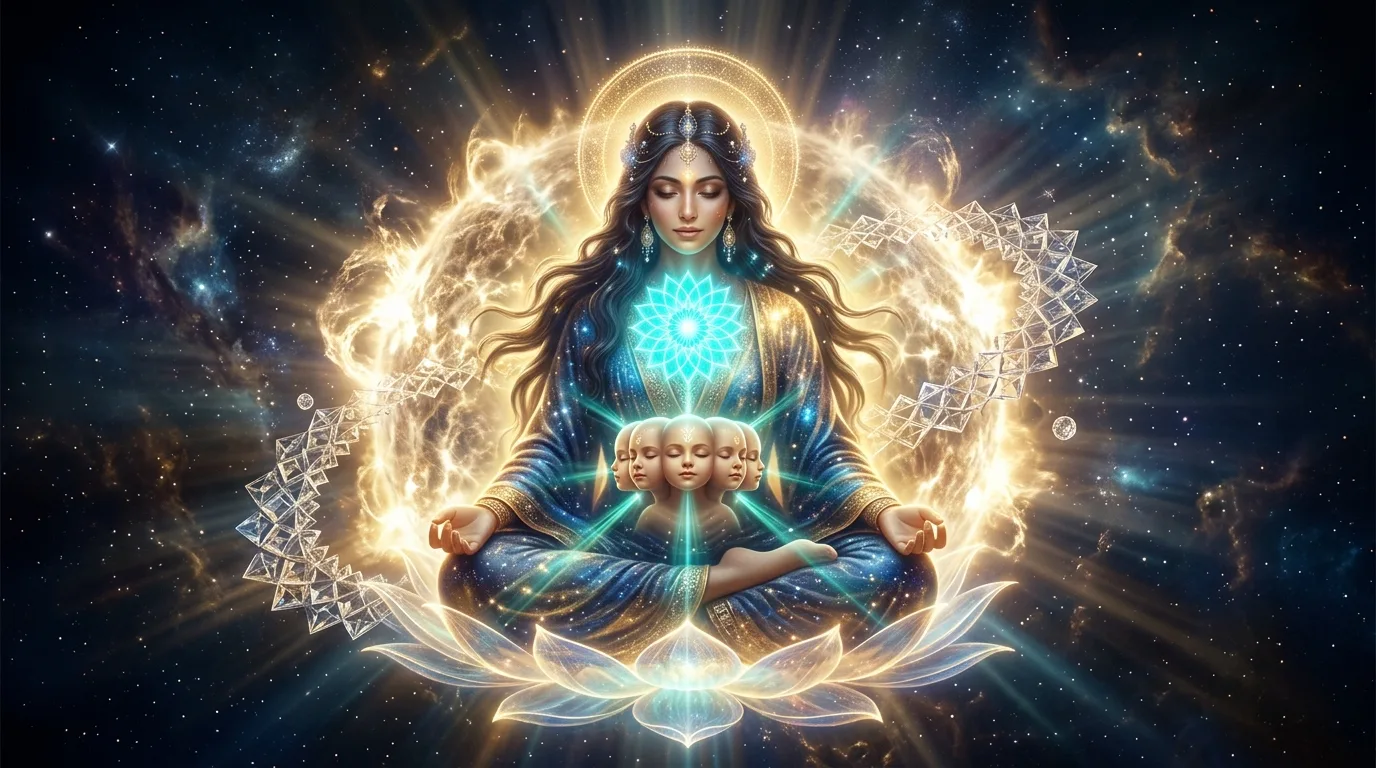
Then, out of this frozen, unmanifest silence, a spontaneous creative impulse emerged. The Devī Bhāgavata Purāṇa states that Ādi Parāśakti, in Her fourth primary cosmic manifestation as Mā Kūṣmāṇḍā, flashed an Īṣat-Hāsya (ईषत्-हास्य)—an infinitesimal, subtle, effortless smile.
Look at what the text specifies occurs in that single instant:
- The impenetrable darkness was pierced by an unborrowed, supreme luminescence (Sphurattā).
- The absolute zero stasis of the void was touched by the first kinetic spark of divine thermodynamic heat (Uṣmā).
- The dormant equilibrium fractured into spontaneous creative vibration (Spanda).
- The curved, embryonic membrane of space and time—the Brahmāṇḍa (the Cosmic Egg)—expanded outwards in an ocean of radiance.
Creation was not work. It was not labor. It was Akartṛtva—effortless action, the natural, joyful overflow of absolute bliss (Ānanda).
The Manidvīpa Revelation: The Infancy of the Trimūrti
In Book 3 (Chapters 3 through 5) of the Devī Bhāgavata Purāṇa, there is an extraordinary scene that shatters the conventional hierarchy of Hindu mythology.
Following the dawn of this new cycle, the male cosmic trinity—Brahmā (the creator), Viṣṇu (the preserver), and Śiva (the dissolver)—find themselves waking up as bewildered infants floating upon a banyan leaf on the primeval causal ocean. They have no idea who they are, where the dark waters came from, or what their purpose is. They are helpless.
A disembodied voice (Aśarīravāṇī) echoes across the waters:
"सर्वं खल्विदमेवाहं नान्यदस्ति सनातनम् ।"
(Sarvaṁ khalvidam evāhaṁ nānyad asti sanātanam)
"All this that exists is Myself; there is nothing else eternal besides Me."
The Goddess appears and invites the three young deities into a celestial aerial vessel (Vimāna), carrying them upward beyond the boundaries of their localized universe into Her transcendent realm: Maṇidvīpa (The Isle of Jewels), resting in the Ocean of Nectar (Sudhāsindhu). There, seated upon a throne supported by the five cosmic principles (Pañca-Pretāsana), they behold Mā Kūṣmāṇḍā in Her full majesty.
As Brahmā, Viṣṇu, and Śiva look at the radiant fingernails of Her hands and the curvature of Her smiling lips, they experience an overwhelming vision: inside every pore of Her skin, they see billions of independent universes floating like specks of dust. Looking into one cosmic bubble, Brahmā sees another Brahmā creating; looking into a second, he sees another Viṣṇu preserving; looking into a third, he sees another Śiva dissolving.
The Trimūrti realize with profound humility that they are not the ultimate authors of existence; they are merely regional operational managers assigned to a single cosmic bubble. The primeval spark that ignited the entire multiversal matrix was the effortless warmth of Mā Kūṣmāṇḍā's smile.
Sūryamaṇḍala-Antarvartinī: The Engine Inside the Sun
The Devī Kavacam and classical liturgy assign Her a cosmic dwelling place that belongs to no other deity:
"सूर्यमंडलान्तर्वर्तिनी" (Sūryamaṇḍalāntarvartinī)
"She who resides within the incandescent interior of the Solar Orb."
In classical Hindu cosmology, the interior of the Sun is considered uninhabitable by any mortal, celestial god (Deva), or demon (Asura), because its brilliance and heat would instantly incinerate their subtle bodies. Mā Kūṣmāṇḍā alone dwells at the core of the Sun because Her internal radiance equals and sustains that heat. The text makes an astonishing metaphysical assertion: the Sun does not shine by its own independent power; the physical Sun is merely a cosmic lens, an aperture through which Kūṣmāṇḍā’s unmanifest spiritual intelligence (Chidagni) is stepped down into physical light and thermodynamic heat.
Key Terms Explained: Deconstructing the Sanskrit Architecture
To really appreciate what the ancients were conveying, we must bypass English approximations and look at the precision of classical Sanskrit Nirukta (etymology).
- KU (कु) — UṢMĀ (ऊष्मा) — AṆḌA (अण्ड)
- Infinitesimal / Subtle — Thermodynamic Heat — Cosmic Egg
- Focal Seed-Point (Bindu) — Kinetic Tapas / Energy — Spacetime Membrane
- KŪṢMĀṆḌĀ (कूष्माण्डा)
- "She who, through an infinitesimal fraction of Her thermal radiance,
- birthed and continuously expands the Cosmic Egg."
1. Kūṣmāṇḍā (कूष्माण्डा)
Popular folklore equates this name with an ash gourd. But in Sanskrit grammatical analysis, Kūṣmāṇḍā is a profound philosophical compound composed of three roots:
- Ku (कु): In Pāṇinian grammar, Ku denotes that which is minute, subtle, or infinitesimal (Alpa). It also designates the foundational terrestrial realm (Pṛthivī) and, in Tantric linguistics, represents the primary seed-point (Bindu) of physical manifestation.
- Uṣmā (ऊष्मा): This specifically denotes thermodynamic warmth, latent kinetic heat, or radiative excitation. In Sanskrit phonetics (Vyākaraṇa), the Ūṣman consonants (श, ष, स, ह — śa, ṣa, sa, ha) represent sibilants produced by the friction of breath generating heat. Without Uṣmā, matter freezes into absolute inertia. Uṣmā is the metabolic fire that makes physical existence dynamic.
- Aṇḍa (अण्ड): The egg, the curved oval sphere, specifically designating the enclosed bubble of space-time (Brahmāṇḍa).
When we assemble these roots, they give a popular explanation of her name:
"She who, through an infinitesimal fraction of Her thermal conscious radiance (Uṣmā) via a subtle smile, birthed and expanded the Cosmic Egg (Aṇḍa)."
She is not named after a vegetable; the botanical specimen was named after Her due to its esoteric properties.
2. Mandasmita (मन्दस्मित) and Īṣat-Hāsya (ईषत्-हास्य)
- Īṣat means microscopic, barely perceptible, subtle.
- Hāsya or Smita means a gentle smile or soft laughter.
Why does this matter? If the text said She "commanded" or "built" the world, it would imply duality, effort, and strain. In Indian aesthetics and philosophy, an involuntary smile is the direct manifestation of Pūrṇatva (inner fullness) and Līlā (divine play). A smile occurs when an internal joy spontaneously overflows without calculation. Creation is thus framed as an aesthetic expression of consciousness delighting in its own boundless potential.
3. Brahmāṇḍa (ब्रह्माण्ड)
Derived from the root Bṛh (बृह्—to swell, expand, grow without limit) combined with Aṇḍa (egg or embryonic vessel).
In Sanatan cosmography, the universe is never described as an empty, flat Euclidean space going on forever. It is an expanding, curved, bio-cosmic envelope. It has a boundary, it breathes, it inflates during creation (Sṛṣṭi), stabilizes during preservation (Sthiti), and undergoes thermal contraction during dissolution (Pralaya).
4. Chidagni (चिदग्नि) vs. Sūryāgni (सूर्याग्नि)
- Chidagni is the self-luminous fire of pure consciousness. The famous Lalitā Sahasranāma opens by addressing the Goddess as Cidagni-kuṇḍa-sambhūtā ("She who emerges from the sacrificial pit of Pure Awareness").
- Sūryāgni is physical thermonuclear fire—the light that burns hydrogen into helium.
Mā Kūṣmāṇḍā represents the cosmic bridge where unmanifest spiritual intelligence (Chidagni) condenses into the physical heat and radiation (Sūryāgni) that sustains our planetary ecology.
5. Surā-sampūrṇa-kalaśa (सुरासम्पूर्णकलश)
In Her iconography, Mā Kūṣmāṇḍā holds eight implements in Her eight hands. One of the most misunderstood is the vessel of Surā. Colonial translators often carelessly rendered this as "a pot of wine/alcohol."
In Vedic Tantric terminology, Sura is the exact ontological opposite of Asura (darkness/division). Su-rā literally means "that which yields divine luminosity"—the distilled nectar of spiritual immortality (Soma-rasa or Amṛta). She holds one vessel overflowing with divine nectar (Surā) and another with biological life-force (Rudhira, blood), demonstrating Her complete command over both immortal cosmic intelligence and physical biological life.
Traditional Interpretation: How the Classical Schools Understood This
This cosmogony was not treated as a children's fairy tale by classical commentators; it was vigorously debated and integrated into the major philosophical systems of India.
The Shakta Advaita Perspective: Abhāsa-Vāda (The Theory of Divine Reflection)
How can a universe emerge from a smile without the Goddess changing Her eternal nature? This question was addressed directly by great commentators like Bhāskararāya (in his masterwork Saubhāgya Bhāskara) and Nīlakaṇṭha Caturdhara (who wrote an extensive commentary on the Devī Bhāgavata Purāṇa).
They rejected Pariṇāma-vāda (the idea that the Goddess literally transforms Her substance into rocks, dirt, and planets, which would mean God ceases to exist as pure spirit). Instead, they advanced Abhāsa-Vāda:
- When the Goddess smiles, the universe does not emerge "outside" of Her, because in absolute non-duality, there is no exterior.
- Just as a sprawling city can be reflected inside a spotless mirror without adding a single gram of weight or scratch to the mirror's glass, the entire Brahmāṇḍa is reflected within the boundless consciousness of the Goddess.
- She is simultaneously the Nimitta Kāraṇa (the intelligent/efficient cause) and the Upādāna Kāraṇa (the conscious material substrate) of all existence.
The Kashmir Shaivism & Shakta Trika Alignment: Spanda and Vimarśa
In the non-dual Shaiva-Shakta traditions of Kashmir (systematized in the Spandakārikā and Abhinavagupta’s Tantrāloka), the genesis of the universe is attributed to Camatkāra—the supreme aesthetic wonder of consciousness tasting itself.
- The static masculine light is Prakāśa (pure luminescence).
- The self-aware, dynamic feminine mirror is Vimarśa.
When consciousness looks into its own nature, it experiences an involuntary shudder of delight (Spanda). That ecstatic shudder generates warmth (Uṣmā). Mā Kūṣmāṇḍā’s smile is the mythopoetic representation of Vimarśa: the moment supreme awareness smiles at its own infinite creative power, triggering the ripples of space and time.
The Tantric Mystery of Kūṣmāṇḍa Bali (The Ash Gourd Offering)
Why is the ash gourd (Benincasa hispida) specifically offered to Her during the fourth night of Navratri?
In texts like the Śatapatha Brāhmaṇa and medieval Tantric manuals such as the Śāradā Tilaka, the ash gourd is identified as a unique botanical entity: it is an exact energetic duplicate of the human and animal embryo (Garbha).
- It possesses an internal fluid cavity mimicking the amniotic waters (Garbhodaka).
- It contains seeds suspended in a delicate vascular network.
- It is protected by a tough, curved outer rind that mirrors both the cranial skull and the shell of the Cosmic Egg.
When early Vedic and Tantric communities sought to eliminate animal sacrifice (Paśu Bali), the ash gourd was introduced as the ideal non-violent (Ahiṁsaka) substitute. Cleaving an ash gourd before Mā Kūṣmāṇḍā is a ritual of internal alchemy: the aspirant offers their individual, hard-shelled ego (Ahaṅkāra) to be split open and dissolved back into the cosmic womb of the Divine Mother.
How This Connects: The Golden Thread Across Sanatan Dharma
The revelation of Mā Kūṣmāṇḍā is not an isolated story tucked away in a single Purana. It connects directly with the oldest hymns of the Vedas and the most intricate systems of internal yogic physiology.
1. The Nāsadīya Sūkta (Rig Veda 10.129)
The famous Creation Hymn of the Rig Veda describes the primordial condition using nearly identical metaphysical language:
तम आसीत्तमसा गूळ्हमग्रेऽप्रकेतं सलिलं सर्वमा इदम् ।
तुच्छ्येनाभ्वपिहितं यदासीत्तपसस्तन्महिना जायतैकम् ॥ ३ ॥
(tama āsīt tamasā gūḷham agre'praketaṁ salilaṁ sarvamā idam / tucchyenābhvapihitaṁ yadāsīt tapasas tan mahinā jāyataikam)
"In the beginning was darkness concealed by darkness; all this was unillumined water. That One which was covered by the void arose through the majesty of Tapas (Cosmic Heat)."
Notice that specific Vedic word: Tapas. Tapas does not merely mean ascetic penance; its root meaning is thermal friction, intense spiritual and physical heat. The Rig Veda states that the cosmos condensed out of the void through Tapas. The Devī Bhāgavata Purāṇa takes that abstract Vedic insight and reveals its personal source: that primal Tapas is the thermodynamic Uṣmā glowing from the gentle smile of Mā Kūṣmāṇḍā.
2. The Chāndogya Upaniṣad: The Sun Within the Heart
In the Chāndogya Upaniṣad (Chapter 3, Section 13, Verse 7), an ancient sage makes a radical declaration connecting the cosmos to human biology:
अथ यदतः परो दिवो ज्योतिर्दीप्यते विश्वतः पृष्ठेषु... इदं वाव तद्यदिदमस्मिन्नन्तः पुरुषे ज्योतिः ॥
(atha yad ataḥ paro divo jyotir dīpyate viśvataḥ pṛṣṭheṣu... idaṁ vāva tad yad idam asminn antaḥ puruṣe jyotiḥ)
"Now, that light which shines above this heaven, beyond all worlds, in the highest realms... is truly the exact same light which burns here within the human body."
Because Mā Kūṣmāṇḍā is Sūryamaṇḍalāntarvartinī (dwelling within the heart of the Sun), She is simultaneously the presiding intelligence of two vital energy centers in Tantric yoga:
- The Maṇipūra Chakra (the Solar Plexus), which governs Jatharāgni (the digestive and metabolic furnace of the body).
- The Anāhata Chakra (the Heart Center), which governs circulation and the pulsation of life.
| SŪRYA MAṆḌALA (The Sun) • Gravitational Equilibrium • Thermonuclear Ignition • Sustainer of Solar System | ↔ | MAṆIPŪRA / ANĀHATA CHAKRAS • Prāṇa-Samāna Equilibrium • Metabolic Fire (Jatharāgni) • Biological Thermoregulation |
|---|
Your physical body is literally a miniature solar system. The moment your internal thermodynamic heat (Uṣmā) drops permanently, clinical death occurs. When a yogi meditates on Mā Kūṣmāṇḍā, they are not imagining an external deity across billions of miles of empty space; they are aligning their internal metabolic fire with the cosmic engine of the Sun.
3. Osho on the Cosmic Laughter
In his discourses on esoteric mysticism, the twentieth-century mystic Osho made a penetrating observation about world religions. He noted that most Western theology painted God as a stern, frowning, elderly judge—someone deeply burdened by morality, keeping a ledger of sins.
Osho pointed out that the Indian vision stands completely apart because it portrays God as a dancer (Naṭarāja), a player of the flute (Kṛṣṇa), and a laughing presence. Seriousness is a symptom of the ego (Ahaṅkāra). The ego takes itself seriously because it lives in constant terror of its own demise. True consciousness is so boundless, so immortal, that its natural response to reality is a smile. When the Devī Bhāgavata says the universe emerged from a smile, it is telling us that reality is fundamentally built on lightness and celebration, not dread.
Modern Research and Science: Cosmological and Botanical Resonances
When we look at this text alongside contemporary science, we find fascinating thematic and empirical parallels that are worth exploring with intellectual rigor.
1. Physical Cosmology: The Thermal Inflation Analogy
In modern physical cosmology, our understanding of the early universe is anchored in the Big Bang framework first proposed mathematically by Georges Lemaître and expanded through the Inflationary Model:
- The Initial Singularity: Modern physics posits that all matter, energy, space, and time were compressed into an initial state of near-infinite density and temperature before expanding outward. The Purana describes an analogous initial condition: a dimensionless seed-state (Mūlaprakṛti / Bindu) resting in unmanifest stillness before expanding.
- Inflation and Reheating: Following the initial exponential expansion of spacetime (inflation), cosmology describes a critical transition known as Reheating. During this phase, the cold, empty, inflating universe was suddenly flooded with immense thermodynamic energy, producing the hot, dense plasma of elementary particles that eventually coalesced into stars and galaxies. This transition from a cold, silent void to a thermal particle furnace bears a striking thematic resonance with the textual description of Uṣmā (kinetic heat) entering the frozen void of Pralaya.
- The Cosmic Microwave Background (CMB): Discovered by Arno Penzias and Robert Wilson in 1964, the CMB is the faint 2.7 Kelvin thermal radiation that fills all observable space—the lingering thermal echo of the early hot universe. In the poetic language of the Purana, the effulgence of Kūṣmāṇḍā’s initial smile is said to permanently permeate every coordinate of the Brahmāṇḍa, sustaining its operational life.
2. Botanical and Biochemical Reality: The Ash Gourd (Benincasa hispida)
The connection between the deity and the ash gourd is not merely ritualistic; it has genuine nutritional and biochemical backing in Ayurvedic medicine and modern food science.
In the Caraka Saṁhitā (Sūtra Sthāna, Chapter 27), the ash gourd is categorized as Param Medhyam—one of the supreme natural cognitive enhancers and nervous system tonics known to Ayurveda. It is documented as:
- Pittahara & Dāhapraśamana: Possessing an extraordinary biochemical capacity to reduce systemic inflammation, neutralize metabolic heat, and cool gastrointestinal acidity.
- Unusual Cellular Moisture Retention: Modern food biochemistry notes that unlike most high-water vegetables that decompose rapidly, an intact ash gourd can sit on a shelf for up to a year without refrigeration while maintaining its cellular integrity, trace minerals, and moisture.
Here we see the classical Sanatan doctrine of Agni-Soma Samanvaya (the harmony of Fire and Nectar). While the deity Mā Kūṣmāṇḍā represents raw, incinerating solar fire (Agni), Her botanical counterpart provides deep, cooling, soothing nourishment (Soma). The tradition balances cosmic fire with biological cooling so that spiritual practice never leads to energetic burnout.
Where the Comparison Holds, and Where It Doesn't
As seekers and researchers on the Sanatan Platform, our duty is to maintain uncompromising intellectual honesty. It has become fashionable on social media to claim that "ancient sages proved quantum mechanics" or that "the Big Bang is fully explained in the Puranas."
Making these claims uncritically is a grave intellectual mistake that damages the credibility of Sanatan Dharma in the eyes of serious scholars. Let us clearly define where the resonance holds, and where the comparison must stop.
| MODERN PHYSICAL COSMOLOGY • Materialist / Physicalist • Mathematical & Quantifiable • Spacetime = Curved fabric • Governed by blind physical laws • Mechanism without purpose | DEVI BHĀGAVATA COSMOGONY • Idealist / Panpsychist • Metaphysical & Experiential • Brahmāṇḍa = Living conscious egg • Governed by conscious play • Purposeful, joyful overflow |
|---|
Where the Comparison Holds (The Structural Resonances)
- A Non-Eternal Universe: Both modern cosmology and the Devī Bhāgavata Purāṇa reject the idea of a steady-state, static universe. Spacetime had an operational beginning, it expands, it has an elliptical/curved architecture, and it will eventually undergo contraction and dissolution.
- The Primacy of Thermodynamics: Both paradigms recognize that you cannot transition from potentiality to tangible matter without crossing a profound thermodynamic threshold. Heat (Uṣmā / Reheating) is the non-negotiable catalyst of cosmic evolution.
- The Micro-Macro Link: The recognition that the elements and thermal dynamics operating in the celestial stars are mirrored in the biological chemistry of living organisms.
Where the Comparison Breaks Down (The Fundamental Divergence)
- Consciousness vs. Dead Matter: Modern astrophysics is strictly physicalist. It assumes that matter and energy are fundamental, and that consciousness is merely an accidental, late-stage byproduct of biological evolution. In the Devī Bhāgavata Purāṇa, consciousness (Chit) is the fundamental ground of reality. Matter, space, and gravity are simply the outer condensation of divine awareness.
- Aesthetic Will vs. Random Fluctuation: In cosmology, inflation is driven by mechanical inflaton fields and quantum vacuum fluctuations. There is no intention, joy, or meaning behind it. In the Shakta tradition, creation is an intentional, joyful expression of supreme freedom (Svātantrya).
- Empirical Proof vs. Metaphysical Intuition: Modern cosmology relies on predictive differential equations, telescope arrays, and spectroscopic measurements of red-shifts. The Purana provides a phenomenological, spiritual mapping of the cosmos seen through the lens of meditative absorption.
To say that the Devī Bhāgavata Purāṇa "predicted the Big Bang" is inaccurate. What it actually did is perhaps even more profound: it anticipated that an expanding, heat-driven universe is not an accident of cold engineering, but the living, breathing body of an infinite, conscious mother.
Frequently Asked Questions
1. Why is Mā Kūṣmāṇḍā called the "pumpkin goddess" in popular culture?
This is a superficial translation error. While the ash gourd (Benincasa hispida, often loosely referred to as pumpkin) is offered to Her in ritual worship due to its unique biophysical and cooling properties, the name Kūṣmāṇḍā is an ancient Sanskrit compound: Ku (infinitesimal point), Uṣmā (thermodynamic heat), and Aṇḍa (the cosmic egg). She is the supreme reality who birthed the universe through an infinitesimal spark of heat.
2. Does the Devi Bhagavata Purana describe the actual Big Bang?
Not in the mathematical or empirical sense used by modern physics. Rather, it shares a profound structural resonance with physical cosmology: both recognize an initial singular state of potentiality, an expansion driven by an immense thermodynamic threshold, and a curved, non-static universe. The Purana approaches this from a metaphysical framework where consciousness is primary, whereas modern physics approaches it from a physicalist framework.
3. What does it mean that Mā Kūṣmāṇḍā lives inside the Sun?
In Shakta metaphysics, the physical Sun is not self-illuminating; it is a material aperture channeling the supreme spiritual intelligence of the cosmos. Mā Kūṣmāṇḍā is described as Sūryamaṇḍalāntarvartinī because Her radiance sustains the thermonuclear fire of the stars. In internal yoga, this same solar intelligence resides in the human body within the Maṇipūra (solar plexus) and Anāhata (heart) chakras.
4. What is the practical life lesson of Mā Kūṣmāṇḍā's cosmic smile?
The core teaching is the principle of Akartṛtva—effortless action. When human beings live in anxiety, guilt, and rigid solemnity, their energy freezes into inertia (Tamas). The teaching of Kūṣmāṇḍā reminds us that the highest creative power comes from inner fullness and joy. Meeting life's chaos with a centered, effortless smile aligns your consciousness with the very thermodynamic frequency that sustains the universe.
Sources
Classical Sanskrit Texts
- Śrīmad Devī Bhāgavata Purāṇa — Book 3 (Chapters 3–7: The emergence of the Trimūrti, the vision of Maṇidvīpa, and cosmic genesis) and Book 7 (Devī Gītā).
- Rig Veda — Maṇḍala 10, Sūkta 129 (Nāsadīya Sūkta: The Creation Hymn of Cosmic Heat and Void).
- Chāndogya Upaniṣad — Chapter 3, Section 13 (The equivalence of the celestial solar light and the internal biological light).
- Lalitā Sahasranāma — With the commentary Saubhāgya Bhāskara by Bhāskararāya.
- Śatapatha Brāhmaṇa & Śāradā Tilaka — Ritual texts detailing the bio-energetic symbolism of the Kūṣmāṇḍa Bali.
- Caraka Saṁhitā — Sūtra Sthāna, Chapter 27 (Ayurvedic pharmacological classification of Benincasa hispida as Param Medhyam).
Modern Scientific Fields & Documented Phenomena
- Physical Cosmology — The Primeval Atom / Singularity Model (Georges Lemaître), Cosmic Inflationary Theory (Alan Guth), and the Cosmic Microwave Background (Penzias & Wilson, 1964).
- Thermodynamics & Astrophysics — Stellar Nucleosynthesis and Thermonuclear Core Dynamics.
- Phytochemistry & Nutritional Neuroscience — Biochemical moisture retention and neuroprotective attributes of Benincasa hispida (Ash Gourd).
This reflects what the text itself says; the modern-science comparisons above are interpretation, not an established finding.