Why Shiva Burned Kamadeva: The Untold Science of Tapas and Maa Brahmacharini
Drafted with the help of AI from the original texts named in the article; I read and correct every article after it is published. How we use AI
Explore why Shiva incinerated Kamadeva in Devi Bhagavata Purana, Maa Brahmacharini's Aparna protocol, and what neuroscience reveals about willpower.
In this article
Have you ever found yourself sitting on the edge of your bed at 2:17 in the morning, staring into the harsh blue glow of your smartphone, feeling an eerie combination of physical exhaustion and complete mental paralysis?
I know that feeling intimately. You planned to wake up early. You promised yourself you would focus, finish your project, meditate, or finally take control of your life. Yet there you are, thumb flicking upward, drowning in an endless algorithmic feed of fifteen-second videos, chasing cheap hits of digital dopamine while your actual dreams gather dust.
We live in an age obsessed with shortcuts. The internet is flooded with self-proclaimed gurus promising that you can "manifest your reality in five minutes," repeat a quick affirmation, or hack your brain with a morning routine. We have been conditioned to believe that desire itself—if felt passionately enough—is the vehicle to obtain whatever our hearts long for.
A few years ago, while digging through the Sanskrit verses of the Śrīmad Devī Bhāgavata Purāṇa and the Śiva Purāṇa, I stumbled upon an ancient episode that shook me to my core. It was the story of why Lord Śiva incinerated Kāmadeva, the god of desire. When you peel back the layers of popular mythology and look at what the texts actually say, you realize that this story is not a quaint fairy tale about an angry deity. It is a severe, existential warning to humanity.
The ancient texts deliver an uncompromising truth: the highest dimensions of reality and self-mastery cannot be seduced by desire, emotional longing, or cheap shortcuts. When desire tried to shortcut consciousness, it was burned into a pile of cold ash.
What rose from those ashes was not despair, but the greatest revolution of willpower ever recorded in sacred literature: the terrifying, beautiful, and thermonuclear spiritual journey of Mā Brahmacāriṇī.
On the second day of Navratri, millions of people see a gentle, pastel image of a goddess in white holding a rosary, and they reduce Her to a symbol of passive maidenhood. But if you open the classical Śākta canons, you discover something vastly different. Mā Brahmacāriṇī is the living embodiment of the cosmic physics of Tapas—the deliberate, voluntary endurance of friction that forces the universe itself to yield.
Let us step beyond the greeting cards and look into the raw, unedited depth of the classical texts.
What the Text Actually Says
To grasp the monumental gravity of Mā Brahmacāriṇī, we have to look directly at the primary texts: the Śrīmad Devī Bhāgavata Purāṇa (specifically Skandha 7, Adhyāyas 8 through 11, and the crown jewel of philosophical exposition, the Devī Gītā, found in Skandha 7, Adhyāyas 31 through 40), corroborated by the vivid narrative architecture of the Śiva Purāṇa (Rudra Saṁhitā, Pārvatī Khaṇḍa, Adhyāyas 21 through 30).
The Metaphysical Vacuum and the Devas' Fatal Mistake
The drama begins at an existential turning point. In the cosmological sequence of Navratri, Day 1 represents Mā Shailaputrī: the Primordial Śakti (Ādi Parāśakti) crystallizing Herself into dense physical matter (Pṛthvī-Tattva), taking birth as Pārvatī, the daughter of the mountain king Himavān. But physical birth is merely latent potential. Pārvatī is born into royal opulence, surrounded by golden chambers and celestial comfort, yet Her soul is tormented by an unrelenting, non-negotiable spiritual pull toward Lord Śiva.
Śiva, however, is not waiting around in the world. Following the tragic self-immolation of Satī at Dakṣa’s sacrifice, Śiva has withdrawn completely from the spacetime continuum. He sits atop Mount Kailāśa in Mahā-Samādhi—unconditioned, motionless awareness (Nirguṇa-Brahman), detached from cosmic affairs.
Meanwhile, the universe is plunged into terror by the demon Tārakāsura, who holds a cosmic boon that he can only be slain by a child born of Śiva and Śakti. The Devas (the gods) are desperate. They need Śiva to open His eyes. They need Him to marry Pārvatī and produce an heir.
Instead of waiting for organic spiritual evolution, the Devas decide to take an arrogant shortcut: they deploy Kāmadeva (the god of lust, sensory attraction, and dopamine-driven infatuation) alongside his companion Vasanta (the deity of intoxicating Spring).
Kāmadeva infiltrates Śiva’s hermitage. He transforms the barren, icy Himalayan landscape into an intoxicating, fragrant paradise. Flowers bloom out of season, gentle southern breezes whisper through the trees, and the forest pulses with sensual longing. Seeing Śiva seated in motionless contemplation, Kāmadeva draws his bow of sugarcane, strings it with buzzing bees, and fires his five flowery arrows of infatuation (Puṣpa-Bāṇa) straight into Śiva’s chest.
Kāma-Dāha: The Incineration of Shortcut Spirituality
What happens next is an earth-shattering lesson in cosmic law.
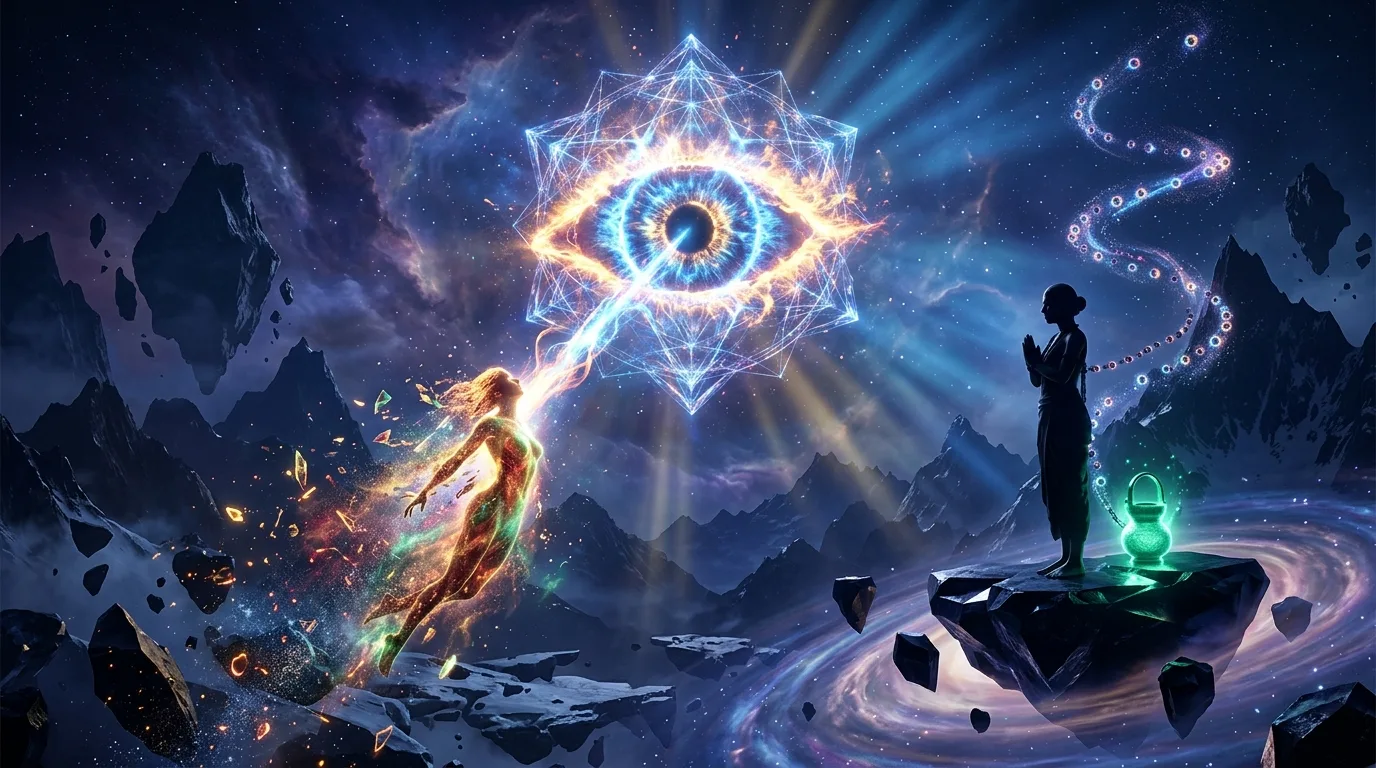
Śiva does not succumb to romantic infatuation. His eyelids slowly part. But instead of affection, His forehead cracks open, and the Third Eye of Transcendence (Jñāna-Netra) ignites. A blinding, incinerating beam of raw cosmic fire bursts forth. In a fraction of a second, Kāmadeva—the very lord of desire and sensory enchantment—is obliterated into a pile of cold, lifeless ash (Kāma-Dāha).
The message of the text is chillingly unambiguous: You cannot bribe, seduce, or trick Supreme Consciousness through biological urges or psychological manipulation. The moment you attempt to pull the Infinite down to the level of cheap, sensory gratification, the fire of truth incinerates the illusion.
Pārvatī’s Awakening: The Choice of Absolute Friction
Pārvatī witnesses this catastrophe with Her own eyes. Her palace attendants are terrified. Her mother, Queen Menā, is grief-stricken, begging Her daughter to stay within the palace walls. But Pārvatī undergoes a profound internal awakening.
She realizes that if Śiva cannot be reached through the flowery arrows of desire, He can only be attained through something more uncompromising, more atomic, and hotter than Śiva’s own fire: pure, unbroken Tapas.
Pārvatī strips off Her royal silk robes. She unclasps Her emerald necklaces and gold bangles, letting them crash to the floor. She twists Her silky hair into the rough, matted locks of an ascetic (Jaṭā), wraps Her body in coarse tree bark (Valkala), and walks barefoot into the desolate, freezing altitudes of the higher Himalayas—a sacred terrain traditionally identified with Gaurī Kuṇḍ and Tapovana.
The Aparṇā Continuum: A Multi-Millennial Biological Alchemy
What follows in the Śrīmad Devī Bhāgavata Purāṇa and the Śiva Purāṇa is a systematic, multi-millennial biological and energetic transformation that defies human comprehension:
- The First Millennium (Phala-Mūlāśinī): For the first 1,000 years, Pārvatī consumes nothing but wild fruits and tubers gathered from the freezing forest, training Her body to dismantle its dependence on cooked, domesticated luxuries.
- The Second Phase (Śākāśinī): For the next 100 years, She abandons fruits entirely, surviving only on bitter wild leaves, wild herbs, and mountain water.
- The Three Thousand Years of the Fallen Leaf (Parṇāśinī): For the next 3,000 years, She refuses even to pluck living herbs. She sustains Her body solely on dry leaves (Parṇa) that have naturally detached from the sacred Bilva trees and fallen to the frozen ground.
- The Threshold of Aparṇā (अपर्णा): Finally, She renounces even the dry fallen leaf. She stops drinking water. She ceases all caloric intake. In the dead of Himalayan winter, She stands motionless in the middle of frozen, chest-deep rivers. In the scorching height of summer, She performs the terrifying Pañcāgni-Tapas—sitting motionless surrounded by four blazing bonfires, with Her gaze fixed directly on the blinding midday sun as the fifth fire.
When Her mother Menā witnesses Her daughter’s frame reduced to skin and bone, yet radiating an impossible, blinding interior luminescence, she cries out in agony: "उ मा!" ("U Mā!" — "Oh, do not!"), giving the Goddess Her eternal name, Umā.
Because She renounced even a leaf (Parṇa), the celestial sages and gods bow before Her in reverence and proclaim Her Aparṇā—She who is without even a leaf.
The Parable of Latent Fire: The Law of Manifestation
In the Śrīmad Devī Bhāgavata Purāṇa, King Janamejaya is baffled by this story. He asks Maharṣi Vyāsa: "O great Sage, if Pārvatī is the Primordial Mother of the universe, the sovereign ruler of Brahmā, Viṣṇu, and Śiva, why did She have to endure thousands of years of terrifying physical suffering in the wilderness? What was the logic behind Her Tapas?"
Vyāsa answers with an ancient Vedic analogy:
Fire is inherently present inside every piece of wood. It saturates every grain of the branch. Yet, a freezing person cannot warm themselves simply by clutching cold timber, nor can an unlit branch illuminate the night. The fire remains sleeping potential until intense, rhythmic friction (Araṇi-Manthana) is applied.
When Ādi Parāśakti assumed a human incarnation as the daughter of Himavān, She embraced the biological laws of the manifest world (Māyika-Śarīra). Even for the Divine Mother in human form, latent divinity is completely inert without the friction of Tapas. Consciousness must forge its own furnace. In Sanatan Dharma, there are no unearned spiritual entitlements.
The Saptarṣi Dialogue: Refuting Pragmatic Compromise
When Pārvatī’s austerities reach an unbearable pitch, Śiva sends the Saptarṣis (the Seven Venerable Sages: Vasiṣṭha, Kaśyapa, Atri, and others) to test Her resolve (Śiva Purāṇa, Pārvatī Khaṇḍa, Adhyāyas 25–27).
The sages approach Her with worldly wisdom, sophisticated logic, and aristocratic pragmatism: "O Princess, look at yourself! You are destroying your breathtaking beauty. Why are you killing yourself for Śiva? He is an eccentric outcast (Avadhūta). He has no noble lineage, no wealth, no palace. He sleeps in cremation grounds, smears himself with human ashes, wears venomous snakes, and rides an old bull. Why throw away your youth for a beggar? Look at Lord Viṣṇu! He is the Lord of Vaikuṇṭha, draped in royal silks, adorned with the Kaustubha gem, served by Lakṣmī. We can arrange your marriage to Viṣṇu this very day!"
Pārvatī’s response is one of the most intellectually uncompromising declarations in spiritual history. She dismantles their logic with diamond-hard clarity:
- The Illusory Nature of Luxury: Viṣṇu’s palaces, Indra’s heavens, and golden thrones are products of the Guṇas (the qualifying attributes of Prakṛti). They are born in time, live in time, and will dissolve (Pralaya) in time. Why exchange the eternal for gilded handcuffs?
- The Truth of Śiva: Śiva appears poor because He is the indwelling Self of everything that exists. He needs no clothes because space itself is His garment (Digambara). He needs no palace because the universe rests within Him.
- The Non-Dual Vow: Pārvatī proclaims:
"Does a river rushing from the mountain stop to negotiate with the plains? It must reach the ocean or dry up completely. My consciousness has recognized Śiva as its home. Even if the sun loses its heat, even if fire becomes freezing cold, and even if Mount Meru floats upon the sea, my resolve will not waver. I will attain Śiva, or I will dissolve this mortal frame into dust!"
The Divine Debtor
Hearing this roar of absolute focus, the sages bow their heads in awe. Pārvatī’s body has become a biological crucible (Tapodhikā). Her individual resolve (Jīva-Saṅkalpa) has fused seamlessly with the cosmic will (Īśvara-Saṅkalpa). The heat of Her austerities permeates the three worlds (Tribhuvana), causing the celestial realms to boil.
Śiva appears before Her. First, He disguises Himself as an old, cynical ascetic who mocks Śiva’s poverty to test Her one final time. Pārvatī turns away in disgust, refusing to hear a single word of slander against the Truth.
At that instant, Śiva discards the disguise and reveals His glorious, four-armed cosmic form. But He does not speak to Her like a king granting charity to a beggar. Kālidāsa’s Kumārasambhava (5.86), the classical poem on this same story from the Śiva Purāṇa, gives Śiva words that turn the entire master-servant dynamic of religion upside down:
"अद्यप्रभृत्यवनताङ्गि तवास्मि दासः क्रीतस्तपोभिः"
(Adya-prabhṛty avanatāṅgi tavāsmi dāsaḥ krītas tapobhiḥ.)
"From this day on, O gentle one, I am your servant, bought by your austerities."
Think about the psychological magnitude of that declaration. In Sanatan Dharma, God does not yield to flattery, emotional begging, or transaction. Consciousness yields only to the unyielding fire of consecrated attention.
Key Terms Explained
To truly appreciate the classical mechanics of this teaching, we have to rescue its technical Sanskrit vocabulary from vague English translations:
- Brahmacāriṇī (ब्रह्मचारिणी): Popular culture mistranslates this word simply as "a celibate female." But look at its actual linguistic roots: Brahman (ब्रह्मन्—the infinite, unconditioned substrate of reality) + Cāriṇī (चारिणी—derived from the verbal root car, meaning "to move," "to dwell," "to walk," "to vibrate in rhythm with"). It literally translates to: "She who moves, lives, breathes, and operates continuously within the frequency of Absolute Consciousness." Physical chastity (Brahmacharya) is merely an external baseline; the true essence is the upward channeling of all mental and vital energy into Brahman.
- Tapas (तपस्): Rooted in the verb tap (तप्), meaning "to heat," "to radiate," "to undergo intense friction." It is fundamentally different from the Western theological concept of "penance" or "mortification" (which is rooted in guilt, original sin, or self-punishment). In Vedic metaphysics, Tapas is thermodynamic spiritual friction. Just as two dry sticks rubbed together create a spark, subjecting the mind-body complex to deliberate voluntary restraint generates an inner furnace that burns away evolutionary debris (Saṁskāras), transforming animal instinct into spiritual radiance.
- Aparṇā (अपर्णा): Formed from the privative prefix A- (without) + Parṇa (leaf). It designates the state of absolute energetic autonomy. It marks the precise threshold where the human biological organism ceases to rely on external caloric intake, instead tapping directly into the unmanifest cosmic life-force (Mahā-Prāṇa).
- Svādhiṣṭhāna (स्वाधिष्ठान): A compound of Sva (one’s true Self / Brahman) + Adhiṣṭhāna (established seat, resting abode). Located at the sacral/pelvic region, it is the psychic center ruled by the Water Element (Jala-Tattva). Human consciousness falls from its true seat (Sva) through dissipated desires, sexual obsession, and emotional instability. Mā Brahmacāriṇī is the reigning deity of this center because She teaches the sublimation of water into an upward-soaring spiritual flame.
- Ūrdhva-retas (ऊर्ध्वरेतस्): From Ūrdhva (upward) + Retas (seminal fluid, generative biological force). It represents the bio-energetic transmutation of generative life-force from downward dissipation (Adhogati) into Ojas (vital subtle energy stored in the heart and brain) and Tejas (spiritual luminosity and razor-sharp intellect).
- Kāma-Dāha (कामदाह): The incineration of desire. It represents the irreversible realization that fleeting sensory pleasure can never bridge the chasm between the mortal individual soul (Jīva) and the Infinite (Śiva). True realization requires the total combustion of self-centered cravings.
- Ekāgratā (एकाग्रता): From Eka (one) + Agra (point, sharp tip). Unbroken one-pointedness of attention. In Patanjali’s Yoga Sūtras, it describes the state where the scattered rays of the mind—which normally leak out into sensory distractions—are gathered into a laser-like beam capable of piercing through cosmic illusion.
- Saṅkalpa-Śakti (सङ्कल्पशक्ति): From Saṅkalpa (consecrated, unshakeable inner intent) + Śakti (dynamic power). Unlike a wish or passive daydream, a Saṅkalpa tempered in the furnace of Tapas becomes an immutable law of reality around which the universe reorganizes itself.
Traditional Interpretation
How have the great classical philosophical schools (Darśanas) interpreted Mā Brahmacāriṇī’s multi-millennial Tapas? This is not just a mythological event; it is an internal yogic map.
1. Śākta Tantra and the Śrīvidyā Lineage (Nīlakaṇṭha Caturdhara)
In his authoritative commentary Tilaka on the Devī Bhāgavata Purāṇa, the great scholar Nīlakaṇṭha Caturdhara decodes the physical iconography of Mā Brahmacāriṇī as an esoteric manual of Kundalinī Yoga:
- The Japa-Mālā (The Rosary of 108 Beads): Held in Her right hand, this is not a decorative ornament. It symbolizes the conscious mastery and rhythmic regulation of the human breath—specifically the 21,600 natural breaths taken by a human being every day (Ajapā-Gāyatrī / Prāṇa-Spanda). It represents the retraction of outward sensory attention into mathematical, rhythmic contemplation.
- The Kamaṇḍalu (Sacred Water-Pot): Held in Her left hand, the pot contains captured, purified water. In esoteric anatomy, the Svādhiṣṭhāna Cakra is ruled by the Water Element (Apas-Tattva). Water obeys gravity: it naturally flows downward (Adhogati). In human psychology, this downward leakage represents the dissipation of vital energy through compulsive sexual release, emotional mood swings, and sensory indulgence. The Kamaṇḍalu signifies the containment, distillation, and upward reversal (Ūrdhva-gamana) of that fluid into the nectar of immortality (Amṛta).
- The Barefoot Posture (Padbhyām Carantī): Walking without footwear on jagged mountain terrain symbolizes unbuffered contact with reality. It signifies the absolute refusal to use psychological defense mechanisms, rationalizations, or emotional numbing agents.
2. Advaita Vedānta and the Kena Upaniṣad
In the Kena Upaniṣad (Chapters 3 and 4), an extraordinary incident occurs. The Vedic gods—Agni, Vāyu, and Indra—become intoxicated with pride after a celestial victory. A mysterious Yakṣa (an apparition of Brahman) appears before them. Agni cannot burn a single blade of dry straw placed by the Yakṣa; Vāyu cannot move it an inch. Humiliated and confused, Indra rushes forward to inspect the apparition, but it vanishes into thin air.
In that empty space appears a woman of dazzling, unearthly brilliance: Umā Haimavatī (Pārvatī, daughter of Himavān).
Umā is the teacher who reveals the supreme secret to Indra: "It is through the majesty of Brahman alone that you have triumphed. You are nothing on your own."
In his commentary on the Kena Upaniṣad, Ādi Śaṅkarācārya explains that Umā/Brahmacāriṇī is Brahma-Vidyā personified—the direct knowledge of the Absolute. Why did She have to perform Tapas? In Advaita Vedānta, while Brahman is omnipresent, the veil of ignorance (Avidyā) is stubborn. Tapas is the systematic, ruthless application of Neti, Neti ("Not this, not this"). Brahmacāriṇī’s progressive renunciation—from royal banquets to wild herbs, to dry leaves, to complete fasting—is the physical enactment of stripping away every layer of ego-identification until only pure consciousness remains.
3. Kashmir Shaivism: The Dynamic Dance of Prakāśa and Vimarśa
In the non-dual Śaiva-Śākta philosophy of Kashmir (articulated by Abhinavagupta), Śiva is Prakāśa—the motionless, self-luminous ground of awareness. Śakti is Vimarśa—the pulsating, kinetic energy of self-awareness.
In the very first verse of the Saundarya Laharī, Śaṅkarācārya captures this truth:
"शिवः शक्त्या युक्तो यदि भवति शक्तः प्रभवितुं
न चेदेवं देवो न खलु कुशलः स्पन्दितुमपि॥"
(If Śiva is united with Śakti, He is capable of creating; if not, the Supreme Lord cannot even stir.)
Without Śakti, Śiva is an inert void—literally a corpse (Śava).
Kashmir Shaivism interprets Brahmacāriṇī’s Tapas as the cosmic contraction (Saṅkoca) of Śakti before Her supreme expansion (Vikāsa). To awaken the meditating Śiva and reactivate the cosmic matrix, Śakti must concentrate Her total potential into a single point of infinite density. Her Tapas is the spiritual gravitational collapse that precedes the big bang of divine union.
How This Connects
The teaching of Mā Brahmacāriṇī does not exist in isolation. It forms the connective tissue linking Vedic cosmology, classical yoga, and internal Tantric physiology.
SUPREME CONSCIOUSNESS Lord Shiva : Nirguṇa Brahman (Pure Witness) ▲ Union Achieved Only Through Consecrated Tapas ▲ DAY 2 • SACRAL CENTER (SVĀDHIṢṬHĀNA) Maa Brahmacāriṇī : Ūrdhva-Retas & Willpower- Containment of Prāṇa (Kamaṇḍalu / Water Element)
- Unbroken Japa & Will (Akṣamālā / One-Pointed Focus)
- Biological Grounding & Nervous System Anchoring
- Piercing the Brahmā-Granthi (Survival Panic)
The Treacherous Leap from Day 1 to Day 2
In the internal map of Navratri:
- Day 1 (Shailaputrī / Mūlādhāra): The work is physical stability, nervous system anchoring, and overcoming survival terror (Brahmā-Granthi).
- Day 2 (Brahmacāriṇī / Svādhiṣṭhāna): Once basic survival is secured, the seeker enters the most perilous zone in spiritual practice: the Sacral Center (Svādhiṣṭhāna).
This is the reservoir of our deepest unconscious evolutionary baggage (Saṁskāras): animal reproductive urges, mood swings, romantic fantasies, and addiction to dopamine. The vast majority of spiritual seekers derail right here. They can handle physical stillness, but the moment vital energy awakens at the sacral center, it gets hijacked by cravings and emotional drama.
Mā Brahmacāriṇī provides the blueprint for navigating this minefield: She does not indulge desire (Kāmadeva), nor does She repress it into mental sickness. She contains it in the Kamaṇḍalu and transmutes it upward (Ūrdhva-gamana).
The Core of Patanjali’s Kriyā Yoga
In the second chapter of the Yoga Sūtras, Maharṣi Patañjali lays down the practical method for dismantling mental suffering (Kleśas):
"तपःस्वाध्यायेश्वरप्रणिधानानि क्रियायोगः॥"
(Tapaḥ-svādhyāyeśvara-praṇidhānāni kriyā-yogaḥ — Yoga Sūtra 2.1)
Notice that Tapas is the very first pillar! Patañjali does not begin with blissful visions; he begins with voluntary friction.
Later, in Sūtra 2.43, he reveals the inevitable consequence of this fire:
"कायेन्द्रियसिद्धिरशुद्धिक्षयात् तपसः॥"
(Kāyendriya-siddhir aśuddhi-kṣayāt tapasaḥ)
"Through the practice of Tapas, as biological and mental impurities are incinerated, there arises absolute mastery over the physical body and the senses."
Mā Brahmacāriṇī is the living incarnation of Sūtra 2.43.
The Nasadīya Sūkta: Creation Born of Heat
In the profound Nasadīya Sūkta of the Rig Veda (10.129.3), the origins of the cosmos are described:
"तपसस्तन्महिना जायतैकम्॥"
(Tapasas tan mahinā jāyataikam)
"That One Reality, shrouded in primordial void, was born through the immense, concentrated majesty of Tapas!"
The universe itself was not created by whim; it was incubated into existence by the thermodynamic heat of pure awareness. Mā Brahmacāriṇī is that primordial cosmic incubator.
Modern Research or Science
As researchers for the Sanatan Platform, we take pride in intellectual honesty. We do not manufacture pseudo-scientific claims or tell you that ancient texts described quantum physics in modern equations. However, when we examine contemporary neurobiology, we find profound, citable resonances with the classical mechanics of Tapas.
THE ARCHITECTURE OF CONSCIOUS WILL
ANCIENT SĀDHANĀ (Brahmacāriṇī)MODERN NEUROSCIENCE (Empirical)Tapas (Voluntary Friction)Anterior Midcingulate Cortex (aMCC)hypertrophy via effortful challengeAparṇā (Sensory Fasting)Dopamine Baseline Reset & AutophagyŪrdhva-Retas (Vital Direction)Prefrontal Regulation of Limbic/Dopaminergic ImpulsesJapa-Mālā / EkāgratāDefault Mode Network (DMN) Quieting& Executive Network Coherence1. The Neuroscience of Willpower: The Anterior Midcingulate Cortex (aMCC)
In modern cognitive neuroscience, researchers (including work highlighted by neurobiologists like Dr. Andrew Huberman and foundational clinical neuroanatomy by Dr. A.D. Craig) have identified the structural brain center responsible for human tenacity and self-regulation: the Anterior Midcingulate Cortex (aMCC).
The scientific literature reveals something extraordinary about this brain structure:
- The aMCC physically increases in volume and neural density only when an individual engages in an activity that is effortful, difficult, and uncomfortable, but chooses to do it anyway.
- If you engage in an activity that is easy, pleasurable, or comfortable, the aMCC does not grow.
- If you continuously indulge in passive comfort, mindless consumption, and instant gratification, the aMCC physically atrophies.
Neurobiologists refer to this as the anatomical seat of the "will to live." When ancient Śākta texts insisted that spiritual transformation requires Tapas—standing in freezing water, tolerating heat, resisting sensory temptation—they were describing the exact behavioral protocol that forces the human brain’s executive circuitry to overpower its primitive survival instincts.
2. The Dopamine Economy and the "Aparṇā" Protocol
Why is modern society suffering from an unprecedented crisis of focus, anxiety, and apathy?
Neurobiology provides a clear answer: the hedonic treadmill and dopamine receptor downregulation. When we bombard our nervous systems with hyper-palatable processed food, endless short-form video feeds, pornography, and instant digital validation, our synapses are flooded with dopamine. To protect itself from neurotoxic overstimulation, the brain physically internalizes and downregulates its dopamine receptors.
The tragic consequence? Anhedonia. Normal life feels boring. Deep work feels excruciating. Focus disintegrates. The modern individual becomes incapable of sustaining effort toward long-term goals.
Pārvatī’s systematic progression into Aparṇā—stripping away royal feasts, then domestic food, then bitter herbs, then fallen leaves, down to sensory stillness—is the ancient world’s most radical neurochemical reset. When external sensory inputs are deliberately starved, the nervous system resets its baseline sensitivity. In the quiet of sensory fasting, the internal apparatus sharpens to an extraordinary degree, enabling the state of unbroken focus (Ekāgratā).
Where the Comparison Holds, and Where It Doesn't
To maintain our scientific and spiritual integrity, we must be brutally clear about the limits of this comparison.
Where the Comparison Holds:
- Voluntary Friction Builds Capacity: Both ancient yoga and modern neuroscience agree that true executive control and mental resilience cannot be cultivated through ease. The brain’s executive centers (aMCC and prefrontal cortex) require voluntary struggle to grow, just as Tapas requires friction to generate spiritual heat.
- Sensory Fasting Restores Perception: Neuroscience confirms that removing hyper-stimulating sensory inputs recalibrates neural sensitivity. The Aparṇā continuum mirrors the principle that profound clarity requires the systematic elimination of dopamine distractions.
Where the Comparison Fundamentally Breaks Down:
- Materialism vs. Non-Dual Idealism: Modern neuroscience operates from a strict materialist premise: it assumes that consciousness is merely an emergent byproduct of neuronal firing in the brain. The Śrīmad Devī Bhāgavata Purāṇa and Kashmir Shaivism operate from the diametrically opposed stance: Consciousness (Cid-Rūpiṇī) is the primary fabric of reality, and the physical brain and body are condensed, crystallized forms of that consciousness (Cid-Ghana).
- Productivity Hack vs. Ontological Union: Modern discussions around dopamine detoxes and the aMCC are utilitarian: they are designed to help you become a more productive worker, study better, or lose weight. Pārvatī did not sit on freezing Himalayan rocks to "build a better morning routine" or "boost her dopamine baseline." Her Tapas had one singular, cosmic objective: the total combustion of the ego (Ahaṅkāra) and non-dual union with the Supreme Absolute (Śiva).
- Mythic Reality vs. Empirical Data: We cannot claim that ancient texts were conducting laboratory experiments. The multi-millennial timeline described in the Purāṇas belongs to the realm of sacred, cosmic time (Kāla), not clinical human trials. Conflating the two damages both genuine science and sacred tradition.
Frequently Asked Questions
1. Why did Lord Shiva burn Kamadeva to ashes if desire is a natural human emotion?
In the Śiva Purāṇa, Kāmadeva was not incinerated because desire is evil, but because he attempted to manipulate and shortcut the Supreme Witness through sensory intoxication. In Sanatan Dharma, desire (Kāma) has a legitimate place within worldly duty (Dharma), but when seeking transcendent spiritual union, mechanical biological urges cannot bridge the gap. Kāma-Dāha represents the cosmic truth that the Infinite cannot be attained through shortcuts; it yields only to the purity of Tapas.
2. Does Brahmacharini simply mean a woman who practices celibacy?
No. The Sanskrit term derives from Brahman (the Absolute Reality) and Cāriṇī (one who moves within or is intimately attuned to). It literally means "She who lives and moves in the continuous awareness of Brahman." While physical celibacy (Brahmacharya) is an external discipline associated with the conservation of energy, the deeper meaning is the conscious upward redirection (Ūrdhva-retas) of all vital and mental energy toward spiritual awakening.
3. Why is Goddess Brahmacharini given the name Aparna?
During Her thousands of years of austerities in the Himalayas, Goddess Pārvatī progressively reduced Her physical intake. After surviving for 3,000 years on only naturally fallen dry leaves (Parṇa), She eventually renounced even those dry leaves and drops of water. Because She sustained Her consciousness without even a leaf (A-Parṇa), the celestial sages honored Her with the immortal title Aparṇā.
4. How does Vedic Tapas differ from Western concepts of penance or mortification?
Western penance historically stems from concepts of guilt, original sin, and seeking divine forgiveness through self-punishment. In contrast, Vedic Tapas (derived from the root tap, meaning heat or friction) is an energetic, thermodynamic science. It is not self-hatred or punishment; it is the deliberate application of voluntary friction to burn away mental conditioning (Saṁskāras) and transmute raw animal instincts into spiritual brilliance (Tejas).
Sources
Classical Sanskrit Canons:
- Śrīmad Devī Bhāgavata Purāṇa — Skandha 7, Adhyāyas 8–11; Devī Gītā, Skandha 7, Adhyāyas 31–40.
- Śiva Purāṇa — Rudra Saṁhitā, Pārvatī Khaṇḍa, Adhyāyas 21–30.
- Kena Upaniṣad — Chapters 3 and 4 (including the commentary of Ādi Śaṅkarācārya).
- Patañjali Yoga Sūtras — Sādhanā Pāda (Sūtras 2.1, 2.32, 2.43).
- Rig Veda — Nasadīya Sūkta (10.129.3).
- Saundarya Laharī — Verse 1 (attributed to Ādi Śaṅkarācārya).
- Tilaka Commentary on Devī Bhāgavata Purāṇa — by Scholar-Sage Nīlakaṇṭha Caturdhara.
Contemporary Scientific and Academic References:
- Cognitive neuroscience research on the Anterior Midcingulate Cortex (aMCC) and self-regulation (including clinical neuroanatomy by Dr. A.D. Craig and neurobiological discussions on tenacity by Dr. Andrew Huberman).
- Neurobiological studies on dopamine receptor downregulation, hedonic adaptation, and the neural mechanisms of sensory/fasting resets.
- Functional neuroimaging studies on Default Mode Network (DMN) quieting during focused mantra and meditation practices.
This reflects what the text itself says; the modern-science comparisons above are interpretation, not an established finding.