Why Navratri Begins with Shailaputri: The Crown Chakra and Grounding
Drafted with the help of AI from the original texts named in the article; I read and correct every article after it is published. How we use AI
Discover the Devi Bhagavata Purana's hidden warning: why rushing to the crown chakra without grounding in Maa Shailaputri collapses your nervous system.
In this article
If you have spent even five minutes on spiritual social media lately, you already know the obsession I am talking about. Everywhere you scroll, someone is trying to sell you a shortcut to the sky. Open your third eye in seven days! Activate your crown chakra (Sahasrāra) with this secret frequency! Download galactic codes, transcend the 3D matrix, and float in a state of pure, detached bliss! We are constantly encouraged to escape our messy, physical biology and leap headfirst into the infinite cosmos.
Now, let me ask you a question that might shake you up: Have you ever looked closely at what happens to people who try to live permanently in the upper chakras?
I have seen this tragic loop play out more times than I can count. Sincere seekers spend weeks forcing their attention into their heads, practicing aggressive breathwork and hyper-focused third-eye meditations. But instead of attaining enlightened peace, they end up wrecked. They experience crippling existential dread, insomnia, heart palpitations, chronic digestive paralysis, brain fog, and a terrifying psychological state known as depersonalization—where they feel like a disembodied ghost floating through their own lives.
In clinical psychology, this is called dissociation and nervous system dysregulation. In classical spiritual terms, it is called catastrophic ungroundedness. They attempted to build a massive penthouse on top of wet, shifting sand—and the entire structure collapsed under its own weight.
Here is the mind-bending truth that modern spiritual influencers will never tell you: The oldest, most unapologetically esoteric tradition in Indian history—Śākta Tantra—flatly warned against this exact mistake thousands of years ago.
Every autumn, millions of devotees celebrate the nine sacred nights of Navratri. Yet, if you ask the average person why the festival begins with Mā Shailaputrī (शैलपुत्री), you will get a simplistic, nursery-rhyme answer: "She is the mountain king's daughter who rides a bull and likes white flowers."
Commercial calendars have turned Her into a domestic cartoon. But within the authoritative philosophical architecture of the Śrīmad Devī Bhāgavata Purāṇa, Shailaputrī is not a sentimental fable. She carries a profound, bone-chilling ontological warning. The scripture does not allow you to speak of cosmic light (Siddhidātrī), radiant wisdom, or transcendent emptiness on Day One. Instead, it forcibly drops your awareness to the lowest, densest, most visceral anchor point in human existence: a cold slab of stone, a stubborn beast of burden, and the pelvic floor of your physical body.
Why? Because according to classical Tantric metaphysics, if you attempt to force open the crown before you have anchored yourself in the bedrock of the root, you do not achieve enlightenment. You trigger a severe psychophysical collapse.
Let's pull back the curtain and look at what the texts, the traditional commentators, and modern neurobiology actually reveal about the primordial bedrock of consciousness.
What the Text Actually Says
To uncover the cosmic necessity of Mā Shailaputrī, we must dive directly into the primary canonical authority of the Śākta tradition: the Śrīmad Devī Bhāgavata Purāṇa, specifically the monumental philosophical treatise known as the Devī Gītā (which occupies Skandha 7, Adhyāyas 31 through 40), corroborated by the cosmic narratives of Skandha 3 and Skandha 12, as well as the foundational Devī Kavacam found in the Mārkaṇḍeya Purāṇa (Durgā Saptaśatī).
The Metaphysical Crisis: From Satī's Fire to the Mountain's Stone
The manifestation of Shailaputrī is not a random mythological episode; it is the philosophical resolution to a massive metaphysical crisis. In the third Skandha of the Devī Bhāgavata Purāṇa, the text recounts the previous incarnation of the Divine Mother as Satī, the daughter of Prajāpati Dakṣa.
Dakṣa was the ultimate embodiment of rigid, transactional, patriarchal orthodoxy (Yajña). His spirituality was bound by social prestige, caste arrogance, and external ritualism. He deeply despised Lord Śiva—the personification of absolute, unconditioned, ascetic consciousness. When Dakṣa publicly insulted Śiva, Satī did not commit a mundane suicide. The text explicitly records that She entered an immovable yogic posture, severed Her senses from external reality, and ignited Yogāgni—the internal fire of yogic combustion. Through this mystic fire, She dissolved Her physical sheath back into the primordial subtle elements (Tanmātras).
Now, consider this critical question: When the Goddess chose to re-manifest in physical reality to reunite with Śiva, where did She go?
She did not descend into a palace of gold. She did not emerge from a royal sacrificial fire-pit. She chose to be born as the biological daughter of Himavān, the king of the Himalayan mountains (Shaila).
In Vedic geography and Śākta ontology, the mountain (Śilā or Parvata) is the cosmic symbol of absolute, unyielding structural mass, the Earth element (Pṛthvī-Tattva), and the spinal axis of the macrocosm (Meru-Daṇḍa). By emerging directly from the lithic density of the mountain, Ādi Parāśakti establishes the premier axiom of non-dual Tantric cosmology:
Matter is not fallen spirit. Matter is not an illusion to be escaped, nor is it a dirty trap for the soul. Matter is Consciousness itself, crystallized into its most durable, unshakeable state (Cid-Ghana).
The Revelation of the Devī Gītā (Skandha 7, Adhyāyas 31–40)
The heart of this esoteric teaching unfolds in the Devī Gītā. When King Himavān recognizes that the infant daughter in his arms is the Supreme Sovereign of the Multiverse, he falls to his knees in philosophical bewilderment. In Adhyāya 31, Himavān asks the ultimate existential question:
"O Supreme Mother, You are Akhaṇḍa-Saccidānanda—Undivided Truth, Consciousness, and Bliss. You are formless, omnipresent, and beyond space and time. How is it possible that You have taken birth inside my mortal household as a localized, touchable daughter made of stone?"
The Goddess does not reply with allegories. She delivers a rigorous, uncompromising ontological deconstruction of reality:
- The Axiom of Non-Duality (Abheda): The Mother declares that between Brahman (Consciousness) and Śakti (Power/Matter), there is zero division. They are indivisible, like fire and its heat, or milk and its whiteness. Viewing physical nature as separate from divine consciousness is spiritual ignorance (Avidyā).
- The Descent into Gross Reality (Sthūla-Rūpa): She reveals that Her highest nature is Nirguṇa Samvit (Pure Unconditioned Awareness). To project creation, She activates Her dynamic kinetic reflection (Māyā / Vimarśa). Through the cascading condensation of the five subtle elements (Pañca-Tanmātras) into the five gross elements (Pañca-Mahābhūtas), Consciousness solidifies into the physical universe. Physical matter is simply awareness condensed into structural form.
- The Microcosm of the Body (Piṇḍāṇḍa and Brahmāṇḍa): The Goddess explicitly instructs Himavān that the external universe is structurally identical to the subtle body (Sūkṣma Śarīra) within. The Himalayan mountain axis (Meru-Daṇḍa) is the human spinal column. At the very root of that spine lies the Mūlādhāra Cakra—the inner lithic bedrock. Within that pelvic center, the Goddess resides in Her dormant, coiled potential as Kuṇḍalinī Śakti.
The Law of Spiritual Grounding (Devī Gītā 7.34)
When Himavān asks whether a seeker can simply bypass physical forms and meditate directly on formless voidness (Nirguṇa Dhyāna), the Goddess delivers a profound law of spiritual physics:
"A person standing upon the earth cannot leap directly into the unmeasured void of the sky without first securing firm purchase upon the ground. If an aspirant attempts to dissolve the mind into the void without first anchoring their vital prāṇas into the rock-like stillness of the root, the mind does not attain liberation; it attains madness, fragmentation, and existential vertigo."
The text establishes an absolute law of esoteric thermodynamics: Ascension requires an equal and opposite depth of grounding.
- If a tree wishes its branches to touch the heavens, its roots must penetrate the deepest, darkest subterranean rock.
- If you attempt to force high-voltage industrial current through a delicate circuit without a heavy grounding (earth) wire, you do not get light—you blow every fuse and destroy the system.
Attempting to awaken the third eye (Ājñā) or crown (Sahasrāra) while living in chronic survival anxiety, somatic dissociation, and ungrounded fear is the exact spiritual equivalent of blowing the fuses of your biological nervous system.
Decoding the Sacred Iconography
The Devī Kavacam, recited with the Durgā Saptaśatī, gives the sequence in its third verse: प्रथमं शैलपुत्री च द्वितीयं ब्रह्मचारिणी। (Prathamaṁ Śailaputrī ca dvitīyaṁ Brahmacāriṇī...)
Why is Shailaputrī first? The traditional Dhyāna Śloka provides the symbolic blueprint:
वन्दे वाञ्छितलाभाय चन्द्रार्धकृतशेखराम्।
वृषारूढां शूलधरां शैलपुत्रीं यशस्विनीम्॥
(Vande vāñchitalābhāya candrārdhakṛtaśekharām |)
(Vṛṣārūḍhāṁ śūladharāṁ śailaputrīṁ yaśasvinīm ||)
Every single attribute held by Mā Shailaputrī is an instruction in psychophysical mastery:
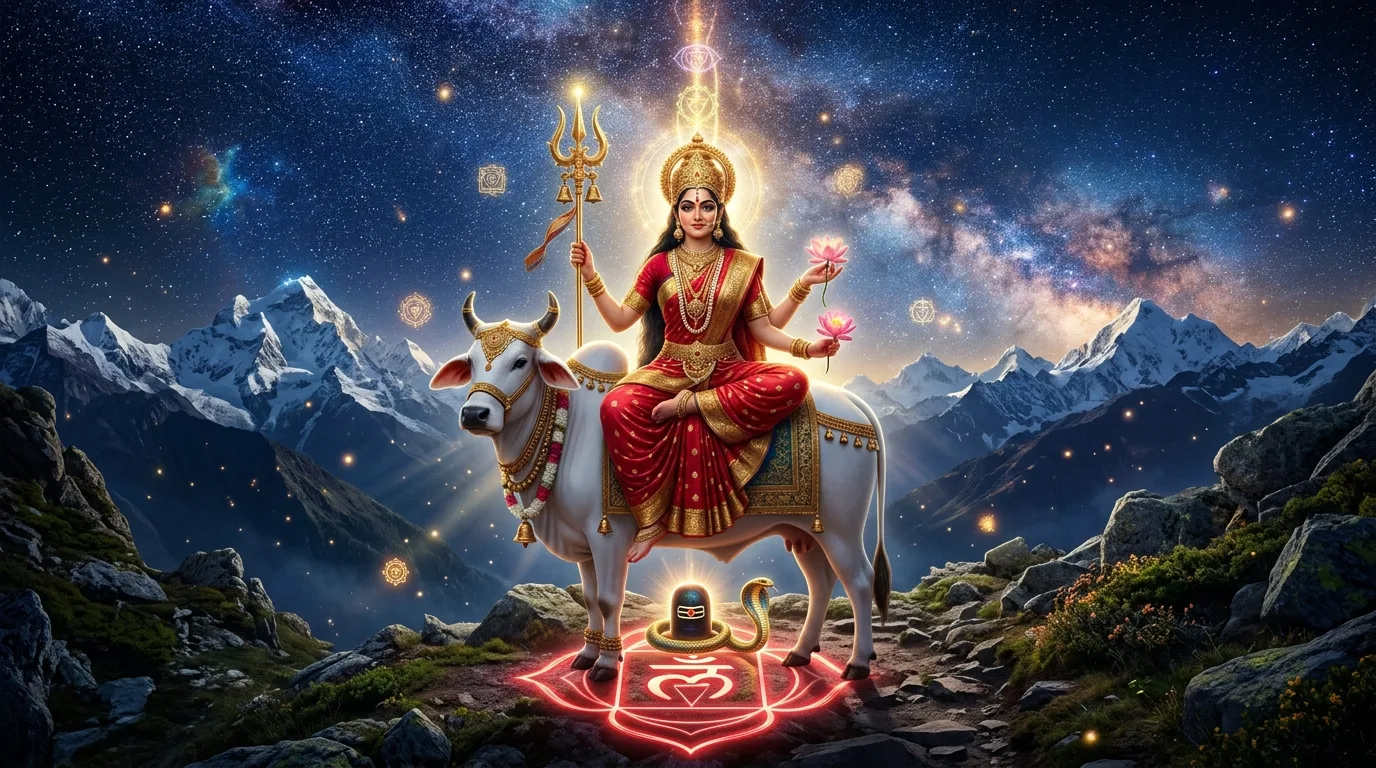
- Vṛṣabhārūḍhā (Mounted upon the Bull / Nandi): The bull represents raw, heavy, instinctual biological power—the animal drives of survival, procreation, physical inertia, and territoriality (Tamas and Rajas). Shailaputrī does not slaughter the bull; She rides it. In Tantra, this signifies the mastery, harness, and conscious direction of biological vitality rather than its neurotic suppression. In the Bhāgavata Purāṇa, the bull is Dharma itself (Catuṣpāda Dharma—Truth, Purity, Compassion, and Steadfastness). Spiritual awakening begins when your animal drives are firmly anchored in cosmic order.
- Śūladharā (Grasping the Trident in Her Right Hand): The trident represents Her absolute dominion over the three primal knots of existence (Tri-Guṇa—Sattva, Rajas, Tamas) and the three dimensions of time. In spinal anatomy, it represents the three primary nadis: Iḍā (cooling, parasympathetic), Piṅgalā (heating, sympathetic), and Suṣumṇā (central channel). By holding the Triśūla, She announces that awakening cannot bypass the dualities of the nervous system; it must pierce straight through them.
- Padmadharā (The Lotus in Her Left Hand): The lotus grows in the darkest, most putrid mud of the lake bed, yet blooms immaculate above the water. Held in Her receptive left hand at the pelvic base, it reveals that mortal biology and physical matter are not dirty; they are the fertile soil from which supreme enlightenment blooms.
- Candrārdha-Kṛtaśekharā (The Crescent Moon on Her Brow): The crescent moon is the vessel of Soma—the cooling nectar of immortal bliss residing at the Sahasrāra. Here is the supreme esoteric paradox: The Earth Goddess of the lowest root chakra wears the emblem of the highest crown chakra on Her head. The Root (Mūlādhāra) and the Crown (Sahasrāra) are intimately bound. You cannot taste the immortal nectar of the crown unless your root is anchored in the mountain.
Key Terms Explained
To understand this scripture with intellectual clarity, we must master its technical Sanskrit terminology:
- Śailaputrī (शैलपुत्री): From Śilā (unyielding rock, lithic bedrock) and Putrī (daughter, kinetic projection). It denotes the kinetic projection of pure consciousness into dense physical reality. It is the name for awareness when it assumes structural mass.
- Mūlādhāra (मूलाधार): A compound of Mūla (root, origin, radix) and Ādhāra (support, vessel, energetic fulcrum). It refers to the four-petaled pelvic lotus at the perineum, governing the transition between subtle prāṇa and physical biology.
- Kuṇḍalinī (कुण्डलिनी): Derived from Kuṇḍala (coiled). In Devī Bhāgavata Purāṇa (7.35.35–42), She is described as the sleeping serpent-power coiled three-and-a-half times around the Svayambhū Liṅga in the perineum, blocking the entrance to the royal central channel (Suṣumṇā / Brahmarandhra).
- Brahmā-Granthi (ब्रह्मग्रन्थि): The "Knot of Brahmā." The first of the three psychic knots in the subtle body (the others being Viṣṇu-Granthi at the heart and Rudra-Granthi at the third eye). Located between Mūlādhāra and Svādhiṣṭhāna, it is the existential knot of biological survival fear, physical bodily attachment (Deha-Adhyāsa), and the paralyzing terror of non-existence. Day One of Navratri is designed entirely to pierce this knot.
- Pṛthvī-Tattva (पृथ्वीतत्त्व): The Earth Element. In Śākta cosmology's 36-tattva schema, it is the final and most condensed tattva, characterized by the quality of smell (Gandha) and the golden square yantra (Caturaśra).
- Vimarśa (विमर्श): The dynamic, self-reflective kinetic aspect of Supreme Consciousness. While Śiva is Prakāśa (pure, static, witnessing light), Devī is Vimarśa (the kinetic mirror-power of self-awareness). Without Vimarśa, Prakāśa is inert, incapable of thought, movement, or creation: "Śivaḥ śaktyā yukto yadi bhavati śaktaḥ prabhavitum..." (Saundarya Laharī, Verse 1).
- Sthiratā (स्थिरता): Absolute psychophysical stability and non-reactivity. The fundamental siddhi of the Mūlādhāra cakra, without which all higher mystical experiences induce neuro-psychiatric imbalance.
Traditional Interpretation
How have classical commentators understood Shailaputrī across centuries of scholastic tradition? The philosophical rigor is breathtaking:
The Śākta Advaita Perspective: Nīlakaṇṭha Caturdhara & Bhāskararāya
- In his definitive commentary on the Devī Bhāgavata Purāṇa, Nīlakaṇṭha Caturdhara interprets the birth of Shailaputrī not as an external mythological fairy tale, but as the moment an individual seeker's consciousness enters the path of genuine discrimination (Viveka). Sati's death represents the failure of external, ego-driven ritualism; Shailaputrī's birth is the consecration of the body as an altar of truth.
- Bhāskararāya Makhin, the legendary 18th-century master of Śrī Vidyā (commenting in Guptavatī on the Durgā Saptaśatī and Saubhāgya Bhāskara on the Lalitā Sahasranāma), links Shailaputrī directly to the sacred name "Kūla-Kuṇḍalinī" (Name 110).
- Bhāskararāya explains that Kula means both "lineage" and "the perineum/Mūlādhāra cakra," while Akula refers to the transcendent Sahasrāra where Lord Śiva resides. Therefore, Shailaputrī is the embodiment of Kaulinī Śakti—the primordial Mother resting inside the mortal bone-structure of humanity. To honor Shailaputrī is to consecrate the physical body as a living Śrī Yantra.
The Nātha and Haṭha Yoga Tradition: The Ṣaṭ-Cakra-Nirūpaṇa
- In the Ṣaṭ-Cakra-Nirūpaṇa (composed by Pūrṇānanda Swāmī, Verses 4–14), the Mūlādhāra is mapped with rigorous geometric precision:
- A crimson lotus of four petals bearing the golden syllables: वं (Vaṁ), शं (Śaṁ), षं (Ṣaṁ), सं (Saṁ).
- Inside it sits the yellow square of the Earth element (Dhātrī-Bīja / Lāṁ), resting upon the seven-trunked elephant Airāvata (symbol of immovable biological mass).
- Inside the square is the inverted red triangle (Traipura Trikōṇa), the womb of the Mother (Kāmarūpa Pīṭha), enclosing the glowing Svayambhū Liṅga.
- For Gorakṣanātha and the Nātha yogis, Shailaputrī is the dormant volcanic fire (Mūlāgni). Day One of Navratri is not for armchair philosophy; it is the day of Āsana Jaya (mastery of physical posture), Mūla Bandha (perineal contraction), and stabilizing the apāna prāṇa. The Nāthas warn: If the root is shaky, any attempt to raise prāṇa will lead to nervous agitation, hysteria, and delusions of grandeur.
The Sāṁkhya-Śākta Synthesis: Nature as Consciousness
Classical Sāṁkhya posited a rigid dualism between Puruṣa (inactive, conscious witness) and Prakṛti (blind, active matter), arguing that Puruṣa must escape nature to achieve liberation. The Devī Bhāgavata Purāṇa thoroughly refutes this dualism. It asserts that Prakṛti is not blind; She is Cidrūpiṇī—Consciousness Itself acting as Nature. Shailaputrī proves this: the mountain (Prakṛti) directly gives birth to Supreme Consciousness (Cit). Nature is Spirit made visible.
How This Connects
The teaching of Shailaputrī connects seamlessly to the grand tapestry of Sanatan Dharma:
1. The Ṛgvedic Devī Sūkta (10.125 - Vāk Ambhṛṇī)
In the oldest hymn to the Divine Feminine in human history, the sage-priestess Vāk proclaims:
"मया सो अन्नमत्ति यो विपश्यति यः प्राणिति य ईं शृणोत्युक्तम्।"
(Mayā so annamatti yo vipaśyati yaḥ prāṇiti ya īṁ śṛṇotyuktam.)
"Through Me alone does anyone eat food, see, breathe, or hear the spoken word."
Notice the radical physical tangibility: eating food, breathing, hearing. Shailaputrī is the direct Puranic continuation of this Vedic revelation. Awakening is not an escape from biology; it is recognizing that every metabolic heartbeat and every gram of matter is the Divine Mother actively operating.
2. The 9-Stage Evolution of the Nava Durgas
The Nava Durgas represent the sequential psychological and spiritual evolution of human consciousness:
- Day 1: Shailaputrī (Mūlādhāra): Biological grounding, somatic safety, piercing survival fear (Brahmā-Granthi).
- Day 2: Brahmacāriṇī (Svādhiṣṭhāna): Ascetic willpower, sublimating creative/sexual energy into spiritual discipline (Tapas).
- Day 3: Candraghaṇṭā (Maṇipūra): Internal digestive fire, conquering emotional reactivity and fear.
- Day 4: Kūṣmāṇḍā (Anāhata): Cosmic heart expansion, radiating unconditional warmth and love.
- Day 5: Skandamātā (Viśuddha): Purification of voice, mastering sonic vibration and spiritual communication.
- Day 6: Kātyāyanī (Ājñā): Intuitive discrimination, destroying intellectual ego (Mahishāsura).
- Day 7: Kālarātri (Sahasrāra / The Void): Dissolution of space-time, the dark void shattering conceptual illusions.
- Day 8: Mahāgaurī (Śuddha-Sattva): The crystalline radiance of non-dual purification and self-realization.
- Day 9: Siddhidātrī (Parā-Mukti): Supreme liberation, where seeker, path, and goal dissolve into one.
You cannot begin at Day 7 or Day 9. To skip Shailaputrī is to build a skyscraper without a foundation.
3. Patañjali's Yoga Sūtras: Conquering Abhiniveśa
In Patañjali's Yoga Sūtras (Sādhana Pāda, Sūtra 2.9), the deepest psychic affliction (Kleśa) is identified as: स्वरसवाही विदुषोऽपि तथारूढोऽभिनिवेशः॥ (Svarasavāhī viduṣo'pi tathārūḍho'bhiniveśaḥ) Abhiniveśa is the instinctive, evolutionary fear of death and extinction that dominates the ignorant and the learned alike. Anchored in the survival circuits of the Mūlādhāra cakra, it can only be uprooted through the mountain-like stability (Sthiratā) of Mā Shailaputrī. When the seeker realizes their physical body is an incarnation of the eternal Mountain Mother, the dread of death dissolves.
4. The Kenopanishad & Skandha 12: The Blade of Grass
In Skandha 12 of the Devī Bhāgavata Purāṇa, the text re-enacts the famous narrative from the Kena Upaniṣad (Third and Fourth Khaṇḍas). After defeating the demons, the gods grew arrogant. Agni boasted he could burn all things; Vāyu boasted he could blow all things away.
Suddenly, a mysterious divine entity (Yakṣa) appeared before them.
- Agni could not scorch a single dry blade of grass placed by the Yakṣa.
- Vāyu could not move the dry blade a single millimeter.
- When Indra raced forward with his lightning bolt, the Yakṣa vanished, and in that absolute void materialized the radiant golden Goddess Umā Haimavatī—Shailaputrī.
She shattered their ego: "You fools. You believe the heat belongs to fire, the motion to wind? I am the kinetic substrate of all existence. Without My baseline presence, the gods are impotent ghosts." The root is the primordial power source that fuels the entire cosmos.
Modern Research or Science
We must firmly reject the sensationalist claim that ancient Rishis had particle accelerators. However, there is a profound structural isomorphism between ancient Śākta physiology and modern clinical neuroscience:
Polyvagal Architecture & Autonomic Survival Circuits
Modern neurobiology (specifically Dr. Stephen Porges' Polyvagal Theory) demonstrates that the human nervous system is hierarchically organized:
- The Dorsal Vagal Complex is the primitive unmyelinated circuit governing immobilization, freeze states, and visceral survival panic.
- The Sympathetic System governs the fight-or-flight mechanism.
- Only when the lower nervous system perceives visceral safety can the Ventral Vagal Complex activate, enabling social engagement, empathy, higher abstract thinking, and contemplative peace.
The Mūlādhāra cakra corresponds precisely to the pelvic-sacral plexus, pudendal nerves, pelvic splanchnic nerves, and adrenal survival feedback loops. When the Devī Bhāgavata Purāṇa commands the seeker to dedicate Day One to Shailaputrī, it describes what clinical neuroscience calls somatic grounding and nervous system down-regulation. A person living in chronic cortisol-fueled survival anxiety cannot meditate on higher non-duality; their biology interprets silence as a predatory threat. Shailaputrī establishes biological safety.
Thermodynamics: Vacuum Ground-State Energy
In quantum field theory, the "ground state" (Vacuum state) is the lowest possible energy state a physical system can occupy. It is not empty voidness, but a dense field of immense potentiality where virtual particles continuously fluctuate. Śākta cosmology conceptualizes Pṛthvī-Tattva and Shailaputrī not as inert dirt, but as the cosmic ground state of consciousness. Just as mass is condensed energy ( = mc^2$), Matter in the Devī Bhāgavata Purāṇa is condensed Awareness (Cid-Ghana).
Where the Comparison Holds, and Where It Doesn't
To maintain absolute intellectual honesty, we must establish clear boundaries between ancient teachings and modern science:
Where the Comparison Holds
- The Neuro-Somatic Reality: The parallel between the Mūlādhāra cakra and the pelvic-sacral autonomic nervous system is functional and clinically observable. A dysregulated, terrified nervous system cannot enter deep meditative states. Ancient Tantra and modern psychology agree: somatic grounding must precede spiritual transcendence.
- The Hierarchical Necessity: The principle that higher contemplative states require prior somatic grounding is validated by neurobiology. Forcing altered states while biologically dysregulated leads to anxiety, depersonalization, and psychic fragmentation.
Where the Comparison Breaks Down
- Subtle Energy vs. Physical Nerves: Mūlādhāra is a subtle energetic construct (Sūkṣma Śarīra), experienced subjectively through meditative awareness. It is not an anatomical organ that a surgeon can extract. It correlates with the pelvic-sacral plexus, but is not identical to physical nerve tissue.
- Evolutionary Biology vs. Ontological Metaphysics: Polyvagal theory explains how mammalian biology adapted to survive physical predators. Śākta Tantra explains how Divine Consciousness intentionally condenses into matter. One is evolutionary biology; the other is metaphysical ontology.
- Debunking Internet Sensationalism: The video script used dramatic metaphors like "high-voltage electricity blowing your fuses." This is a brilliant rhetorical device for describing psychological overwhelm, but it is not literal electrical engineering. The human body does not run on 220V household electricity, and Kundalini is not measured in amperes. Ancient texts do not claim Rishis built particle colliders. Treating poetic parallels as literal scientific proofs damages the credibility of Sanatan Dharma.
Frequently Asked Questions
1. Why is it dangerous to try opening the Crown Chakra (Sahasrāra) first?
Attempting to force open higher energy centers without grounding bypasses the nervous system's safety mechanisms. The sudden surge of unintegrated prāṇa overstimulates cognitive centers while the body remains in subconscious survival fear. This frequently triggers acute anxiety, insomnia, severe depersonalization, and emotional fragmentation.
2. What does Mā Shailaputrī riding a bull symbolize?
The bull represents raw, heavy biological instincts—survival drives, sexuality, physical inertia, and animal power. Instead of violently suppressing these primal energies, Mā Shailaputrī mounts and steers the bull. Spiritual evolution does not involve hating biological nature; it requires taming and anchoring animal vitality upon the bedrock of Dharma.
3. What is the Brahmā-Granthi and how do I know if it is blocked?
The Brahmā-Granthi is the psychic knot between the root and pelvic chakras, governing existential survival terror and bodily attachment. When tightly bound, an individual lives in perpetual fight-or-flight: suffering from chronic financial panic, hypochondria, fear of the future, restlessness, and an inability to sit in silence. Piercing it brings profound inner security.
4. How can a modern seeker practically practice the grounding of Day One?
On Day One of Navratri:
- Sit upon the floor in a stable, motionless posture (Sthirāsana).
- Bring awareness to the base of your pelvis, feeling the heavy pull of earth's gravity.
- Breathe deeply into the pelvic floor, consciously releasing muscular tension.
- Chant the earth seed-syllable LAṀ (लं) while visualizing the unyielding Mountain Mother anchoring your mortal cells into stillness.
Sources
- Śrīmad Devī Bhāgavata Purāṇa: Skandha 7, Adhyāyas 31–40 (Devī Gītā); Skandha 3, Adhyāyas 3–7; Skandha 12.
- Mārkaṇḍeya Purāṇa / Durgā Saptaśatī: Devī Kavacam and Dhyāna Śloka of Mā Shailaputrī.
- Ṣaṭ-Cakra-Nirūpaṇa: By Pūrṇānanda Swāmī (Verses 4–14, mapping the Mūlādhāra cakra).
- Kena Upaniṣad: Third and Fourth Khaṇḍas (The narrative of the Yakṣa and Umā Haimavatī).
- Ṛgveda Saṁhitā: Maṇḍala 10, Sūkta 125 (Devī Sūkta / Vāk Ambhṛṇī Sūkta).
- Patañjali Yoga Sūtras: Sādhana Pāda, Sūtra 2.9 (The concept of Abhiniveśa).
- Commentaries: Guptavatī and Saubhāgya Bhāskara by Bhāskararāya Makhin; Śrīmad Devī Bhāgavata Ṭīkā by Nīlakaṇṭha Caturdhara.
- Modern Neuroscience: The Polyvagal Theory: Neurophysiological Foundations of Emotions, Attachment, Communication, and Self-regulation by Dr. Stephen W. Porges (2011).
This reflects what the text itself says; the modern-science comparisons above are interpretation, not an established finding.