The Real Bhavishya Purana: What It Actually Teaches About the Future and the Sun
Drafted with the help of AI from the original texts named in the article; I read and correct every article after it is published. How we use AI

Beyond internet myths about Queen Victoria, discover what the Bhavishya Purana actually teaches about memory loss, degraded food, and the solar antidote.
In this article
- The Colonial Tampering Behind the Internet Myths
- What the Authentic Text Actually Teaches
- The Great Surprise: Why a Book of the Future is a Solar Text
- The Story of Samba and Universal Light
- Key Sanskrit Terms and What They Mean
- How Classical Commentators Understood the Text
- Connections Across Sanatan Dharma
- What Modern Research Shows About These Themes
- Where the Comparisons Hold, and Where They Do Not
- Frequently Asked Questions
- Sources
If you have spent even ten minutes searching for the Bhavishya Purana on the internet, you have probably run into bizarre claims. Websites and social media videos routinely insist that ancient sages sat down thousands of years ago and explicitly predicted Queen Victoria, the British Parliament, Jesus of Nazareth, or Napoleon.
When I first encountered those claims years ago, something felt completely off. Why would a sacred Sanskrit text care about nineteenth-century British administrative politics?
When you bypass the clickbait and sit down with the actual palm-leaf manuscripts and authentic editions, you discover that the real Bhavishya Purana is something entirely different. It is not a cheap fortune-telling manual. It is a rigorous exploration of time, human psychology, environmental decay, and above all, the healing power of the Sun.
The Colonial Tampering Behind the Internet Myths
To understand the Bhavishya Purana honestly, we have to clear away the historical clutter first. The text that circulates on popular websites contains four broad books: Brahma Parva, Madhyama Parva, Pratisarga Parva, and Uttara Parva.
The bizarre references to foreign monarchs and modern history appear exclusively in the third and fourth sections of the Pratisarga Parva. For more than a century, serious Sanskrit philologists and historians, including Theodor Aufrecht, Moriz Winternitz, and notably Dr. R.C. Hazra, have demonstrated that these specific chapters were inserted during the late eighteenth and nineteenth centuries.
During the British colonial period, local scribes and scholars were engaged in active debates with British East India Company officials and Christian missionaries. Scribes wrote recent history backwards into Sanskrit verse to show that their texts were not silent on current affairs.
Accepting these colonial additions as ancient prophecy damages the credibility of Sanatan Dharma. The authentic ancient core of the Bhavishya Purana is proven by historical records to be very old. The Apastamba Dharmasutra, a legal text dated to around the third or fourth century BCE, explicitly quotes an earlier version of the text with the words iti bhavishyat-purane.
The real, ancient scripture is not interested in Victorian politics. It focuses on how human attention, memory, food, and social harmony change across long cycles of time.
What the Authentic Text Actually Teaches
The true philosophical heart of the Bhavishya Purana sits in its earliest book, the Brahma Parva, along with the ethical discourses of the Uttara Parva. Here, the framing is a calm discussion between King Satanika, the grandson of Janamejaya, and Sage Sumantu, who was a disciple of Maharshi Vyasa and Jaimini.
In this authentic text, prophecy is not presented as magic. The future is treated as a natural outcome of human choices, governed by kala-parinama, which means the transformation of life across time. Just as an unpicked fruit naturally softens and then rots through the steady heat of the air, human cultures also change according to the habits they cultivate.
The text outlines four specific ways that human life decays as society moves into a dark age:
The first change is the decay of language. The text calls this mlecchita-vak. Words gradually lose their depth and precision. Speech stops being a search for truth and turns into a commercial tool, used to deceive, flatter, or create bitter arguments. People produce endless talk, but genuine understanding drops to almost zero.
The second change is the collapse of living memory, described as smriti-bhransha. Sage Sumantu warns that future human beings will have a contracted mental bandwidth. They will struggle to hold complex, connected ideas in their heads. Instead of possessing knowledge inside themselves, they will rely completely on external mechanical tools to remember and calculate for them, mistaking easy access to information for actual wisdom.
The third change is ecological depletion, captured by the phrase nirvirya-aushadhi. The text explains that as human greed strips the natural world, the earth loses its core vitality. Crops and healing plants will still grow and produce physical bulk, but their inner nutritional and medicinal potency will dry up. People will eat until their stomachs are full, but their bodies will remain exhausted and restless.
The fourth change is biological agitation and shortened life. The text explains that human lifespan does not drop because of an arbitrary curse. It drops because people live in constant inner worry, which makes breathing rapid and shallow. By disrupting their breath, people burn through their vitality prematurely.
The Great Surprise: Why a Book of the Future is a Solar Text
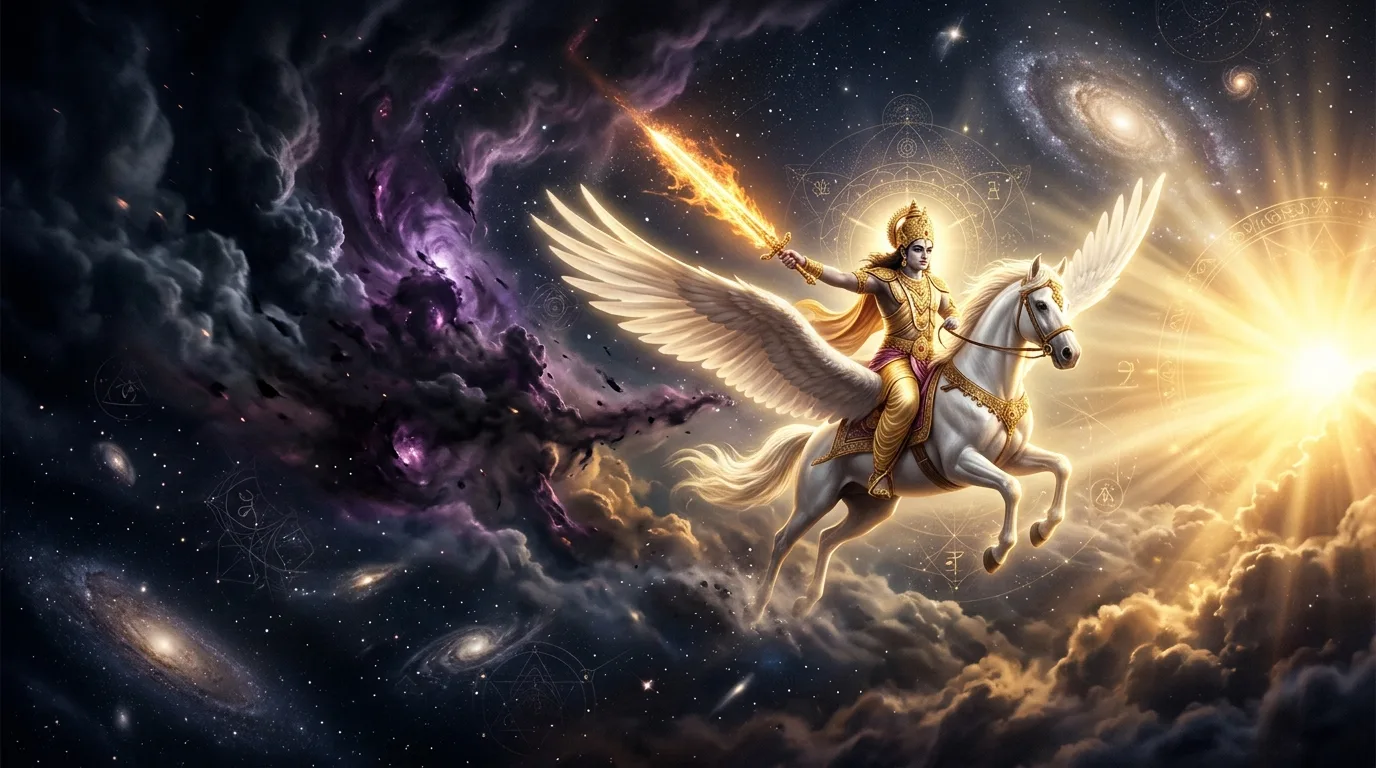
Here is the most striking fact about the Bhavishya Purana that internet summaries never mention: more than half of the entire scripture is dedicated to Surya, the Sun.
Why would a book named after the future spend hundreds of chapters detailing the worship, science, and meditation of the Sun?
King Satanika asks Sage Sumantu a practical question in the opening chapters of the Brahma Parva. He asks what hope exists for ordinary human beings when society breaks down, religious teachers become greedy, rituals are corrupted, and nobody has the mental stillness to study complex philosophy.
Sage Sumantu gives an answer that cuts through religious pretension. He admits that complicated fire rituals and academic debates are fragile. If the wood is bad, if the priest is angry, or if the mantras are mispronounced, the ritual fails.
The sage explains that in a dark age, human beings need an anchor that cannot be corrupted or hoarded. He points straight at the sky.
The Sun cannot be locked inside a temple treasury. It does not ask for money. It shines with identical warmth on a king and a laborer. Most importantly, the text calls the Sun pratyaksha-devata, meaning the divinity you can see directly with your own eyes. You do not need blind belief to know the Sun is real.
The Story of Samba and Universal Light
To drive this point home, the Brahma Parva tells the story of Samba, the son of Krishna. Samba was proud of his handsome appearance and mocked Sage Narada. As a consequence, he developed a severe, debilitating skin disease that the royal physicians could not cure.
Krishna did not tell his son to perform an expensive private ceremony or sit in intellectual debate. He told Samba to leave the palace, travel to the banks of the Candrabhaga river, and spend his days in open-air solar contemplation. Samba bathed in the river, absorbed the morning sunlight, and his body eventually healed.
When Samba decided to build a temple to honor the Sun, the local priests refused to conduct the service because the Sun was not their private family deity. The text says that the Sun appeared to Samba and told him to invite the Maga priests from Shakadvipa.
These Maga priests were solar practitioners from the Iranian plateau who wore a sacred girdle called the avyanga. The text makes an open-minded point here: when local rituals become narrow and commercial, true wisdom seeks out anyone who genuinely understands the universal reality of light.
Key Sanskrit Terms and What They Mean
To appreciate the text, we have to look past casual English translations and examine the original Sanskrit words:
- Kala-Parinama: This compound combines kala, which means time or the measure of duration, and parinama, which means transformation or ripening. In this worldview, time is not an empty background line. It is an active solvent. Every deed, plant, and society ripens and changes its character over time.
- Pratyaksha-Devata: Pratyaksha comes from prati (toward) and aksha (the eye). Most divine concepts in Indian philosophy are paroksha, meaning hidden or subtle, requiring faith or deep meditation. The Sun is pratyaksha because it is visible to sensory perception every single morning.
- Smriti-Bhransha: Smriti is retained memory and constitutional self-awareness, while bhransha means slippage or decay. This does not mean simply forgetting where you put your keys. It refers to losing your grip on your true values and identity, leaving you reactive and easily swayed by ambient noise.
- Nirvirya-Aushadhi: Nir means without, virya means biological potency or vitality, and aushadhi means plants and herbs. It describes food that has mass and calories, but lacks the deeper nourishing qualities needed to support calm nerves.
- Mlecchita-Vak: Mlecchita means corrupted, unrefined, or transactional, and vak means speech. It denotes language that has abandoned truth and clarity in favor of manipulation and superficial noise.
- Kala-Cakra-Pravartaka: This epithet describes the Sun as the prime mover of the wheel of time. The Sun does not merely move through space. Its daily and seasonal cycles create the very rhythm that makes earthly biology possible.
How Classical Commentators Understood the Text
Within the traditional branches of Sanatan Dharma, the Bhavishya Purana held an esteemed place, particularly in the Saura tradition.
Adi Shankaracharya recognized six legitimate pathways of worship, known as the Shanmata. The Saura pathway, dedicated to Surya, considered the Bhavishya Purana its primary authority. Saura thinkers did not look at the Sun as an idol. They viewed the physical star as the visible eye of the supreme consciousness, matching the ancient Upanishadic phrase chakshur devanam.
During the medieval era, great scholars compiled vast legal and ethical encyclopedias known as Nibandhas. Scholars like Hemadri, Lakshmidhara, and Mitra Mishra quoted thousands of lines from the Bhavishya Purana.
Every single verse quoted by these medieval scholars comes from the Brahma Parva and the Uttara Parva. Not a single medieval commentator quoted the bizarre stories about European rulers found in the modern internet versions. This provides clear historical proof that traditional scholars recognized the solar and ethical chapters as the genuine scripture, while the later stories were recognized as recent additions.
Non-dualist thinkers interpreted the solar teachings on an internal level as well. They taught that while the physical Sun warms the body and orders the seasons, it also points to the inner witness within the mind. Puranic realists, on the other hand, insisted that physical sunlight itself is necessary for human health, arguing that you cannot have a clear mind if your biological rhythms are neglected.
Connections Across Sanatan Dharma
The solar philosophy in the Bhavishya Purana does not stand alone. It draws directly from the oldest layers of Vedic literature and echoes across the Epics.
In the Taittiriya Aranyaka of the Krishna Yajur Veda, the Aruna Prashna contains an ancient chant that reveals the same view of the Sun:
चित्रं देवानामुदगादनीकं चक्षुर्मित्रस्य वरुणस्याग्नेः ।
आप्रा द्यावापृथिवी अन्तरिक्षं सूर्य आत्मा जगतस्तस्थुषश्च ॥
The verse declares that the Sun has risen, the eye of Mitra, Varuna, and Agni, filling the sky and earth, standing as the inner soul of everything that moves and everything that stays still. The Bhavishya Purana takes this lofty Vedic hymn and turns it into a daily habit for ordinary people who do not know complex rituals.
The Bhavishya Purana also connects directly with the Bhagavad Gita. In Chapter 11, Verse 32, Krishna reveals his cosmic form and states:
कालोऽस्मि लोकक्षयकृत्प्रवृद्धो लोकान्समाहर्तुमिह प्रवृत्तः ।
He says that he is Time itself, moving forward to dissolve worlds. The Bhavishya Purana provides the everyday details of that sentence. It shows that time dissolves civilizations not through sudden fire, but through slow mental forgetfulness, degraded speech, and poor soil.
You find the same observations in the twelfth canto of the Srimad Bhagavatam and the Vishnu Purana. Both texts warn that in the final age, wealth alone will define respect, physical force will define law, and words will lose their meaning. The Bhavishya Purana adds the biological reason: when human beings live disconnected from the Sun and earth, their nervous systems naturally become anxious and reactive.
What Modern Research Shows About These Themes
When we compare these ancient observations with contemporary research, we find several areas where modern studies observe similar patterns.
The first and clearest parallel is in circadian biology. In 2017, the Nobel Prize in Physiology or Medicine was awarded to Jeffrey C. Hall, Michael Rosbash, and Michael W. Young for identifying the molecular gears that run our internal biological clocks.
Neurobiologists have since mapped out how specialized cells in the human retina, called intrinsically photosensitive retinal ganglion cells, contain a light-sensitive pigment called melanopsin. These cells do not help us see shapes or read books. Instead, they send a direct electrical signal to the suprachiasmatic nucleus, the master clock in the brain.
Early morning sunlight, which carries a specific blend of red, near-infrared, and rising blue light, triggers the morning release of cortisol to wake us up, supports dopamine production for motivation, and starts a countdown timer for melatonin release at night. When people stay indoors under dim lighting all day and stare at glowing screens all night, that biological clock falls out of rhythm. The Bhavishya Purana's insistence on greeting the morning sun every day describes a habit that directly supports this internal pacemaker.
The second area of interest is cognitive offloading. Cognitive scientists, such as Dr. Gloria Mark, have documented that human attention on computer screens has shrunk dramatically over the past two decades, now averaging under a minute before switching tasks.
Research on the phenomenon often called digital amnesia shows that when people know a search engine holds a piece of information, their brains spend less effort committing the underlying concept to memory. This modern observation mirrors the text's description of smriti-bhransha, where external mechanical storage replaces internal cognitive depth.
The third area involves agricultural nutrition. A landmark study led by Donald Davis and published in the Journal of the American College of Nutrition evaluated historical nutrient tables for dozens of garden crops between 1950 and 1999.
The researchers documented statistically significant drops in protein, calcium, phosphorus, iron, riboflavin, and vitamin C across many vegetables and fruits. Modern industrial agriculture often selects crops for rapid growth, shelf life, and cosmetic size, which can dilute the concentration of micronutrients. This real-world trend closely matches what the Purana called nirvirya-aushadhi, where food retains physical volume but carries less vital nourishment.
Where the Comparisons Hold, and Where They Do Not
We must be very precise about where the classical text and modern science meet, and where they do not. Making exaggerated claims harms the reputation of both ancient literature and modern scholarship.
The Bhavishya Purana was not written as a laboratory manual. When Sage Sumantu speaks of time, he is describing a philosophical and moral reality, not the mathematical equations of thermodynamics. While it is true that the text's view of kala-parinama shares the concept of natural decay with the Second Law of Thermodynamics, it is a poetic and structural resonance, not a formal physics proof.
Similarly, we must firmly reject modern internet attempts to link Puranic verses with quantum mechanics. Texts like the Yoga Vasistha explore mental perception and subjective reality in ways that interest philosophers of mind. But the Bhavishya Purana is fundamentally a work of solar realism. Trying to insert quantum terminology into a text about outdoor sunlight and seasonal agriculture only creates confusion.
Most importantly, we must completely discard the claim that ancient sages wrote down nineteenth-century European names. Those verses were written during the colonial period by human scribes. Acknowledging that fact does not diminish the scripture; it protects the dignity of the authentic text, which deals with universal human questions that remain relevant today.
Frequently Asked Questions
Did the Bhavishya Purana predict Queen Victoria or Jesus? No. Those specific lines are found only in the late sections of the Pratisarga Parva. Textual scholars like Dr. R.C. Hazra have proven that these passages were written during the British colonial era. The ancient core of the scripture, especially the Brahma Parva, contains no such references.
Why does the Bhavishya Purana focus so heavily on the Sun? The text argues that as human society grows more divided and confused, complicated rituals and elite institutions become corrupt. The Sun was designated as the visible, uncorrupted reality that belongs equally to everyone, providing a practical foundation for mental and physical stability.
What does the text mean by food losing its vitality? The scripture uses the phrase nirvirya-aushadhi to describe plants that retain their external bulk but lose their subtle nourishing and medicinal strength. This observation closely resembles modern findings regarding micronutrient decline in industrially grown crops.
How does the text suggest we protect our mental focus? The Bhavishya Purana recommends stepping outside, aligning our daily routine with natural daylight, practicing regular morning contemplation of the Sun, keeping speech honest and simple, and avoiding unnecessary mental clutter.
Sources
- Bhavishya Purana, Brahma Parva and Uttara Parva, Venkateshwara Press edition.
- Apastamba Dharmasutra, citing the ancient Bhavishyat Purana.
- Hazra, R.C., Studies in the Puranic Records on Hindu Rites and Customs, Motilal Banarsidass.
- Winternitz, Moriz, A History of Indian Literature, Vol. 1.
- Davis, D. R., Epp, M. D., & Riordan, H. D. (2004). Changes in USDA food composition data for 43 garden crops, 1950 to 1999. Journal of the American College of Nutrition, 23(6), 669-682.
- Hall, J. C., Rosbash, M., & Young, M. W., Nobel Prize in Physiology or Medicine (2017), discoveries of molecular mechanisms controlling the circadian rhythm.
- Sparrow, B., Liu, J., & Wegner, D. M. (2011). Google effects on memory: Cognitive consequences of having information at our fingertips. Science, 333(6043), 776-778.
This reflects what the text itself says; the modern-science comparisons above are interpretation, not an established finding.