When Darkness Attacks the Mind: The Real Meaning of the War with Bhandasura
Drafted with the help of AI from the original texts named in the article; I read and correct every article after it is published. How we use AI
In the Brahmanda Purana, ten avatars emerge from Lalita Devi's fingernails. Here is what the text actually teaches about mind, grief, and inner balance.
In this article
If you have ever gone through a season where grief suddenly turned into bitter anger, or where exhaustion left your mind feeling completely hollowed out, you know how futile it feels when people tell you to just push through it with brute willpower. The harder you fight your own mental fatigue, the tighter it seems to grip you.
Many years ago, when I first came across the description of the battle between Lalita Devi and Bhandasura in the Brahmanda Purana, I thought it was simply another mythological war story filled with flying arrows and colossal armies. That is certainly how popular internet retellings present it. They talk about a demon attacking heaven and the Goddess shooting avatars from her fingernails to finish him off.
When you sit down with the actual Sanskrit verses of chapter 3.29 in the Lalitopakhyana, you realize the text is describing something much more intimate. It is an exploration of how living awareness handles the collapse of order, how destructive habits attack our memory and clarity, and why the deepest healing never happens through violent struggle.
What the Brahmanda Purana Actually Says
The 29th chapter of the third section (Uttarabhaga) of the Brahmanda Purana opens with a conversation between the sage Agastya and Lord Hayagriva, the horse-headed manifestation of divine wisdom. Agastya is not asking about a routine military clash. In verse [3.29.2], he specifically asks about the state of Bhandasura after his two brothers, Vishukra and Vishanga, have been killed by Mantrini and Dandanatha:
श्रीदेव्याः श्रोतुमिच्छामि रणचक्रे पराक्रमम् । सोदरस्यापदं दृष्ट्वा भण्डः किमकरोच्छुचा
śrīdevyāḥ śrotumicchāmi raṇacakre parākramam / sodarasyāpadaṃ dṛṣṭvā bhaṇḍaḥ kimakarocchucā
"I wish to hear of the supreme valor of the Goddess in the mandala of combat. Seeing the ruin of his brothers, what did Bhanda do in his sorrow?"
Agastya deliberately uses the phrase ranacakre, the field of battle as an active energetic circle rather than a flat piece of dirt. Hayagriva responds in verse [3.29.4] that listening to this sacred account cuts away accumulated afflictions and grants inner spiritual faculties starting with Anima.
The Purana then traces the breakdown of Bhandasura with extraordinary psychological realism. The demon does not start by roaring with courage. In verses [3.29.6] and [3.29.7], he collapses into utter despair. Paralyzed by grief, he falls onto the bare earth with his hair disheveled, finding no comfort anywhere. His supreme commander, Kutilaksha, rushes to console him. As his sorrow is stoked, it turns into pure, toxic fury in verse [3.29.8]:
शोकेन युक्तः कोपमवाप सः
śokena yuktaḥ kopamavāpa saḥ
"Joined with deep sorrow, he fell into wild wrath."
The text records his bodily reaction in verses [3.29.9] to [3.29.11]. His brow twists into grotesque knots. His eyes glow red like burning coals. His breath heaves like a coiled black cobra, and he swings his sword, bellowing like a storm cloud at the end of an era. In verses [3.29.12] and [3.29.13], Bhanda makes a bitter vow: he will extinguish the roaring fire of his grief with the blood flowing from the severed throat of that divine woman whose mere glance erased his family.
He straps on hard armor capable of withstanding lightning strikes, as noted in verse [3.29.14], and marches out from his capital city, named Shunyaka, which literally means "The City of the Void." Verse [3.29.21] notes that in that city, only women were left behind. Every active, aggressive impulse of the ego had been marshaled to the front lines.
His army is so vast that the scripture introduces a striking image in verse [3.29.23]. The dust kicked up by their marching boots rises into the sky as if the Earth, crushed by their intolerable weight, were trying to run away into heaven. Verses [3.29.25] and [3.29.26] describe a space that can no longer contain what has been forced into it:
न दिक्षु न च भूचक्रे न व्योमनि च ते ममुः । दुःखदुखेन ते चेलुरन्योन्याश्लेषपीडिताः
na dikṣu na ca bhūcakre na vyomani ca te mamuḥ / duḥkhadukhena te celuranyonyāśleṣapīḍitāḥ
"Neither in the directions, nor on the terrestrial orb, nor in the sky could they fit; they moved with great torment, crushed and suffocated by their own mutual crowding."
His own soldiers get crushed under chariot wheels and trampled by war elephants simply because there is no room left to exist. When Bhandasura unleashes his lion-roar in verses [3.29.28] to [3.29.30], the text says the manifest universe feels as though it is splitting open. Oceans boil, the sun and moon try to flee, stars fall from the sky, the Earth rocks like a cradle, and the guardian elephants of space faint in fear.
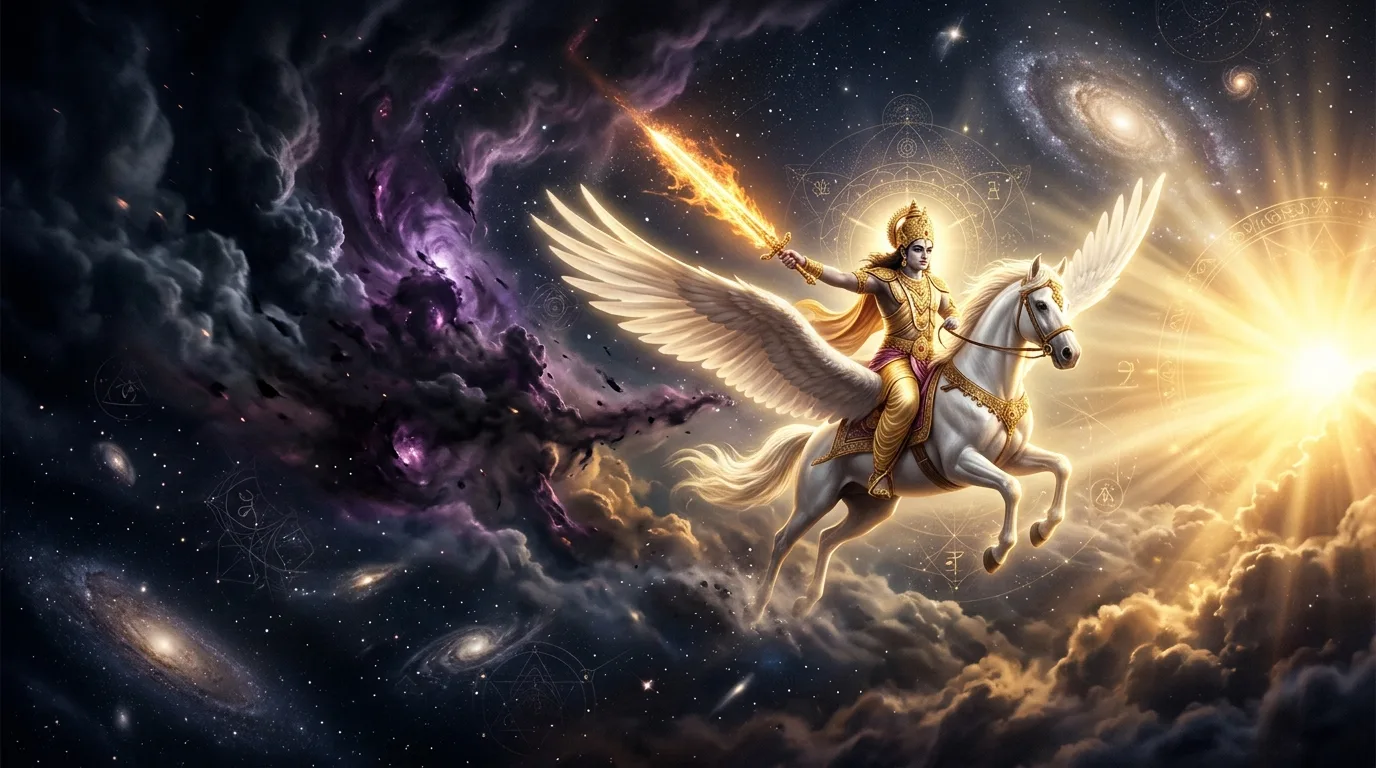
Seeing that none of the subordinate energies can withstand this total pressure, Lalita Devi resolves to step directly onto the field, recorded in verses [3.29.33] and [3.29.34].
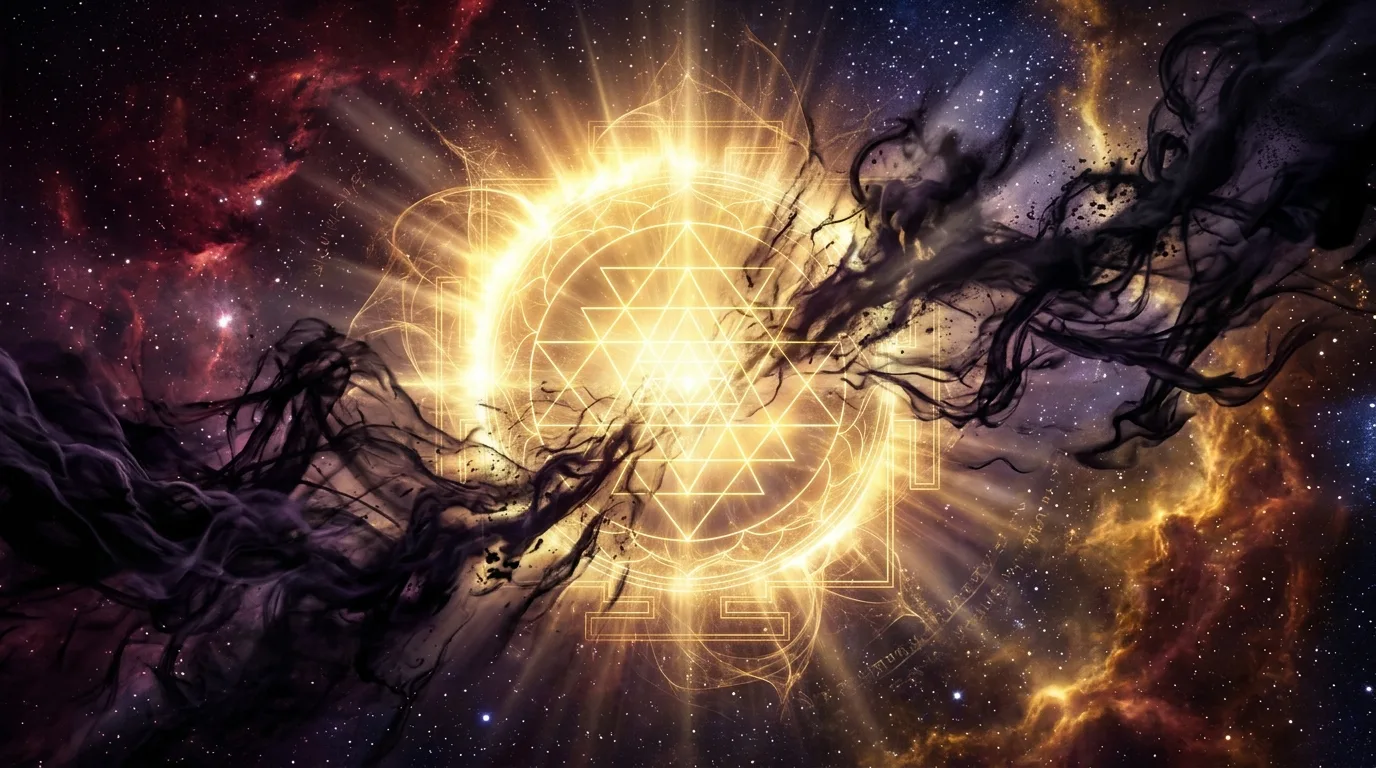
Her vehicle is the Cakraraja Ratha, the living Sri Yantra in active motion. In verse [3.29.35], the chariot is described as moving upon the four Vedas as its great wheels and anchored in the four primary aims of human life: Dharma, Artha, Kama, and Moksha. Verse [3.29.36] states that it has nine distinct tiers (navaparva), directly embodying the nine concentric enclosures of the Sri Cakra. Each tier is manned by guardian deities holding great bows, protected by retinues exceeding a quadrillion in number. According to verse [3.29.38], it stands ten yojanas high and four yojanas wide. It moves flanked by the Geyacakra chariot of Mantrini ahead and the Kiricakra chariot of Dandanatha behind, as detailed in verse [3.29.39].
When millions of divine divisions attempt to pass through the defensive fire-rampart (vahniprakara), the gateway of one yojana is physically far too narrow. In verses [3.29.42] and [3.29.43], the deity Jvalamalinika stretches the fabric of the gateway infinitely wide so the entire army streams through without touching or crowding.
When Bhanda and Lalita clash directly, ordinary physics gives way. In verse [3.29.59], when the Goddess draws her bow, a single arrow loaded on the string becomes ten as it leaves the bow, turns into a hundred in mid-air, expands to a thousand as it enters the opposing lines, and strikes the enemy as tens of millions of razor-sharp points.
Bhandasura then releases twelve metaphysical weapons designed to degrade and dissolve consciousness. Lalita counters every single one not with violence, but with an awakening antidote:
First, Bhanda fires Andhatamisraka, the weapon of blinding delusion and pitch darkness. Lalita dissolves it with Mahataranibana, the great solar arrow of radiant light, in verse [3.29.62].
Second, he launches Pakhandastra, the weapon of hypocrisy and dishonest doctrines. Lalita counters it with Gayatryastra, the weapon of the solar Gayatri mantra, in verse [3.29.63].
Third, he unleashes Andhastra, which destroys inner perception. She meets it with Cakshushmata-mahastra, the weapon of clear inner vision, in verse [3.29.64].
Fourth, he sends Shaktinashastra, which drains primal vitality and spiritual energy. She neutralizes it with Vishvavasor-astra in verse [3.29.65].
Fifth, he shoots Antakastra, the weapon of temporal death and destruction. She dissolves it with the Mahamrityunjayastra in verse [3.29.66].
Sixth, he fires Sarvastrasmritinashastra, a weapon that erases memory, sacred mantras, and learned skills from the mind. Lalita counters it with Dharanastra, the weapon of unbroken meditative concentration and mental retention, in verse [3.29.67].
Seventh, he sends Bhayastra, the weapon of existential dread and panic. She meets it with the Abhayankara-aindrastra, the weapon of pure fearlessness, in verse [3.29.68].
Eighth, he fires Maharogastra, which infects the armies with wasting consumption (Rajayakshma) and thousands of acute physical illnesses. Lalita releases the Namatraya Mahamantra Mahastra in verses [3.29.69] to [3.29.72]. From this arrow emerge three divine forms embodying the names Acyuta, Ananta, and Govinda. With a single sacred sound of hum, they burn away the diseases, bring joy to the exhausted hosts, and are appointed across the three worlds to protect all future seekers from physical sickness.
Ninth, he releases Ayurnashanastra, the weapon that drains lifespan. She absorbs it with Kalasankarshani-rupam astra, the form of transcendent time, in verse [3.29.73].
Tenth, Bhanda launches Mahasurastra in verses [3.29.74] to [3.29.77]. This weapon conjures the historical phantoms of past Kalpas: Madhu, Kaitabha, Mahishasura, Dhumralocana, Canda, Munda, Cikshubha, Camara, Raktabija, Shumbha, Nishumbha, and the Kalakeyas. As the divine hosts cry out in fear, Lalita lets out an immense laugh of wrath in verse [3.29.79]. From that sound arises Durga Narayani, armed with the collected weapons of all the gods. Exactly as told in the Candika-saptasati (Devi Mahatmya), she destroys the demonic host and bows before Lalita, recorded in verses [3.29.80] to [3.29.88].
Eleventh, he fires Mukastra, which induces muteness and intellectual paralysis. She dissolves it with Mahavagvadini-astra, the power of articulate, creative speech, in verse [3.29.89].
Twelfth, Bhanda generates Veda-taskaras, thieves who plunder sacred wisdom. Lalita flicks her right thumb fingernail and dismisses them into nothingness in verses [3.29.90] and [3.29.91].
This brings the battle to its famous climax: the emanation of the Ten Avatars from the fingernails of Lalita Devi, chronicled across verses [3.29.91] to [3.29.135]. As Bhanda summons the darkest cosmic forces of history, the Goddess meets each one by releasing a form of Vishnu from her fingertips:
| Hand and Fingernail | Asuric Weapon / Demon Host | Manifested Avatar |
|---|---|---|
| Right Index (dakṣahastatarjanī) | Arnavastra (Cosmic deluge submerging creation) | Adi Kurma (Primordial Tortoise drinking up the deluge) |
| Right Middle (dakṣahastamadhyamā) | Hairanyakshastra (Legions of Hiranyakshas) | Maha-Varaha (White Boar tearing through the demons) |
| Right Ring (dakṣahastānāmikā) | Crores of Hiranyakashipus attacking child Prahlada | Narasimha (With blazing eyes and diamond claws) |
| Right Little (dakṣahastakaniṣṭhā) | Balindrastra (Forces of Bali) | Vamana (Expanding continuously and holding nooses) |
| Left Thumb (vāmahastāṅguṣṭha) | Haihayastra (Thousand-armed Kartavirya Arjunas) | Parashurama (Roaring with his raised battle-axe) |
| Left Index (vāmahastatarjanī) | Ravana, Kumbhakarna, and Meghanada | Kodanda Rama and Lakshmana (Armed with bow and arrows) |
| Left Middle (vāmahastamadhyamā) | Dvividastra (Legions of wild, fiery-eyed simians) | Balarama (Adorned in indigo robes with his plow) |
| Left Ring (vāmahastānāmikā) | Rajasurastra (Corrupt kings: Shishupala, Kamsa, etc.) | Sanatana Vasudeva (Unfolding the fourfold Caturvyuha) |
| Left Little (vāmahastakaniṣṭhā) | Kalyastra (Total moral decay, chaos, and confusion) | Kalki Janardana (Mounted on a blazing white steed) |
Among these verses, verse [3.29.100] holds a profound disclosure about Prahlada: yaḥ prahlādo 'sti śaktīnāṃ paramānandalakṣaṇaḥ. Prahlada is revealed not merely as an ancient prince, but as the living embodiment of supreme spiritual joy within the heart of the seeker. Material greed and ego (Hiranya) constantly seek to crush this inner innocence, prompting the sudden, roaring intervention of Narasimha.
Finally, when Bhanda unleashes the Kalyastra in verses [3.29.130] to [3.29.132], bringing forth moral decay, violators of truth, and cruel rulers who oppress life, Lalita releases Kalki from her left little fingernail. Kalki laughs with the sound of thunder. That roar alone dissolves the chaotic mass into non-existence, returning peace to the universe.
Key Sanskrit Terms Explained
When reading these verses, translation often flattens the rich technical meaning behind the Sanskrit words. The text chooses its terms with deliberate care:
Shunyaka [3.29.21]: This is the name of Bhandasura's capital city. Literally, it means "The City of the Void" or "Absolute Nullity." In Tantric thought, Bhandasura does not represent ordinary physical evil. He represents the frozen ego that views reality as devoid of divine consciousness. When verse [3.29.21] notes that only women were left in Shunyaka, it indicates that the outward, aggressive projections of the void had all been dragged into the open conflict, leaving behind only the passive, unmanifest root of nothingness.
Cakrarajaratha [3.29.35, 3.29.38]: This compound translates to "The Royal Chariot of the King of Mandalas." It refers to the Sri Yantra, but not as a static diagram drawn on a sheet of copper. Here, it is described as a mobile citadel moving through dimensional space. Its forward movement represents the shift of still, unmanifest awareness (Prakasha) into dynamic, world-ordering action (Vimarsha).
Navaparva [3.29.36]: Meaning "possessing nine tiers or stages." In Sri Vidya, both the external universe and the human nervous system are understood to be organized across nine distinct levels. In the text, each of these nine tiers is occupied by guardian deities drawing massive bows, showing that every level of consciousness has its own active defense mechanism against psychological decay.
Sarvastrasmritinashastra and Dharanastra [3.29.67]: Bhanda fires a weapon named Smriti-nasha, which means the destruction of memory and mental retention. It wipes away the recollection of sacred mantras and practical skills. Lalita counters it not with fire, but with Dharanastra. In classical yoga, Dharana is the power of unbroken mental focus, holding the mind steady on a single point. The text is showing us that mental amnesia cannot be cured by agitation; it can only be restored through the steadying power of meditative stillness.
Namatraya-mahamantra-mahastra [3.29.70]: The great weapon composed of the three sacred names: Acyuta (He who never falls from truth), Ananta (The Infinite), and Govinda (The Protector of the senses and light). In verse [3.29.71], these names do not remain abstract words on a page. They manifest as conscious energies that incinerate disease with a single syllable, establishing the ancient canonical link between divine sound and physical healing.
Paramanandalakshanah [3.29.100]: The text uses this phrase to define Prahlada: "He whose intrinsic quality is supreme bliss." By explicitly identifying Prahlada with unconditioned joy, the Purana reveals the inner meaning of the conflict. The demonic forces of greed and pride always target our capacity for joy.
Caturvyuha [3.29.127]: The ancient doctrine of the fourfold divine emanation: Vasudeva (transcendent consciousness), Sankarshana (vital strength and ego), Pradyumna (the cosmic mind), and Aniruddha (the sensory intellect). When Krishna emerges from Lalita's fingernail, he immediately expands into this fourfold matrix to restore balance on Earth.
Kalyastra [3.29.130]: The weapon of the Kali age, described as dharma-viplavakam, that which washes away and drowns righteous order. It does not kill with fire; it corrupts human character, promotes cruelty toward living creatures (pranihimsakah), and breaks down ethical discernment.
Traditional Interpretation
How did traditional scholars understand this dramatic passage? Did they view it as a sectarian claim that the Goddess is superior to Vishnu?
The most authoritative commentary on this subject comes from Bhaskararaya Makhin, the brilliant eighteenth-century philosopher and master of Sri Vidya. In his work Saubhagyabhaskara, which comments on the Lalita Sahasranama, he examines name 80: Karanguli-nakhotpanna-narayana-dasakritih ("She from whose fingernails arise the ten forms of Narayana").
Bhaskararaya addresses the sectarian question directly and answers with a clear no. In the non-dual view of Sri Vidya, ultimate reality is one unbroken consciousness. When that awareness wishes to sustain the universe, it takes a masculine expression as Narayana or Krishna, and when it acts as the supreme generative matrix, it takes the feminine form of Lalita.
There is no rivalry here. The sustaining power of the cosmos (Sthiti-shakti), represented by Vishnu, is inseparable from the sovereign will and creative power of the Mother.
Traditional commentators also highlight the deliberate symmetry between her two hands:
The right hand represents the solar current, the outward path of cosmic preservation and foundation (Pravritti). That is why the foundational cosmic descents emerge from the right fingers: Kurma who supports the cosmos, Varaha who rescues it from dark depths, Narasimha who protects inner devotion, and Vamana who restores universal balance.
The left hand represents the lunar current, the introspective path of dissolution and inner correction (Nivritti). It releases the avatars that dismantle entrenched social and psychological corruption: Parashurama who humbles arrogant tyrants, Rama who breaks sensory pride, Balarama who calms chaotic passion, Krishna who dissolves systemic oppression, and Kalki who clears civilizational rot.
Why did the author of the Purana choose the fingernails rather than the heart or the womb?
In traditional Indian anatomy, the fingernails (nakha) are made of insensitive, dead tissue at the very edge of the body. You can trim your nails without feeling pain because they sit at the extreme boundary of physical life. The philosophical argument of the Purana is deliberate: if the mere light reflecting off the dead, insensitive edge of her fingernails possesses enough power to manifest the ten great descents of Vishnu and rescue creation across multiple world-cycles, what mind could ever measure the infinite depth of her living heart? It is an argument built from the edge to the center.
In the internal yogic tradition of Sri Vidya, Bhandasura represents the hardened ego (Ahamkara). When human desire is scorched by intellectual austerity without being softened by devotion, the ego retreats into Shunyaka, a state of cynical emptiness and spiritual nihilism. The ten fingernails correspond to the ten indriyas: five organs of perception (eyes, ears, nose, tongue, skin) and five organs of action (hands, feet, speech, elimination, generation). When divine grace touches these ten peripheral instruments, each sensory gate is cleared of distortion and protected by a divine energy.
How This Connects to Other Teachings
This chapter of the Brahmanda Purana is not an isolated story; it draws from the broader current of Sanatan literature:
First, there is a clear and direct connection to the Devi Mahatmya from the Markandeya Purana. When Bhandasura summons ancient demons like Mahishasura and Raktabija in verses [3.29.74] to [3.29.77], the Brahmanda Purana explicitly references the older scripture by name:
चण्डिकासप्तशत्यां तु यथा कर्म पुराकरोत् । तथैव समरञ्चक्रे महिषादिमदापहम्
caṇḍikāsaptaśatyāṃ tu yathā karma purākarot / tathaiva samarañcakre mahiṣādimadāpaham
"Just as she acted formerly in the Candika-saptasati, even so she fought here, removing the pride of Mahisha and the rest."
The text names the Candika-saptasati directly in verse [3.29.87]. It shows Durga Narayani emerging with the identical weapons given to her by the gods in that earlier scripture. The Puranic tradition views all previous manifestations of the divine feminine as living patterns within one supreme consciousness, ready to reappear whenever the same darkness returns.
Second, this passage provides the structural mechanism for the famous promise made in the Bhagavad Gita (4.7-4.8). When Krishna tells Arjuna that he manifests age after age whenever righteousness declines, the Brahmanda Purana illustrates how that restorative power is generated. The divine descent is not a historical coincidence; it is the natural, systemic response of cosmic intelligence to specific forms of disorder.
Third, verses [3.29.69] to [3.29.72] tell a story in the same spirit as one of the best-known healing verses of the Vaishnava tradition. The verse itself is not in this chapter: it is found in the Narada Purana 1.34.61, and its first line also appears in the Padma Purana 6.78.53:
अच्युतानन्तगोविन्दनामोच्चारणभेषजात् । नश्यन्ति सकला रोगाः सत्यं सत्यं वदाम्यहम्
acyutānantagovindanāmoccāraṇabheṣajāt / naśyanti sakalā rogāḥ satyaṃ satyaṃ vadāmyaham
"By the medicine of chanting the names Acyuta, Ananta, and Govinda, all diseases are destroyed; this I declare as the absolute truth."
The Brahmanda Purana tells a story in the same spirit. In this chapter, the three names come forth as living powers during the battle to neutralize the Maharogastra, and Lalita Devi appoints them across the three worlds to protect her devotees from sickness.
Modern Research and Science
To maintain credibility, we must be completely clear: this chapter does not contain mathematical formulas for quantum mechanics, and it does not describe subatomic particles. Claiming that ancient sages were discussing quarks in fingernails is a modern invention that undermines genuine scholarship.
However, there are two areas of modern thought where the concepts in this chapter share a striking philosophical resonance:
First, in modern information theory and thermodynamics, disorder is understood through the concept of entropy. In 1944, physicist Erwin Schrödinger pointed out in his book What is Life? that a living organism stays alive by continually drawing what he called "negative entropy" (negentropy) from its environment to counteract natural decay. Claude Shannon later showed in information theory that random noise degrades and erases meaningful signals.
When you examine Bhandasura's weapons, they function exactly like informational noise:
- Andhatamisraka degrades visual signal (delusion).
- Sarvastrasmritinashastra erases stored data in the mind (amnesia).
- Mukastra shuts down communication channels (muteness).
- Maharogastra disrupts biological coordination (systemic disease).
- Kalyastra dissolves social and ethical rules (cultural entropy).
Lalita Devi never fights noise by creating more noise. She injects high-density order and structured meaning back into the system: Gayatryastra (the primordial verbal signal), Dharanastra (mental stability), and the Namatraya (harmonious biological sound). The battle is conceptually structured as an encounter between entropic decay and conscious order.
Second, verses [3.29.25] and [3.29.42-43] display an intuitive understanding of flexible spatial boundaries. In ordinary physics, space is a rigid box: if you crowd too many objects into a room, they crush one another, which is exactly what happens to Bhanda's army in verse [3.29.25]. But when the divine hosts need to pass through the one-yojana gateway of the fire-rampart, Jvalamalinika expands the gate infinitely. Space is treated not as a fixed container, but as an elastic medium shaped by conscious intent.
Where the Comparison Holds, and Where It Doesn't
It is essential to draw an honest line between poetic resonance and scientific equivalence.
Where the comparison holds: The Purana accurately diagnoses how psychological and social disorder spreads. The text recognizes that destructive impulses do not build anything new; they only subtract, erase, and confuse. It understands that when human beings are gripped by grief and fear, their mental space shrinks, leading to friction and panic. Its prescription for restoring balance through focused attention (Dharana) and verbal clarity aligns closely with modern cognitive psychology, which shows that chronic stress erases working memory and that mindfulness restores mental coherence.
Where the comparison fails: The text is not doing empirical physics. It does not offer testable physical laws, predictive mathematical models, or laboratory measurements. The expansion of the gateway by Jvalamalinika is a poetic depiction of divine omnipotence, not a treatise on non-Euclidean geometry or general relativity. The emergence of avatars from fingernails is a rich theological metaphor for the ease of cosmic preservation, not an explanation of cellular cloning or quantum entanglement.
Confusing a spiritual insight with physical science does a disservice to both. The Purana is interested in the transformation of human consciousness, and its teachings stand firmly on their own ground without needing forced scientific validation.
Frequently Asked Questions
Did Lalita Devi create Vishnu according to this text?
No. In traditional Sri Vidya philosophy, as explained by commentators like Bhaskararaya, Lalita and Vishnu are non-dual aspects of the same supreme consciousness. Vishnu represents the sustaining power (Sthiti) expressed in masculine form, while Lalita represents the sovereign creative power (Vimarsha) in feminine form. The emergence of the avatars from her fingernails illustrates that cosmic preservation flows effortlessly from divine awareness.
Why is the chant of Acyuta, Ananta, and Govinda linked to curing disease?
In verses [3.29.69] to [3.29.72] of the Brahmanda Purana, Bhandasura fires a weapon that infects the armies with wasting diseases. Lalita counters it by manifesting three divine forms embodying the names Acyuta, Ananta, and Govinda, who incinerate the illness. The scripture records that she stationed these three names across the worlds specifically to heal physical suffering. The well-known verse in praise of these three names as a medicine for all disease is found in the Narada Purana (1.34.61).
What does Prahlada represent in this battle?
In verse [3.29.100], the Purana states that Prahlada represents Paramananda, the natural state of supreme spiritual joy within the seeker. The text explains that the demonic ego, driven by material greed (Hiranya), constantly torments this fragile inner innocence. The appearance of Narasimha from the fingernail represents the fierce, protective intervention of divine awareness to preserve that inner joy.
Why did the avatars emerge from fingernails instead of her hands or heart?
Fingernails consist of dead, insensitive tissue at the outermost boundary of the physical body. By having the ten incarnations emerge from her fingernails, the text uses a powerful metaphor: if the mere peripheral, insensitive edge of the Goddess's awareness can effortlessly generate all the avatars needed to sustain creation across time, her central consciousness is infinite beyond measure.
Sources
- Brahmanda Purana, Uttarabhaga, Lalitopakhyana, Chapter 3.29 (Verses 3.29.1 to 3.29.135).
- Brahmanda Purana: original Sanskrit text
- Bhaskararaya Makhin, Saubhagyabhaskara (Commentary on the Lalita Sahasranama, Name 80).
- Markandeya Purana, Devi Mahatmya (Candika-saptasati).
- Bhagavad Gita, Chapter 4, Verses 7–8.
- Claude Shannon, A Mathematical Theory of Communication (1948).
- Erwin Schrödinger, What is Life? (Cambridge University Press, 1944).
This reflects what the text itself says; the modern-science comparisons above are interpretation, not an established finding.