Ahoi Ashtami: The Ancient Mother's Fast and the Story of the Forest Soil
Drafted with the help of AI from the original texts named in the article; I read and correct every article after it is published. How we use AI
Explore the scriptural origins of Ahoi Ashtami, the story of Syahu Mata from ritual digests, and why mothers fast and offer arghya to the stars.
In this article
- The Story of the Spade and the Seven Cubs
- Key Terms Explained
- How the Commentators and Purāṇas Understand Ahoi
- Offenses Against Animals and the Continuity of Lineage
- The Meaning Behind the Courtyard Rituals
- Animal Grief and Ecological Accountability
- Distinguishing Ethics from Pseudoscience
- Frequently Asked Questions
- Sources
If you grew up in a North Indian home, you have probably seen your mother or grandmother sitting before a courtyard wall painted with red ochre and rice paste a few days before Diwali. On that wall, among drawings of trees, cradles, and the sun, sits a central figure that often surprises people who look closely. It is not an eight-armed goddess riding a tiger. It is a drawing of a hedgehog or Indian crested porcupine, known in traditional households as a Syahu, surrounded by seven little cubs.
A mother fasts all day without water so that her children might have health and a long life. Why would an ancient ritual place a wild, burrowing woodland animal and her litter right at the center of the altar?
Most modern calendar prints replace the animal with a sweet-faced goddess wearing a gold crown. It looks gentle and reassuring. But if you open the older ritual digests, the medieval manuals that priests and families actually consulted, the real story behind this day is far more unsettling, honest, and morally challenging. It is not a story about asking heaven for easy gifts. It is an account of an accidental killing, an animal mother's grief, and the difficult work of moral repair.
The Story of the Spade and the Seven Cubs
The narrative of Ahoi Ashtami is preserved in the traditional collections of vows affiliated with the Bhavishyottara Purana. It was carefully recorded by scholars in ritual digests like Visvanatha Sharma's Vrataraja, Kamalakara Bhatta's Nirnayasindhu from the seventeenth century, and Kashinatha Upadhyaya's eighteenth-century Dharmasindhu.
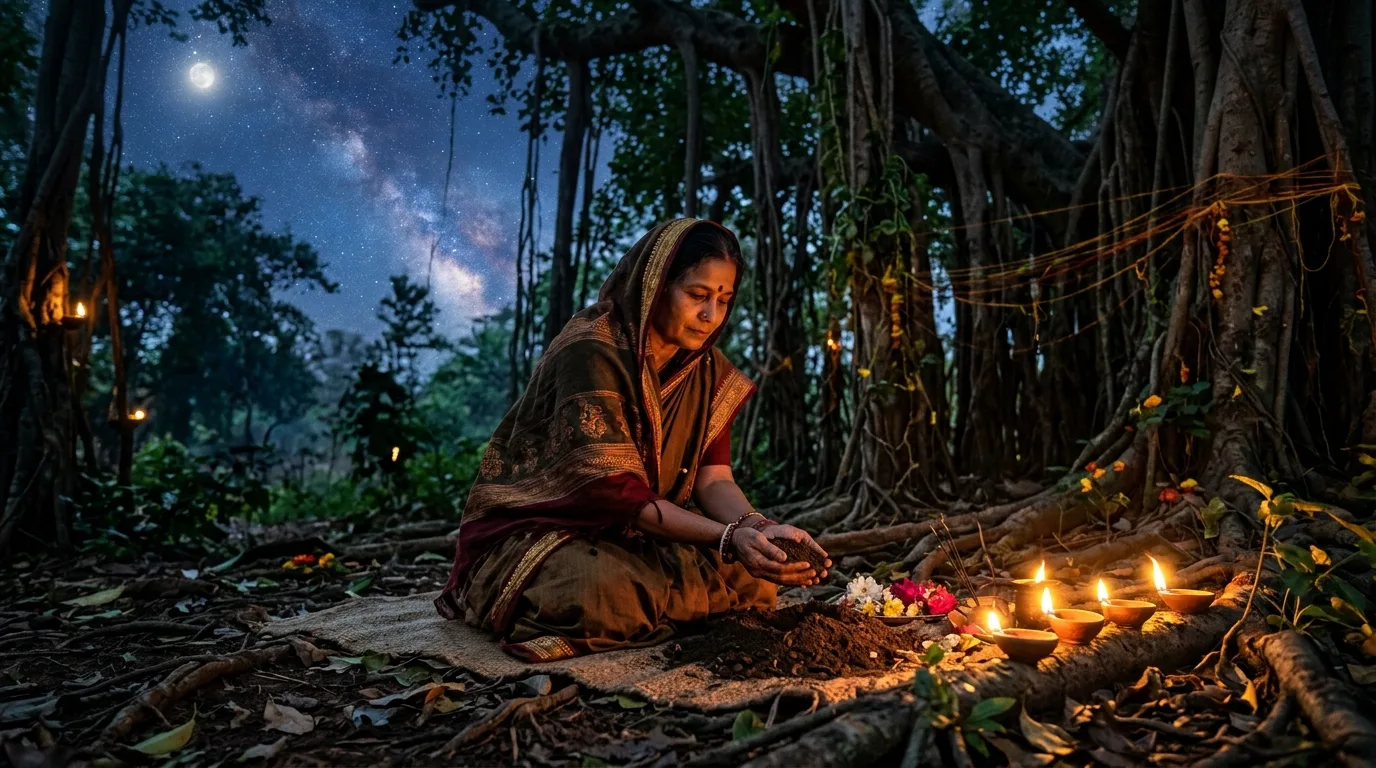
The story begins with a prosperous, devoted woman who lived in an ancient settlement. She was the mother of seven healthy sons. A few days before the festival of Diwali, she set out to prepare her house, exactly as millions of families still do today. In those days, preparing a home meant digging fresh yellow clay from the earth to repair the hearth and plaster the courtyard walls.
She took a small spade and walked to the edge of the forest. Finding a patch of clean yellow soil, she began to dig. She did not know that directly beneath the surface lay the underground den of a Syahu, an Indian crested porcupine. Inside the den were seven newborn cubs, blind and tender, resting while their mother searched for food.
As the woman drove her iron blade into the ground, it cut deep into the burrow. With a few quick strikes, all seven cubs were crushed. When she pulled back the earth, she saw blood on the tool and realized what had happened. Panicking, she dropped her spade and ran home in silence, telling no one.
A little later, the animal mother returned to her burrow. She found her seven young lying in pools of blood, lifeless.
The text describes her anguish not as a mindless animal reflex, but as a tearing maternal grief. Standing over the bodies of her young, she spoke a curse into the air:
"Just as you crushed my womb without mercy and killed my seven infants in a single moment, your own womb will become barren, and your sons will die before your eyes."
Within a year, the curse took shape. One by one, under sudden illnesses and mishaps, all seven of the woman's sons passed away.
Drowning in catastrophic sorrow and broken by guilt, the woman and her husband abandoned their home. They felt their lives were over, and they walked into the forest, intending to starve themselves to death.
While wandering, they met an elderly sage. When the weeping mother explained their intention to die, the sage stopped them. His response forms the theological backbone of the entire festival.
He told them that destroying one's own body is never dharma. Suicide burns no accumulated karma; it merely deepens spiritual confusion. You cannot outrun your past actions by running into the woods. An unintended wound inflicted upon life cannot be erased by self-destruction, but it can be repaired through voluntary penance, genuine remorse, direct service to living creatures, and surrender to the Supreme Mother.
The sage gave her clear instructions. She was to return to her home and begin by serving Surabhi, the cow who represents universal motherhood. She had to cultivate active kindness toward every living creature around her. Then, on the eighth day of the dark half of the month of Kartika, she was to keep a complete, waterless fast.
Most importantly, the sage gave a ritual instruction that remains unique in Hindu tradition. She was not allowed to simply close her eyes and pray to an abstract deity. She was commanded to take red ochre and rice flour, draw the likeness of the porcupine mother and her seven slain cubs on the wall of her house, worship them with humility, beg the animal mother for forgiveness, and offer water to the evening stars.
The woman returned home and did exactly as told. She faced the memory of what she had done, wept with sincere regret, and offered worship to the very creature she had harmed. Moved by her remorse and discipline, Goddess Parvati interceded, the animal mother's anger softened, and the seven sons were restored to life.
The festival takes place on Kartika Krishna Ashtami. In North India, which follows the Purnimanta calendar, this falls in the month of Kartika. In Western and Southern India, following the Amanta calendar, the exact same day is counted as Ashvina Krishna Ashtami. It falls four days after Karwa Chauth and eight days before the new moon of Diwali.
The eighth day of the waning moon has a distinct character in the traditional calendar. The moon is half-eaten by shadow, marking a threshold between fullness and darkness. In the tradition of the Smritis and Tantras, Krishna Ashtami is dedicated to the protective, fierce forms of the Mother and of Shiva. It is considered a time when unseen dangers and sudden calamities can be calmed through discipline.
On this exact same day, the Vaishnava tradition celebrates Bahulashtami, recorded in the Padma Purana and the Hari Bhakti Vilasa. That festival honors Bahula, a cow whose devotion and honesty subdued a hungry tiger. It is also celebrated as the appearance day of Radha Kunda in Mathura, where couples travel even now to take a midnight bath in the sacred pond to pray for children. Both traditions, emerging from different regions and lineages, converge on the exact same moral idea: human life and non-human life share the same sacred fabric.
Key Terms Explained
To understand why this ritual works the way it does, we have to look at the specific technical words the texts use. Translating them into loose English terms like "sin" or "fasting" hides the precision of the original thought.
The first term is Matri-tattva, the principle of motherhood. In the view of the Puranas, motherhood is not just a biological mechanism limited to human beings. It is an active, cosmic principle of nurture, protection, and fierce love that runs through every living creature. The Devi Mahatmya, a central text of the Goddess tradition, states this plainly:
या देवी सर्वभूतेषु मातृरूपेण संस्थिता।
yā devī sarva-bhūteṣu mātṛ-rūpeṇa saṁsthitā
"To the Divine Mother who dwells in all beings in the form of motherhood, salutations again and again."
Because that principle lives in a porcupine as fully as it lives in a human mother, the cosmos responds to an animal's maternal grief with the same weight.
The second concept is Pramada-himsa, which means harm caused by negligence, distraction, or carelessness. It is closely related to Aniccha-papa, an unintended wrong. In classical Indian ethics, there is a clear distinction between deliberate cruelty and accidental harm. If you hurt someone intentionally, your mind is corrupted by malice. But even if you hurt someone without intending to, a real physical rupture has occurred in the living world. You cannot casually dismiss it by saying you did not mean to do it. The earth was broken, living bodies were killed, and that rupture demands conscious repair.
The third term is Pashcattapa. While this is often translated as remorse or repentance, its literal breakdown is far more vivid. It comes from pashcat, meaning after, and tapa, meaning burning heat. It is the internal heat that follows a wrong action. It is not cold, helpless guilt where a person wallows in self-pity. It is a purifying fire inside the conscience where a person stops making excuses, admits what happened, and willingly feels the pain they caused another.
This leads directly into Prayashcitta, commonly translated as expiation or atonement. In the Manusmriti (11.44) and the Mimamsa school of philosophy, the word has a precise definition. Prayas refers to the destruction of accumulated fault, while citta refers to the firm stabilization of the mind. An expiation is not a punishment handed down by a courtroom. It is an intentional, disciplined action you perform to balance a debt and bring your mind back into alignment with dharma.
The festival is also described as having the power of Apamrityu-harana, the averting of untimely death. In classical medicine and astrology, a full, natural human life is thought to be a hundred years. When a life is cut short in childhood or youth due to sudden accidents or severe karmic reactions, it is called apamrityu. Ahoi Ashtami is categorized in ritual digests as a vow specifically undertaken to turn away premature death.
The practices of this day belong largely to Stri-acara, the living traditions maintained by women. In the jurisprudence of Dharmashastra, written texts are not the only source of law. The customs preserved, embodied, and passed down from mother to daughter across generations are recognized as valid and authoritative, often preserving environmental care that formal priestly texts overlook.
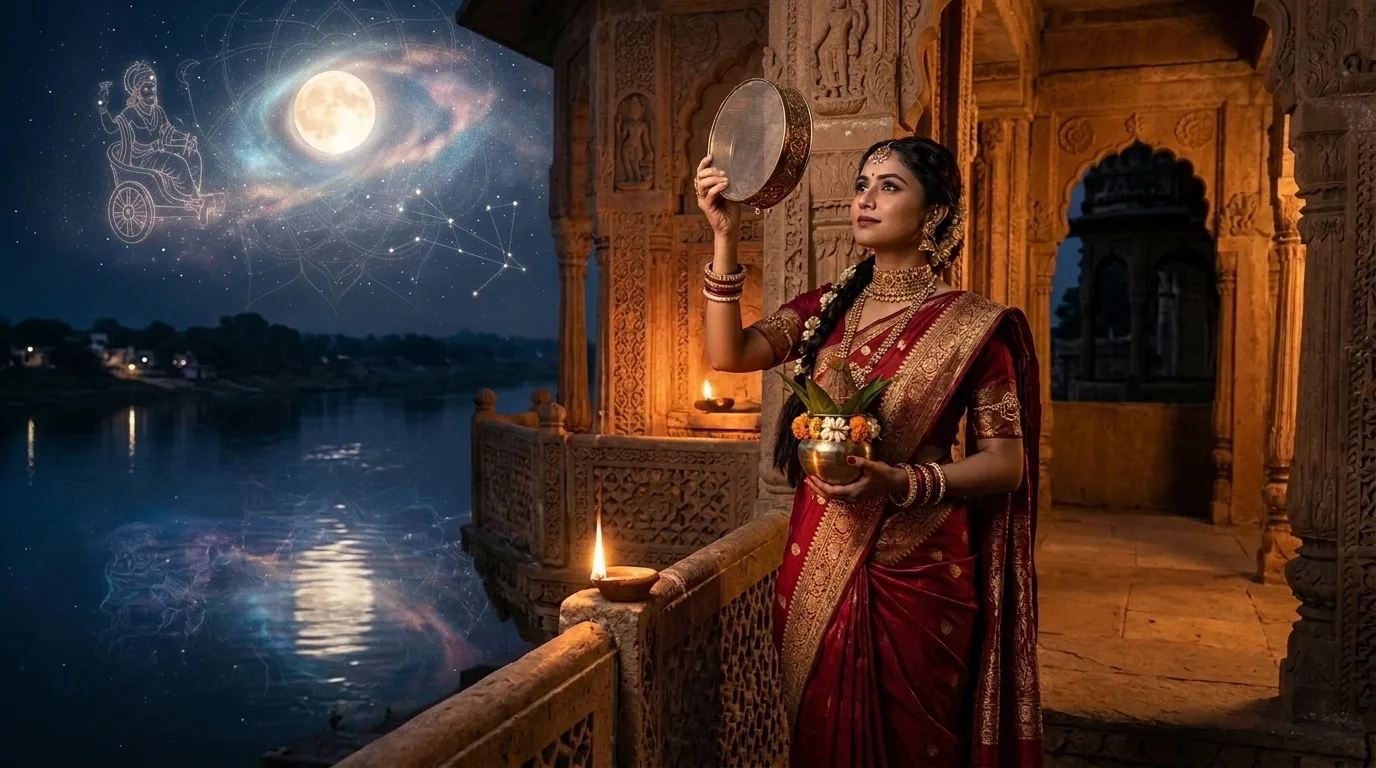
Finally, the fast concludes with Taraka-arghya, the offering of water to the evening stars. The Sanskrit root Tri means to cross over, to save, or to carry across safe to the other side. A star is called a Taraka because it is an unmoving point of light that helps travelers navigate through darkness. Offering water to the stars is an appeal to the constant, unmoving order of the heavens to keep a child safe through the uncertainties of mortal life.
How the Commentators and Purāṇas Understand Ahoi
When the medieval legal commentators wrote down the rules for this day, they looked at it through strict technical lenses.
In both the Nirnayasindhu and the Dharmasindhu, the commentators debate whether to observe the fast on a day when Ashtami touches the previous day (Purvaviddha) or the following day (Paraviddha). Their conclusion is based on a practical rule: because the fast ends with the appearance of the stars at twilight, the vow must be observed on the day when the Ashtami tithi is present during the evening twilight hours, known as Pradoṣa-vyāpinī.
They also classify the nature of the vow. In their terminology, it starts as a Kamya-Vrata, a vow undertaken with a specific desire in mind, which is the long life and safety of children. But they note that once a family begins this practice, it becomes Nitya-vat, meaning it carries the moral weight of an ongoing, obligatory family commitment.
Who is Ahoi Mata herself? You will not find a goddess named "Ahoi" in the ancient Vedic hymns. Classical commentators on the Puranas understand her as a regional manifestation of Parvati, also known as Uma or Gauri.
She has a close scriptural counterpart in Goddess Shashthi, also called Devasena. In the Brahmavaivarta Purana (Prakriti Khanda, Chapter 43) and the Devi Bhagavata Purana (Book 9, Chapter 46), there is a well-known story about King Priyavrata. His newborn child was born dead. In overwhelming sorrow, the king prepared to end his life on the cremation grounds. At that moment, a radiant goddess appeared on a celestial chariot. She identified herself as Devasena, the daughter of Brahma and protector of all infants. She touched the child, bringing him back to life, and spoke these verses:
अपुत्रो लभते पुत्रं दारो लभते प्रियाम्।
मृतवत्सा जीववत्सा भवेद्धर्मिष्ठपूजनात्॥
aputro labhate putraṁ dāro labhate priyām |
mṛtavatsā jīvavatsā bhaved dharmiṣṭha-pūjanāt ||
"The childless obtain a child; a spouse finds harmony; and a mother whose children have repeatedly died will see her offspring live long if she worships me with righteousness."
Ahoi Mata is the living, regional expression of this exact divine protector, honored on the eighth lunar day instead of the sixth.
Linguistically, traditional scholars suggest that the word Ahoi is an informal evolution of the Sanskrit word Akshayini, meaning the one who grants imperishable protection, or Ahata, meaning unhurt and invulnerable. She is Parvati in her identity as Skandamata, the divine mother who sheltered the young god Kartikeya from childhood dangers.
The legal commentators give substantial authority to these women-led customs. In the Nirnayasindhu, Kamalakara Bhatta explicitly affirms that where written codes are silent on specific regional practices, regional custom (Deshacara) and women's customs (Stri-acara) carry genuine authority, provided they remain aligned with truthfulness, non-violence, and devotion. Ahoi Ashtami is an example of women preserving an ethical teaching directly within the domestic sphere.
Offenses Against Animals and the Continuity of Lineage
The idea that harming an animal can damage a human family line is not an isolated folk belief. It appears repeatedly across classical Sanskrit literature.
In the Atharva Veda, the famous Bhumi Sukta (12.1.12) sets the ground rule for human interaction with the soil:
माता भूमिः पुत्रो ऽहं पृथिव्याः।
mātā bhūmiḥ putro 'haṁ pṛthivyāḥ
"The Earth is my mother; I am a child of the soil."
If the earth is a shared mother, every creature burrowing inside it is an equal resident, not an obstacle to be swept aside.
The ancient legal text Manusmriti (3.68–69) explains that every householder commits unintentional violence every day through five unavoidable domestic tools, known as the Panca-suna: the mortar and pestle, the grinding stone, the cooking hearth, the water jar, and the broom. Whenever we grind grain, light a fire, pour water, or sweep a room, unseen microscopic life and tiny crawling insects are killed. To balance this inevitable everyday harm, the text prescribes the five daily sacrifices, which include setting aside food for animals and birds.
Ahoi Ashtami extends this exact logic to the renovation of a house. The mother in the story was not doing anything malicious. She was simply cleaning her home for a festival. Yet, life was crushed beneath her spade.
A direct parallel to this occurs in the opening cantos of Kalidasa's Raghuvamsha. King Dilipa, the ancestor of Lord Rama, finds himself unable to have a child. Troubled, he visits his spiritual teacher, Sage Vasishta, to understand why his line has stopped. The sage reveals that once, while returning from heaven in a hurry, Dilipa walked past Surabhi, the divine cow, without bowing or offering respect. Because he ignored an animal mother in his haste, a curse fell upon him.
Vasishta tells the king that no royal ceremonies or temple offerings will solve the problem. The only remedy is personal, physical service to an animal. Dilipa must live in the forest, follow Surabhi's daughter Nandini wherever she grazes, protect her from predators, sleep when she sleeps, and eat only after she is satisfied. Dilipa carries out this humble service for twenty-one days, even offering his own body to a lion to keep the cow safe. Only after the animal mother is satisfied does she grant the blessing that allows his lineage to continue.
The Mahabharata tells a similar story in the famous account of Savitri (Vana Parva, chapters 293–299). When Yama, the lord of death, comes to take her husband Satyavan, Savitri does not fight him with weapons. She follows him through the dark forest, relying on the quiet strength of her voluntary discipline and moral clarity. Yama is bound by cosmic law and cannot ignore someone anchored in truth, ultimately returning Satyavan to life. In Ahoi Ashtami, the mother uses that same weapon: voluntary discipline (Tapas) to step between her children and untimely death.
In Eastern India, in Bihar, Jharkhand, and parts of Bengal, mothers observe the Jitiya or Jivitputrika fast on the eighth day of the dark half of Ashvina. The narrative there centers on King Jimutavahana, who offers his own flesh to the divine bird Garuda to save the young serpent Shankhacuda and stop the tears of the serpent mother. Whether it is a porcupine in North India, a cow in Kalidasa's poetry, or a serpent in Eastern India, the scriptural lesson is identical: human children can only flourish in a world where human beings respect the young of wild creatures.
The Meaning Behind the Courtyard Rituals
Every action performed on Ahoi Ashtami carries a deliberate meaning that connects back to the original story.
| Ritual Practice | Common Modern Assumption | Scriptural and Traditional Meaning |
|---|---|---|
| Drawing the Syahu and cubs on the wall | Just a traditional decoration for the puja room | Visual Expiation: The worshiper must draw and face the very creature that was harmed, honoring the animal mother on equal footing with the divine. |
| The Silver Syahu Necklace (Chandi ke Dane) | Family jewelry worn for festive occasions | The Mnemonic Rosary: Silver beads added for each child, tethering the memory of mortal fragility to the protective image of the animal mother. |
| Offering Water to the Stars (Taraka-Arghya) | A way to break the fast early before the moon rises | Scriptural Compassion: On the eighth day of the waning moon, the moon rises near midnight. The tradition accepts stars to protect the mother's health while invoking the steady, unmoving order of the heavens (Dhruva). |
| Preserving Water from Karwa Chauth | Convenient re-use of ritual water pots | The Continuity of Vows: Linking the prayer for the spouse with the prayer for children into a single, unbroken stream of household care. |
The silver necklace worn during this puja has a quiet, moving purpose. In traditional families, a silver locket depicting the Syahu is strung on a sacred thread. For every child born into the family, or when a child gets married, two silver beads are added to the necklace. During the puja, the mother holds this necklace in her hands and wears it until Diwali. It serves as an ongoing reminder of the fragility of life.
The practice of offering water to the stars rather than the moon is an example of the practical compassion embedded in Hindu law. On Karwa Chauth, which occurs on the fourth day after the full moon, the moon rises in the mid-evening. But by the eighth day, the waning moon does not rise until close to midnight. Forcing a mother who has had no water all day to wait until midnight would cause physical harm and disrupt her household duties. The tradition recognizes the evening stars as valid celestial representatives. The stars guide the traveler, just as the mother hopes her children will be guided through difficult times.
Animal Grief and Ecological Accountability
When you read the story of the Syahu mother weeping over her crushed den, it feels surprisingly close to modern observations of nature.
In modern environmental thought, the Norwegian philosopher Arne Naess introduced the idea of Deep Ecology. His primary argument was that every living being has intrinsic worth, entirely separate from whether it is useful to human beings. Nature does not exist merely as raw material for our homes, our furniture, or our celebrations.
The story of Ahoi Ashtami makes that exact point. The woman was not clearing the forest to build an empire. She was not hunting for sport. She was simply gathering clay to clean her home for a religious holiday. Yet the story insists that her cultural purpose did not excuse the destruction of an underground home. Human domesticity cannot be built on the unheeded ruin of the creatures living quietly beneath our feet.
In the study of animal behavior, researchers like Frans de Waal, Marc Bekoff, and Jane Goodall have documented for decades that mammals experience deep, lasting distress when their young die. Mothers across many mammalian species show clear signs of mourning: they stop eating, emit vocal cries of distress, carry lifeless infants for days, and display physiological markers of severe stress.
The author of the traditional Ahoi story did not have access to neurology or hormonal measurements. But by observing nature carefully, they recognized a fundamental truth: a mother's grief sounds the same whether it comes from a human throat or an animal den. By building a major festival around an animal's sorrow, the tradition demanded that people acknowledge that emotional reality.
Distinguishing Ethics from Pseudoscience
It is important to be clear about where this comparison makes sense and where it breaks down.
The resonance between this ancient festival and modern knowledge is ethical, psychological, and ecological. The story shows a culture that understood habitat disruption, recognized emotional capacity in wild mammals, and created an active ritual to encourage empathy across species lines.
Where the comparison does not hold is when it comes to physical mechanics. Modern science explains animal mourning through evolutionary biology and brain chemistry. It does not support the idea that an animal's spoken curse can physically stop a human heart, or that drawing an animal on a wall can alter the biological health of children.
We should be especially careful to avoid the pseudoscientific claims that frequently appear on social media around festival seasons. You will sometimes hear claims that waterless fasting on Ashtami reorganizes the DNA of a mother's children, or that porcupine burrows emit a unique electromagnetic frequency that ancient sages measured. These claims are entirely made up. They find no support in the Sanskrit texts, and they find no support in real biology or physics.
The real strength of Ahoi Ashtami does not need fabricated science. Its genuine value lies in its moral honesty. At a time when human development across the world continues to tear through wildlife habitats without a second thought, a festival that asks us to pause, look at the soil, and ask forgiveness from a wild animal mother is both rare and necessary.
Frequently Asked Questions
Why is an animal drawn on the wall during Ahoi Ashtami instead of just a goddess?
The ritual requires visual expiation. According to the foundational story, the human family suffered because an animal mother's cubs were accidentally killed. The tradition insists that you cannot ask God for forgiveness while ignoring the victim you harmed. Drawing the Syahu and her cubs brings the wild animal directly onto the altar, honoring her maternal grief on equal terms with human motherhood.
Why do mothers break their fast after seeing stars instead of waiting for the moon?
On the eighth day of the waning moon, moonrise occurs very late at night, often near midnight. Requiring a mother to fast without water until midnight could cause severe physical weakness. The ritual digests permit mothers to offer water to the first evening stars. The word for star (Taraka) comes from a root that means to protect or guide across, symbolizing steady, protective guidance for children.
Who is Ahoi Mata in classical scripture?
Ahoi Mata is the regional North Indian expression of Goddess Parvati in her nurturing and protective forms. Scripturally, she corresponds to Goddess Shashthi (also known as Devasena) described in the Brahmavaivarta Purana and Devi Bhagavata Purana, who protects infants and restores health to afflicted children. She also represents Parvati as Skandamata, the mother of Kartikeya.
What is the connection between Ahoi Ashtami and Radha Kunda in Mathura?
The exact same day is celebrated as Bahulashtami, honoring the sacred cow Bahula. According to the Padma Purana, this is also the appearance day of Radha Kunda in Vraja. On this night, couples travel to Mathura to take a midnight bath in the sacred waters, praying for the blessing of children. Both observances share the identical ethical foundation of honoring animal motherhood.
Sources
- Bhavishyottara Purana (traditional Vrata-katha recensions)
- Nirnayasindhu by Kamalakara Bhatta (1612 CE)
- Dharmasindhu by Kashinatha Upadhyaya (1790 CE)
- Vrataraja by Visvanatha Sharma
- Manusmriti (Chapters 3 and 11)
- Brahmavaivarta Purana (Prakriti Khanda, Chapter 43)
- Devi Bhagavata Purana (Skandha 9, Chapter 46)
- Kalidasa's Raghuvamsha (Cantos 1 and 2)
- Atharva Veda, Bhumi Sukta (Hymn 12.1)
- Studies in Ethology and Animal Behavior (field observations of mammalian maternal grief by Frans de Waal, Marc Bekoff, and Jane Goodall)
- Principles of Deep Ecology (Arne Naess)
This reflects what the text itself says; the modern-science comparisons above are interpretation, not an established finding.