Karwa Chauth in Classical Scripture: Beyond Bollywood and Folk Tales
Drafted with the help of AI from the original texts named in the article; I read and correct every article after it is published. How we use AI
Discover the real scriptural roots of Karwa Chauth, the story behind the sieve, Savitri's debate with Yama, and what modern research says about fasting vows.
In this article
- What the Classical Texts Actually Say
- Key Terms and Their Precise Meanings
- Traditional Practice Versus Regional Folk Tradition
- How This Connects to the Broader Philosophy of Marriage
- What Modern Research and Science Actually Show
- Where the Comparison Holds, and Where It Falls Apart
- Frequently Asked Questions
- Sources
Every autumn, right around October or November, social media splits into two predictable camps. One side shares glossy clips with film music, bright red clothes, and decorated sieves. The other side calls the entire festival an outdated custom where women go hungry for men who do not return the favor.
If you step away from both camps and open the actual classical texts, you find something entirely different. The Sanskrit treatises do not treat a married woman as a fragile dependent begging for her husband's life.
The original festival, known in classical texts as Karakā Caturthī, is an exercise in deliberate spiritual willpower. It is rooted in deep ethical debates, spousal partnership, and ancient community rituals. To understand what this day really means, we have to look past modern cinema and read the original sources.
What the Classical Texts Actually Say
The festival known today as Karwa Chauth is formally recorded in classical Hindu ritual manuals and legal digests as Karakā Caturthī.
If you want to read the primary rules for this day, you will not find them in short social media posts. You find them in authoritative ritual digests compiled by medieval scholars. The most prominent among these are Bhatta Kamalakara's Nirnayasindhu from 1612 CE, Kashinatha Upadhyaya's Dharmasindhu from 1790 CE, and Vishvanatha Sharma's Vrataraja. These works gathered older material from Purāṇas such as the Skanda Purana (specifically the Nagara and Prabhasa sections), the Vamana Purana, and the Bhavishyottara Purana.
The timing of the festival follows a clear astronomical rhythm. The observance falls on the fourth tithi (Caturthī) of the waning fortnight (Krishna Paksha) of the lunar month.
Depending on where you live in India, the month name on the calendar looks different, even though the actual day is identical:
- In the Purnimanta calendar, used across North India in places like Punjab, Rajasthan, Uttar Pradesh, and Madhya Pradesh, months end on the full moon. Here, the day falls four days after the harvest moon of Sharad Purnima, placing it in the dark half of the month of Kartika.
- In the Amanta calendar, used in Gujarat, Maharashtra, and South India, months end on the new moon. Here, that exact same lunar day is counted in the dark half of the month of Ashvina.
Across the Hindu lunar calendar, the fourth day of every waning fortnight is observed as Sankashti Chaturthi, a fast dedicated to Lord Ganesha, the remover of obstacles. Karakā Caturthī is an elevated, specialized form of Sankashti Chaturthi. The primary deities worshiped on this day are Lord Ganesha, Lord Shiva, Goddess Gauri, Karttikeya, and Chandra, the Moon.
The narrative foundation of this observance appears in the Vrataraja and the Bhavishyottara Purana. The story is set during the twelve-year forest exile of the Pandavas. Arjuna had traveled far into the northern mountains to perform intense meditation and obtain protective weapons from Lord Shiva. Months passed without any news of his safety.
Draupadi became deeply anxious for Arjuna's life and the survival of her family. When Shri Krishna visited their forest dwelling, Draupadi asked him directly:
"O Janardana, by what vow or discipline can a woman shield her household from impending calamity, protect her husband facing distant perils, and restore prosperity to her family?"
Shri Krishna did not hand her a magical charm. Instead, he narrated an older history: Goddess Parvati had once asked Lord Shiva the exact same question when they faced cosmic separation. Shiva instructed Parvati to observe the Karakā Caturthī Vrata on the fourth tithi of the dark half of Kartika. Draupadi undertook the vow with firm resolve, and Arjuna returned safe and victorious.
Behind this ritual formula lies a much larger epic archetype: Savitri in the Mahabharata (found in the Vana Parva, chapters 293 to 299).
While the Pandavas were suffering in the forest, King Yudhishthira asked Sage Markandeya if any woman in history had ever possessed the moral resolve of Draupadi. Markandeya replied by telling the story of Princess Savitri.
Savitri chose to marry Satyavan even though Sage Narada had warned her that Satyavan had only one single year left to live. When the final three days of his life approached, Savitri undertook the Tri-ratra Vrata, an unbroken fast lasting three days and three nights, remaining upright through the entire ordeal.
When Yama, the lord of death and cosmic justice, arrived to carry away Satyavan's soul, Savitri followed him into the subtle realms. She did not beg, weep, or threaten violence. Instead, she engaged Yama in five philosophical debates on cosmic law, the company of the wise, non-injury, and moral integrity.
Yama was deeply impressed by her sharp intellect and righteous discipline. Because universal law bound even him, he granted her successive blessings, eventually restoring Satyavan to mortal life.
This story is the moral foundation of the Indian woman's fast. It is not an act of begging. It is an act of inner discipline and mental strength that stands firm against fear and death.
Key Terms and Their Precise Meanings
When modern articles translate classical Sanskrit terms into English, they often use flat words like "fast," "chastity," or "superstition." These translations strip away the actual meaning of the practice.
Here are the key Sanskrit terms used in the classical texts, explained in their original context:
Vrata The word vrata comes from the root vr, which means to choose, to enclose, or to exercise deliberate conscious will. A vrata is not just hunger. It is an act of personal choice where someone willingly undertakes a physical and mental discipline to quiet their restless mind and fulfill a noble intention.
Sankalpa A sankalpa is the formal statement of purpose made before any sacred practice. On Karva Chauth it asks for the happiness, good fortune and lasting prosperity of the whole family. This declaration turns an ordinary day of going without food into a conscious mental commitment.
Karaka (or Karva) In classical dictionaries and legal texts, a karaka is a small clay or metal pot fitted with a spout. In symbolic language, the round body of the pot represents the container of physical life, while the water inside represents life-giving nourishment. Pouring water from the spout represents an uninterrupted stream of goodwill and life-energy flowing outward into the family and community.
Saha-dharma-carini This is the foundational Vedic term for a wife. It literally means "she who walks beside her husband in the fulfillment of shared ethical duty." In classical Indian thought, marriage is not an economic transaction. A person cannot perform a Vedic ritual alone. The Taittiriya Brahmana states:
"अर्धो वा एष आत्मनो यत् पत्नी"
This means: "The wife is half of a man's own self; until he finds a wife, he remains incomplete." A vow observed by a wife is therefore an exercise of her role as an equal guardian of the home's shared life, not an act of submission.
Pativrata In modern colloquial speech, this term has been reduced to mean blind obedience. In the epics and Purāṇas, it means someone who holds an unshakeable commitment to the shared vow of marital truth. It represents two minds aligned toward common life goals. It is the exact equivalent of the male vow known as Eka-patni-vrata, the lifelong devotion to one wife exemplified by Rama.
Tapas The root tap means to produce heat. Tapas is the voluntary willingness to endure physical discomfort, such as hunger or cold, to burn away personal selfishness and mental distraction. Going without food and water during the day is considered a way to generate this internal focus.
Saubhagya Coming from su-bhaga, this term means to be endowed with inner grace and well-being. It does not merely mean that one's spouse is alive. It refers to a state of domestic peace, mutual trust, and healthy family life.
Candrarghya This is the oblation of pure water, milk, and flowers offered to Chandra, the Moon. The Chandogya Upanishad describes the moon as a vessel of cooling, peaceful energy. Offering water to the moon at night marks the end of the day's discipline, cooling the intense heat of fasting with gentle calm.
Traditional Practice Versus Regional Folk Tradition
One of the most confusing things about Karwa Chauth today is the gap between what the classical scriptures prescribe and what people actually do at home.
Most people assume that every detail they see on television is an ancient Vedic rule. In reality, the festival is a blend of two distinct streams: the written rules from the Sanskrit manuals (Shastrokta Vidhi) and local family customs (Lokacara).
The following comparison clarifies what comes from ancient texts and what developed later as regional tradition:
| Dimension | Classical Scripture (Shastrokta) | Regional Folk Tradition (Lokacara) |
|---|---|---|
| Primary Texts | Nirnayasindhu, Dharmasindhu, Vrataraja, Mahabharata. | Oral family story booklets (Vrat Katha), community songs. |
| Deities Worshiped | Lord Ganesha, Shiva-Gauri, Karttikeya, and Chandra. | Painted figures of Karwa Mata, clay figurines. |
| Core Rituals | Full-day fast, evening prayers to Shiva and Ganesha, gifting spouted pots (Karaka-Dana), and offering water to the moon (Candrarghya). | Passing the prayer plate in a circle (Thali Phirna), singing regional songs, listening to the story of Queen Veeravati. |
| Looking Through a Sieve | Not mentioned in any Sanskrit Purana, Veda, or Smriti text. | Widely practiced North Indian custom born from the folk story of Queen Veeravati. |
| Pre-Dawn Meal (Sargi) | Classical texts say fasts begin at sunrise; no mandatory pre-dawn feast is mentioned. | A popular domestic custom in Punjab and nearby regions where the mother-in-law gives food to the daughter-in-law before dawn. |
| Regional Scope | Found in major Sanskrit digests across northern and western traditions. | Historically concentrated in Punjab, Haryana, Rajasthan, western Uttar Pradesh, and Delhi. |
| Fasting Rules for Frail Health | Texts explicitly exempt the sick, pregnant, elderly, and nursing mothers from severe fasting. | Heavy social expectation to observe a strict waterless fast regardless of medical health. |
The story that families listen to on Karwa Chauth afternoon is the oral legend of Queen Veeravati. This story does not appear in the classical Sanskrit Purāṇas, but it has lived in family memory for generations.
According to the story, Veeravati was the beloved sister of seven brothers. While observing her first fast after marriage at her parents' house, she grew faint from hunger and thirst. Unable to watch her suffer, her brothers climbed a tall tree, lit an oil lamp, and held a sieve in front of it. They told her the moon had risen.
Believing them, Veeravati broke her fast. Immediately, news arrived that her husband was critically ill or dead, his body covered in needles.
Veeravati spent an entire year in penance, carefully removing one needle each day. At the end of that year, Goddess Gauri appeared to her, explained that she had been tricked by an artificial moon, and advised her to observe the next Karaka Chaturthi with pure sincerity. She did so, and her husband's health was fully restored.
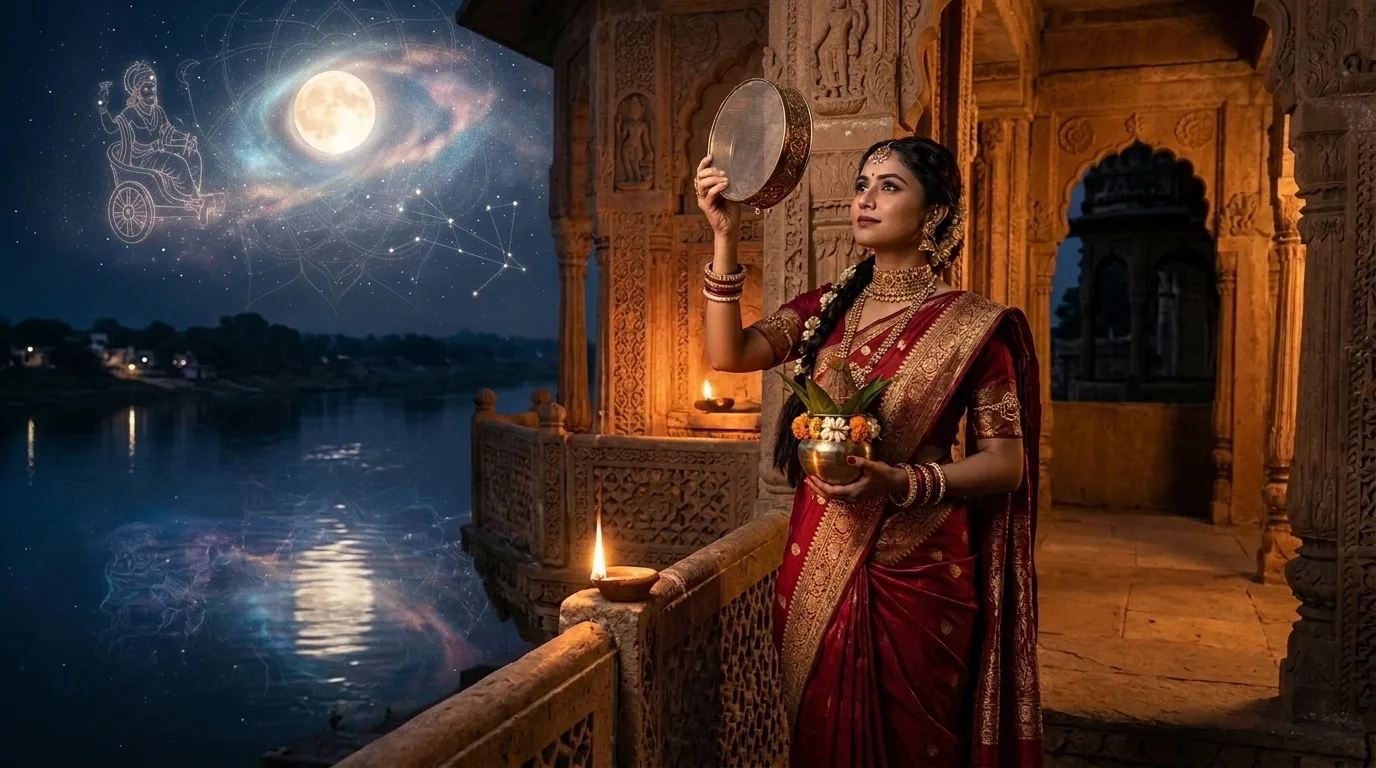
This folk story is where the flour sieve (chhalni) came from. Because the brothers in the legend used a sieve to fake the moon, women in North India began holding up a sieve to verify that the moon in the sky was real, and not a deception. Over generations, this grew into a symbolic ritual: looking through the mesh at the moon and then at one's husband to filter out falsehood and ill will.
In the 1990s and early 2000s, popular Hindi films took this specific regional custom from Punjab and western Uttar Pradesh and showed it to millions of viewers. Because it looked beautiful on camera, families across India and the diaspora began adopting the sieve ritual, assuming it was a mandatory Vedic command. It is a tender and meaningful folk tradition, but it is not found in the Vedas or Purāṇas.
India has never had only one way to celebrate spousal well-being. Different regions express the same spiritual intention through their own festivals:
- In Maharashtra and Gujarat, women observe Vat Savitri Purnima during the summer month of Jyeshtha. They tie sacred threads around a banyan tree, recalling Savitri's conversation with Yama under the tree.
- In Tamil Nadu, women observe Karadayan Nombu when the month of Panguni transitions into Chithirai. They prepare special sweet and savory rice cakes called karadai and tie a sacred yellow thread around their neck, praying for their family's health.
- In Bengal, women observe Savitri Vrata and Bipattarini Vrata, praying to Goddess Durga to protect their households from sudden crises.
- Across South India, the most widespread celebration for domestic prosperity is Varalakshmi Vratam, observed on the Friday before the full moon of Shravana.
Knowing these different practices helps us appreciate the diversity of Indian traditions. No single regional custom speaks for the whole country.
How This Connects to the Broader Philosophy of Marriage
Karwa Chauth makes little sense if you look at it as an isolated day of fasting. Its real meaning comes from the classical view of marriage as a joint spiritual effort, known in Sanskrit as dampatya.
In modern consumer culture, marriage is often treated like a legal contract between two independent individuals looking after their own interests. In classical thought, marriage is treated as a lifelong sacred fire ceremony (Vivaha-yajna), where two separate egos come together to support something larger than themselves.
In the Rig Veda (10.85.36), during the marriage ceremony, the groom speaks directly to the bride:
"गृभ्णामि ते सौभगत्वाय हस्तं मया पत्या जरदष्टिर्यथासः ।
भगो अर्यमा सविता पुरन्धिर्मह्यं त्वादुर्गार्हपत्याय देवाः ॥"
This verse says: "I take your hand for blessed auspiciousness, that you may reach old age together with me as your partner. The cosmic guardians have united us so that we may sustain the sacred duties of the home together."
Notice that the bride is not described as entering servitude. She is welcomed as an equal partner to maintain the household fire (Garhapatya).
A person remains incomplete until they find a life partner. In classical Indian society, the wife was honored with titles like Grihalakshmi (the auspicious guardian of the home) and Annapurna (the provider of nourishment). When she fasts, it is an annual reminder to the entire family that domestic life depends on her dedication, her health, and her conscious will.
There is another deep idea running through the epics: mechanical fate can be changed by genuine discipline (tapas).
When Goddess Parvati wanted to marry Lord Shiva, who was deep in solitary meditation, no outward charm could stir him. She left royal comfort behind, went into the cold mountains, and undertook severe discipline. She eventually stopped eating even dry leaves, earning the name Aparna. It was her mental resolve that moved Shiva to accept her as his equal half.
Savitri did the same thing when she faced Yama. Karwa Chauth is an annual renewal of that principle. It reminds a couple that their relationship is kept alive not just by legal papers or casual affection, but by mutual sacrifice and quiet inner strength.
What Modern Research and Science Actually Show
When we look at Karwa Chauth through the lens of modern sociology, psychology, and medicine, we find some interesting parallels. It is important to look at what science actually says, rather than inventing claims.
In evolutionary anthropology and behavioral sociology, there is a well-established concept called Costly Signaling Theory, developed by Amotz Zahavi and later studied in cultural settings by researchers like Richard Sosis.
The core idea is simple: words are cheap. Anyone can say "I love you" or "I am committed to this family" because speaking words requires no physical effort. But when someone willingly takes on a difficult physical task—such as giving up food and water for a day, enduring thirst, and dedicating their time to family well-being—they provide a signal that cannot be easily faked.
In long-term relationships, these deliberate, high-effort actions build deep psychological trust. They demonstrate that an individual values the shared bond above immediate personal comfort. When practiced with mutual respect, such shared customs strengthen emotional closeness between partners.
From a medical perspective, short-term voluntary fasting has received serious scientific attention. Fasting for 16 to 24 hours can trigger autophagy, a cellular recycling process where the body clears out damaged cell components. The Japanese cell biologist Yoshinori Ohsumi was awarded the Nobel Prize in Physiology or Medicine in 2016 for uncovering the genetic mechanisms behind this process.
Short-term fasting can also improve insulin sensitivity and give the digestive tract a period of rest.
However, medical science also gives us a clear warning about waterless fasting (Nirjala). Going without water for an entire day, especially in warm climates, can lead to severe dehydration, sudden drops in blood pressure, headaches, and unnecessary strain on the kidneys.
This is where classical texts show remarkable practical wisdom. The Sanskrit manuals like Dharmasindhu and Nirnayasindhu explicitly state that anyone who is ill, pregnant, nursing, or elderly must not observe extreme physical fasts. The texts advise taking water, milk, or fruit, reminding practitioners that the vow lives in the mind (manasa sankalpa), not in physical harm. The idea that a woman must refuse water even when sick is a modern social pressure, not a scriptural command.
Modern psychology also recognizes the difference between voluntary discipline and passive helplessness. When someone chooses to undertake a challenge for a purpose they care about, it builds self-reliance and emotional stability.
Savitri's story in the Mahabharata reflects this active strength. Her husband was unconscious and helpless on the ground. Yama was an unyielding force of nature. Savitri did not faint or wait for someone else to rescue her. She used her own stamina and intellect to resolve the crisis. Understood this way, the day is an expression of personal agency, not passive endurance.
Where the Comparison Holds, and Where It Falls Apart
In recent years, the internet has become flooded with messages attempting to explain Karwa Chauth with fabricated science. It is essential to address these claims directly so that ancient traditions are not mixed up with false physics.
You may have seen messages claiming that the metal wire of a flour sieve acts as a special lens to filter out harmful cosmic radiation from the moon. Other messages claim that fasting on this specific date creates a biological frequency that directly extends another human being's physical lifespan.
None of this is true.
There is zero evidence in physics or medicine for any of these claims. The flour sieve is not a piece of optical equipment; it is a prop from a seventeenth-century folk story about Queen Veeravati. The moon does not emit dangerous radiation on the fourth night of Kartika that requires filtering through kitchen utensils.
Furthermore, a person's biological lifespan is determined by genetics, diet, environment, medical care, and lifestyle. Fasting does not magically transmit years of life from one body into another across the room.
Claiming that ancient sages invented quantum tools in the kitchen does not honor the tradition. In fact, it makes the culture look foolish to anyone with a basic education.
The real beauty of the festival does not rely on fake science. It lies in its authentic psychological and ethical depth:
- The ritual provides an honest space for mutual appreciation and renewed commitment in a marriage.
- It offers an opportunity to practice self-control and step back from daily consumption.
- It keeps alive a tradition of community bonding among women, who gather to share stories, songs, and food.
We can appreciate the cultural and emotional power of Karwa Chauth without needing to invent false scientific explanations for it.
Frequently Asked Questions
Is looking through a sieve mentioned anywhere in the Vedas or Purāṇas? No. There is no mention of looking through a flour sieve in any Veda, Upanishad, or Sanskrit Purana. The custom comes entirely from the North Indian folk story of Queen Veeravati, where her brothers used a sieve to fake the moon. It became popular nationwide primarily through Hindi films in the late twentieth century.
Does Hindu scripture force pregnant or unwell women to fast without water? No. Classical ritual texts such as the Dharmasindhu and Nirnayasindhu clearly state that people who are ill, pregnant, nursing, or elderly are exempt from severe fasting. They are encouraged to drink water, consume milk or fruits, and take necessary medicines while maintaining the vow in their thoughts.
Why is Karwa Chauth celebrated on the fourth day of Kartika? In the Hindu calendar, the fourth tithi of every waning fortnight is dedicated to Lord Ganesha as Sankashti Chaturthi. Falling four days after the full moon of Sharad Purnima, this specific day combines prayers to Ganesha, Shiva, and Parvati with offerings to the moon for family peace and health.
Is Karwa Chauth the only spousal festival celebrated in India? No. India has several regional spousal observances with similar themes. These include Vat Savitri in Maharashtra and Gujarat, Karadayan Nombu in Tamil Nadu, Savitri Vrata in Bengal, and Varalakshmi Vratam across South India.
Sources
The classical information in this article comes from the following traditional texts:
- Nirnayasindhu of Bhatta Kamalakara (1612 CE)
- Dharmasindhu of Kashinatha Upadhyaya (1790 CE)
- Vrataraja of Vishvanatha Sharma
- Mahabharata, Vana Parva (chapters 293–299, the Savitri-Upakhyana)
- Rig Veda (Mandala 10, Sukta 85, the Surya Vivaha Sukta)
- Taittiriya Samhita and Shatapatha Brahmana
- Chandogya Upanishad
The modern discussions reference the following scientific and academic work:
- Costly Signaling Theory in anthropology and ritual studies, developed by Amotz Zahavi and studied in cultural contexts by Richard Sosis.
- Research on the physiological mechanisms of autophagy during intermittent fasting, recognized in the 2016 Nobel Prize in Physiology or Medicine awarded to Yoshinori Ohsumi.
This reflects what the text itself says; the modern-science comparisons above are interpretation, not an established finding.