The Shiva Linga and the Cosmic Pillar of Light in the Linga Purana
Drafted with the help of AI from the original texts named in the article; I read and correct every article after it is published. How we use AI
Discover what the Linga Purana really says about the infinite pillar of light, the debate between Brahma and Vishnu, and the true meaning of the Shiva Linga.
In this article
- The Night the Void Split: What the Linga Purana Actually Describes
- Seven Sanskrit Words That Shift How We Read the Story
- Four Traditional Schools and How They Read the Same Event
- The Vedic Roots and the Design of the Temple Sanctum
- Limits of the Observer: What Modern Logic and Physics Say
- Where the Science Fits, and Where the Comparison Stops
- Frequently Asked Questions
- Sources
If you walk into any Shiva temple across India, you will see people offering water, milk, and bilva leaves to a smooth, vertical stone pillar. If you search for the meaning of this stone on the internet, you will usually find two noisy extremes. One side repeats nineteenth-century colonial theories that reduce the Shiva Linga to an anatomical sexual totem. The other side posts sensational claims that the Linga was an ancient nuclear reactor designed by forgotten technologies.
Both claims miss what is actually written in the scriptures.
I used to find this whole debate confusing until I sat down with the Sanskrit text of the Linga Purana. When you read the original chapters, you do not find primitive biology, nor do you find nuclear engineering. Instead, you find a story about two massive cosmic intellects hitting the absolute limit of what their minds could measure, and an infinite column of light that shattered their pride.
The Night the Void Split: What the Linga Purana Actually Describes
The central event of the Linga Purana is known as the Lingodbhava, the emergence of the pillar of light. It appears in the first section of the text, called the Purvabhaga, across chapters 3 and 17 through 20.
The story is set at the end of a cosmic cycle, a time called Kalpanta. The entire manifest universe has dissolved into a single, dark, quiet expanse of water known as the Ekarnava. All planets, stars, and living beings have returned to their unformed, causal state. The whole cosmos rests under a blanket of primordial darkness, or Tamas.
In that vast stillness, two primary cosmic principles appear. The first is Lord Brahma, representing the power of projection, activity, and dynamic emergence, which the tradition associates with the quality of Rajas. The second is Lord Vishnu, also known as Narayana, resting upon the serpent of cosmic duration, Shesha. Vishnu embodies the power of preservation, balance, and pervasive continuity, associated with the quality of Sattva.
As they meet in the dark void, an argument breaks out between them. The text calls this an emergence of Ahankara, which means ego or the sense of separate individuality. Brahma looks at Vishnu resting on the serpent and demands to know his identity. Brahma announces that he is the architect of everything, the self-born creator of the worlds. Vishnu smiles gently and answers that Brahma himself was born from the lotus that sprouted from Vishnu's own navel. Therefore, Vishnu claims, he is the true father and ground of all life.
The dispute quickly moves from words to cosmic confrontation, called Vimarda in the text. This is not just a quarrel between two characters. It represents a fundamental tension: does dynamic creation come first, or does preservative continuity come first? Both principles assume that they are independent, supreme, and self-caused.
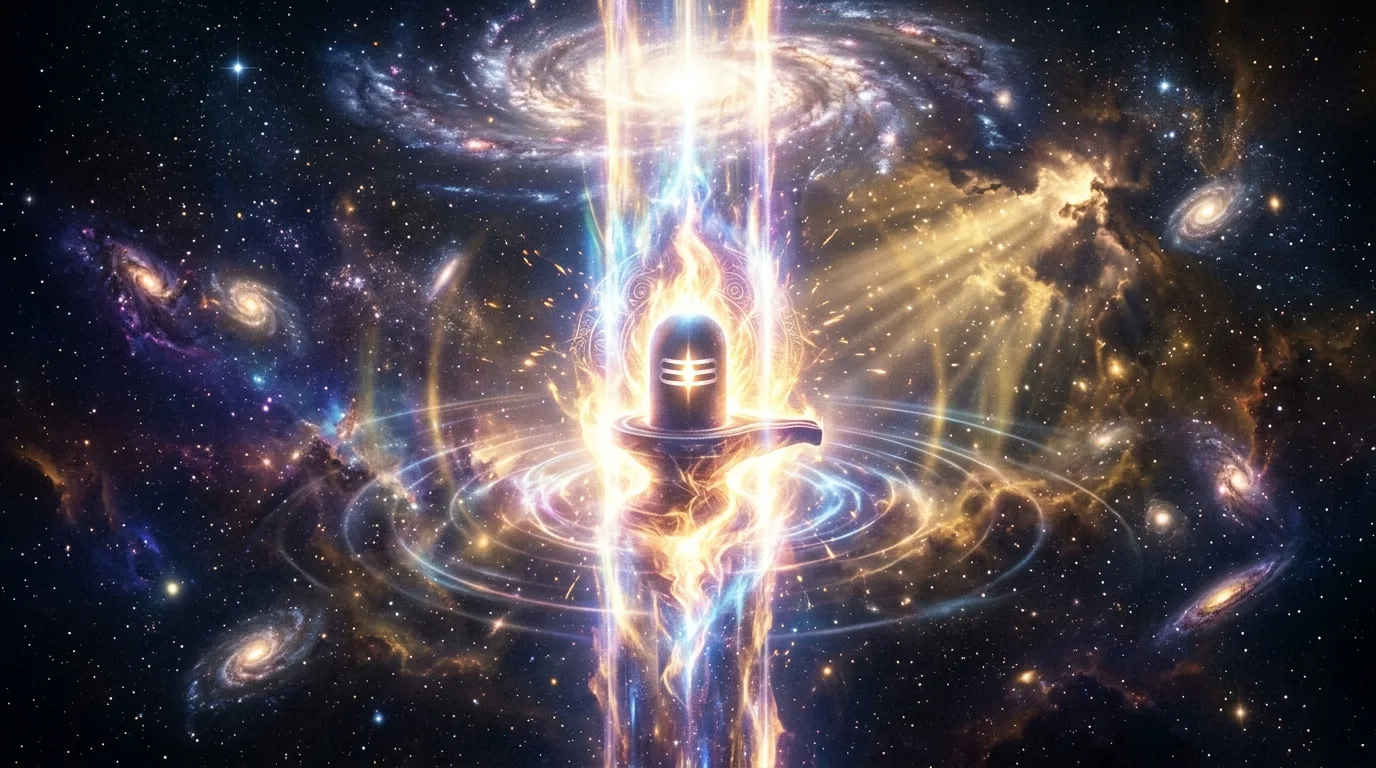
To shatter their misunderstanding, the dark void suddenly tears open. Right between the two competing deities, an immeasurable column of blazing light and fire bursts into view:
ज्वालामालासहस्राढ्यं कालानलसमप्रभम् ।
क्षयवृद्धिविनिर्मुक्तमादिमध्यान्तवर्जितम् ॥
"It was adorned with thousands of clusters of raging flames, equal in splendor to the cosmic apocalyptic fire; entirely free from increase or decrease, utterly devoid of beginning, middle, or end."
The Linga Purana describes this column as Nishkampam, meaning completely motionless and unshakeable. It is Aparimeyam, which means impossible to measure by any yardstick, standard, or metric. It is Tejomayam, formed of pure concentrated energy and light. It does not grow larger, and it does not shrink.
Brahma and Vishnu pause their battle. Confused by this presence that ignores their cosmic authority, they make an agreement. Whoever can find the boundary of this pillar will be acknowledged as the supreme sovereign of existence.
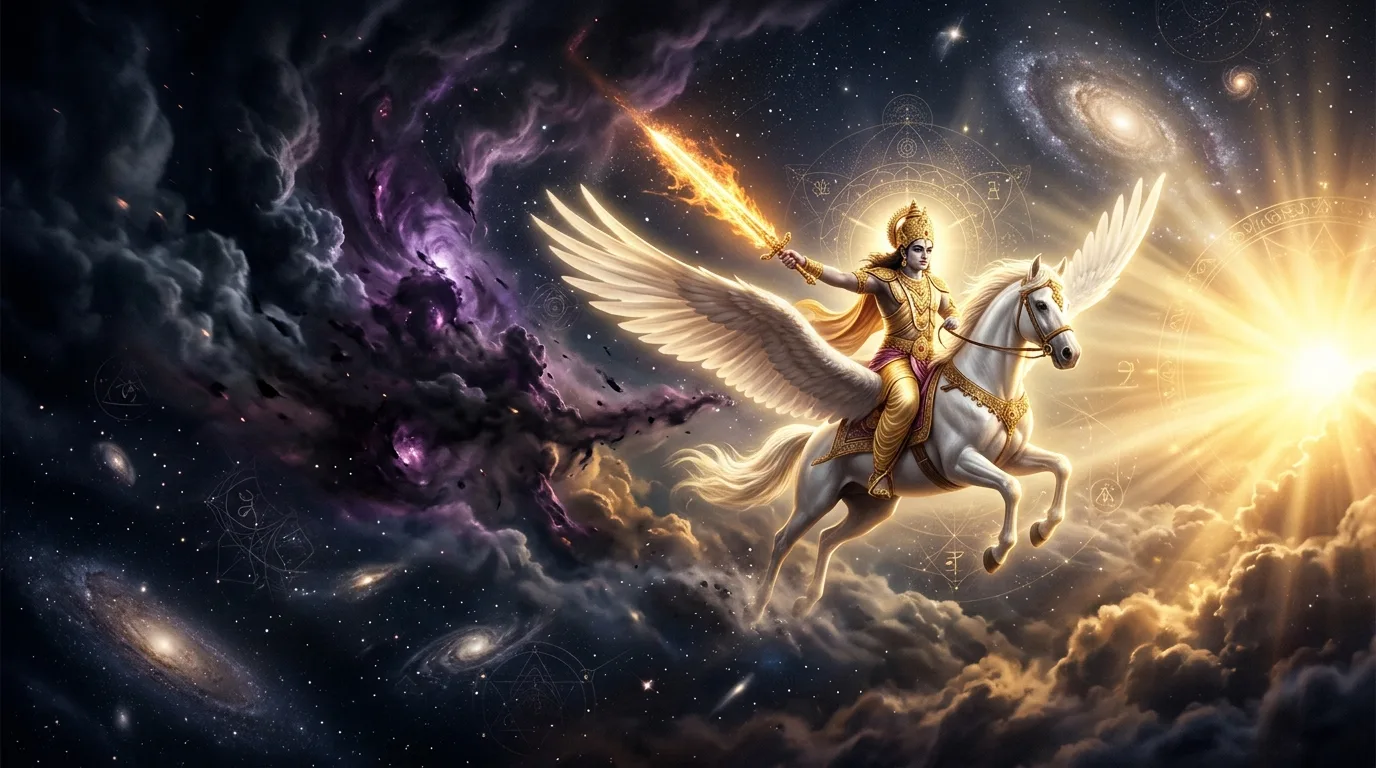
Brahma assumes the form of a celestial white swan, the Hamsa. Flying with the speed of thought and cosmic winds, he climbs upward for thousands of celestial years, trying to reach the top crown of the pillar, called the Shiras. In classical Indian thought, the swan represents the soaring intellect, Buddhi, and abstract conceptual thinking that tries to fly to the highest limit of reality.
Vishnu transforms into a massive boar, the Varaha. He measures a hundred leagues across, dark as black collyrium, equipped with adamantine tusks. He dives downward, burrowing through the depths of the cosmic abyss and subterranean strata for thousands of celestial years to locate the foundational base, called the Mula. The boar represents empirical investigation, digging downward into finer and denser layers of matter to find the basic particle or bedrock of the world.
Both efforts end in total failure.
No matter how far Brahma flies upward, the column stretches further above him. No matter how deep Vishnu digs downward, the column continues below him. Vishnu returns to the surface exhausted, his physical strength broken, and his pride completely shattered. Brahma descends from the upper heights equally depleted, having found no boundary.
Standing before the column with their pride gone, both deities fold their hands in reverent surrender. The text notes that as their ego dissolves, something remarkable happens. The pillar stops being merely a silent, blinding phenomenon of thermal fire. It begins to vibrate. A deep sound hums from the core of the pillar: the sacred syllable OM, also known as the Pranava.
In chapters 17 through 20, the Linga Purana explains the inner composition of this sound:
- On the right side of the pillar, they see the first letter, A (Akara). It glows with the golden hue of the rising sun. It represents the Rigveda, the waking state of consciousness, and the active function of cosmic creation.
- In the middle of the pillar, they see the second letter, U (Ukara). It gleams like flashing lightning. It represents the Yajurveda, the dreaming state of consciousness, and the stabilizing function of preservation.
- At the upper crest of the pillar, they see the third letter, M (Makara). It shines with the soft white radiance of the full moon. It represents the Samaveda, the state of dreamless deep sleep, and the quiet function of cosmic dissolution.
- Surrounding and carrying all three letters are the Nada, the ongoing acoustic vibration, and the Bindu, the unmoving point of awareness. These represent the Atharvaveda, the fourth state of pure awareness called Turiya, and the nature of Lord Shiva Himself.
From the glowing heart of this sounding column, Lord Shiva steps forth as Maheshvara, bearing five faces and three eyes. He explains to Brahma and Vishnu that they are not rivals fighting for ownership of reality. They are two functional branches emerging from His single, indivisible nature. Brahma was born from His right side to project the world into form, and Vishnu from His left side to protect and pervade it. Rudra resides at His heart to dissolve it when the cycle is done.
The entire episode demonstrates that the cosmic pillar is the threshold between potentiality and form, where unmanifest reality reveals itself through light and acoustic vibration.
Seven Sanskrit Words That Shift How We Read the Story
When people translate ancient Sanskrit texts into modern English, they often use flat words that strip away the philosophical precision of the original language. Calling the Linga a symbol or a phallus loses the entire teaching of the Linga Purana.
The following table lays out the seven terms that carry the weight of this teaching:
| Sanskrit Term | Literal Root | Definition in the Linga Purana |
|---|---|---|
| Liṅga | Lī (to dissolve) + Gam (to go, emerge) | That in which all manifest forms dissolve at dissolution, and from which they emerge at creation; also the primary sign or mark. |
| Aliṅga | A- (without) + Liṅga (sign or mark) | The supreme reality (Paramashiva) that is entirely without parts, marks, or spatial coordinates. |
| Liṅgin | Liṅga + the suffix -in (the bearer of the mark) | The conscious reality behind the mark; the text states that nature is the Linga, and Paramashiva is the Lingin. |
| Pradhāna | Pra (forth) + Dhā (to hold, place) | The unmanifest root matrix of matter and energy before it splits into three qualities. |
| Skambha | Skabh (to prop, fix, hold apart) | The cosmic axis that props apart the sky and the earth, preventing them from falling into chaos. |
| Śabda-Brahman | Śabda (sound) + Brahman (ultimate reality) | The ultimate ground of existence expressing itself as acoustic resonance, especially the syllable OM. |
| Ahaṅkāra-Bhaṅga | Ahaṅkāra (ego) + Bhaṅga (fracturing) | The shattering of the observer's pride when confronted with an immeasurable reality. |
The word Liṅga itself is defined in the text through an etymology: Layāl-liṅgamityucyate. The syllable lī points to dissolution, and gam points to emergence. When you put them together, the Linga is that stillness into which every galaxy, star, and creature merges when time runs out, and from which every new universe sprouts when the dawn returns.
At the same time, classical Indian logic uses the word linga to mean an indicator or sign. For instance, when you see smoke rising behind a hill, the smoke is the linga, the visible mark, that allows you to know there is fire, even though the fire itself is hidden from your eyes. In the same way, the physical universe is the visible mark that indicates the presence of an underlying conscious ground.
The text contrasts this with the term Aliṅga. You can describe an object if it has color, shape, weight, or edges. But the supreme source, Paramashiva, has no shape, no weight, and no edges. You cannot assign gender or spatial coordinates to it. It is the causeless cause behind everything that exists.
In chapter 17, verse 5, the text makes a striking statement: “Pradhānaṃ liṅgamākhyātaṃ liṅgī ca parameśvaraḥ.” This means that Pradhana, the root material energy of the cosmos, is the Linga, while Paramashiva is the Lingin, the conscious spirit animating it. This single verse dissolves the popular modern misconceptions. The Linga is not an anatomical drawing. It is the vast matrix of physical nature serving as the outward body of the invisible Divine.
The text also highlights Ahaṅkāra-Bhaṅga, the fracturing of ego. As long as Brahma and Vishnu approached the pillar as observers trying to dominate an object, they were trapped in an endless loop. The moment they dropped their pride, the silent fire spoke to them. Knowledge in this tradition is not a weapon to conquer nature; it is a transformation of the observer that occurs through humility.
Four Traditional Schools and How They Read the Same Event
Classical Indian philosophy has never been a single, flat doctrine. Different schools of thought spent centuries reading and debating the Lingodbhava story, each finding a different layer of meaning within it.
In the tradition of Shaiva Siddhanta, formalized by teachers like Aghorashivacharya and Srikantha, existence is understood through three eternal categories: Pati (the Lord), Pashu (the individual soul), and Pasha (the binding cords of karma, delusion, and ego). In this view, the pillar of light is the manifestation of Sadashiva, the state that bridges formlessness and form.
Shaiva Siddhanta teaches that Brahma and Vishnu are souls of extraordinary stature, but at the start of a cosmic dawn, they still carried a subtle trace of Anavamala, the primal ego that whispers that an individual is completely self-sufficient. The column of light was the descent of Shiva's grace, called Anugraha. It did not appear to punish them, but to cleanse that subtle pride so they could carry out their cosmic duties without delusion. The smooth stone pillar in a temple is considered the highest form of worship because it avoids the limitations of a human-like statue while giving the mind a clear, steady center for meditation.
The non-dual school of Advaita Vedanta, guided by the commentaries of Adi Shankaracharya, approaches the story through the lens of pure consciousness. In Advaita, the term Alinga refers to Nirguna Brahman, the unconditioned witness that sits behind every thought and perception.
To an Advaitin, Brahma represents the cosmic intellect, called Hiranyagarbha, and Vishnu represents the power of preservation, Ishvara. The failure of the swan and the boar is an allegory for the mind trying to turn consciousness into an object. Think of your own eyes: your eyes can see a tree, a book, or a star, but your eyes cannot turn around and see themselves. Consciousness is the subject that makes all seeing possible. When Brahma and Vishnu tried to find the top and bottom of the column, they were trying to treat the ultimate subject as an external object located in space. The sound of OM reminds them that the ground of existence is the witness of their own waking, dreaming, and deep sleep states.
In Kashmir Shaivism, explained by thinkers like Abhinavagupta in the Tantraloka and Kshemaraja in the Pratyabhijnahridayam, the teaching turns inward toward the subtle body. The column is described as Prakasha, the luminous light of existence, united with Vimarsha, the inner vibration of self-awareness represented by the echoing sound of OM.
In this tradition, the upward flight of the swan and the downward dive of the boar represent the two natural movements of breath: Prana, the upward inhalation, and Apana, the downward exhalation. In ordinary life, our breath and attention run outward into sensory objects, trying to grasp the world. Only when both breath currents stop their outward movement and dissolve into the central vertical channel, the Sushumna Nadi, does the infinite light of consciousness reveal itself within the human heart.
An honest study of Sanatan traditions must also acknowledge the classical Vaishnava understanding. Teachers in the lineages of Ramanuja and Madhvacharya read these passages differently. They point to the classification found in the Padma Purana, where the Linga Purana is listed among texts intended for readers under the influence of Tamas.
Vaishnava commentators explain that Vishnu's apparent defeat is not a sign of limitation, but a divine play, called Lila, or a secondary manifestation enacted to maintain cosmic order and grant prominence to Shiva for a specific purpose. In the Dvaita school of Madhva, Lord Narayana is always Sarvottama, supreme across all times and conditions, and never subject to genuine exhaustion or confusion.
Recognizing these different viewpoints is essential. Sanatan Dharma is not a rigid monolith where every book says the exact same thing; it is a living intellectual tradition where great minds debated the nature of God, the soul, and the world with deep philosophical rigor.
The Vedic Roots and the Design of the Temple Sanctum
The story in the Linga Purana did not appear out of thin air. It is the direct continuation of ideas that were already being sung thousands of years earlier in the Vedas.
The clearest ancestor of the pillar of light is found in the Atharva Veda, in two remarkable hymns known as the Skambha Suktas (book 10, hymns 7 and 8). In these hymns, the Vedic sage meditates on the Skambha, the cosmic pillar that holds the universe upright:
कस्मिन्नङ्गे तिष्ठति भूमिरस्य कस्मिन्नङ्गे तिष्ठत्यन्तरिक्षम् ।
कस्मिन्नङ्गे तिष्ठति द्यौरुदिता कस्मिन्नङ्गे तिष्ठत्युत्तरं दिवः ॥
"In which of his limbs does the earth abide? In which of his limbs the atmosphere? In which of his limbs is the sky established, and in which what is beyond the sky?"
The Atharva Veda describes the Skambha as the great supporting framework of existence. The sun, the moon, the winds, and all the thirty-three devas are said to branch out from this single vertical pillar like boughs spreading from the trunk of a great tree. When the Linga Purana describes a fiery column standing between heaven and the abyss, it is taking this Vedic concept of the Skambha and presenting it through a vivid narrative.
The philosophical roots run equally deep in the Upanishads. In the Katha Upanishad (chapter 2, section 3, verse 8), we find the exact distinction between that which has marks and that which is signless:
अव्यक्तात्तु परः पुरुषो व्यापकोऽलिङ्ग एव च ।
यं ज्ञात्वा मुच्यते जन्तुरमृतत्वं च गच्छति ॥
"Higher than the Unmanifest is the all-pervading Purusha, who is entirely without any distinctive mark (Alinga); knowing Him, a mortal is freed and attains immortality."
The classical Sankhya philosophy also uses this vocabulary. In the Sankhya Karika, the visible universe is called Vyakta, which is defined as Linga, meaning that which dissolves and has measurable marks. The ultimate unmanifest nature is Avyakta and Alinga. The Linga Purana pulls these Vedic and Upanishadic threads together, showing that the physical universe is the outward sign of an unconditioned reality.
This same vision is built directly into the physical layout of classical Hindu temples through the science of Vastu Shastra.
When you enter a traditional stone temple, the innermost sanctum, called the Garbhagriha, is intentionally built as a dark, unadorned, quiet cube. It contains no windows and very little decoration. This dark room represents the Ekarnava, the silent causal ocean before creation began, wrapped in primordial darkness.
In the exact center of this dark room stands the Shiva Linga. It represents the vertical axis of light breaking through the darkness of non-manifestation. Directly above the Linga, the stone tower of the temple, the Shikhara, rises into the open air, pointing straight toward the sky.
When you stand at the threshold of the sanctum to offer a prayer, the temple architecture places you in the exact same position as Brahma and Vishnu. You are standing in front of a vertical, unmeasured axis that cuts through everyday horizontal space, inviting you to quiet your busy intellect and remember the source from which life emerges.
Limits of the Observer: What Modern Logic and Physics Say
When we look at the Linga Purana today, we should avoid the trap of claiming that the ancient sages were doing modern laboratory science. They were not writing textbooks on astrophysics, and they were not calculating mathematical formulas. But they were asking profound questions about how the human mind gathers knowledge, and those questions connect directly with problems modern science has encountered in its own work.
The first real connection is found in mathematical logic, specifically in the work of Kurt Gödel. In 1931, Gödel published his famous Incompleteness Theorems. He demonstrated that in any consistent mathematical system capable of doing basic arithmetic, there will always be true statements that cannot be proven using the rules of that system itself.
To put it in everyday terms: a box cannot contain itself, and a ruler cannot measure its own total validity.
In the Linga Purana, Brahma and Vishnu represent the highest functional operators within the cosmic system. Brahma is the intellect that builds forms; Vishnu is the principle that maintains the system. When they encounter the column of light, they are trying to use internal operations, flying upward and digging downward, to measure the foundation that generated the system in the first place. Their failure illustrates the same logical boundary that Gödel proved mathematically: an internal observer cannot fully calculate the ground of the total system from within.
The second resonance appears in physical cosmology. When people picture the universe expanding, they often imagine a ball of matter growing inside a giant, empty room. They wonder: what lies outside the edge of the universe? If we flew a spaceship far enough, would we hit a wall?
Albert Einstein's General Theory of Relativity and modern cosmological models, such as the Friedmann-Lemaître-Robertson-Walker metric, completely changed that picture. Modern physics shows that spacetime itself is the geometry of the universe. There is no empty room outside spacetime. There is no physical wall you could touch, and there is no ceiling to fly toward. The universe does not expand into pre-existing space; space itself is stretching.
Brahma and Vishnu made the common-sense mistake of treating the pillar like an object inside an everyday room. They assumed it had a roof they could touch if they flew high enough, and a floor they could find if they dug deep enough. The Linga Purana tells us that the column has no beginning, middle, or end. It behaves like a non-spatial reality that cannot be placed on an ordinary coordinate grid. The ancient story and modern cosmology both challenge the naive human assumption that reality must be a box with edges.
Where the Science Fits, and Where the Comparison Stops
It is essential to be completely honest about where these comparisons work, and where they fall apart. On the internet today, it is common to see claims that ancient Indian texts contains secret blueprints for quantum computers, nuclear reactors, or particle accelerators.
Those claims are unfounded, and making them damages the credibility of genuine Sanatan scholarship.
The Linga Purana is not an ancient science textbook. The sages were not measuring the speed of light in kilometers per second, they were not calculating gravitational wave frequencies, and they were not building physical particle colliders. Modern science relies on quantitative mathematics, repeatable laboratory experiments, and empirical tests that can be falsified. The Linga Purana is concerned with something entirely different: the nature of consciousness, the dissolution of spiritual pride, and the inner relationship between the human individual and the Divine.
Where the comparison genuinely holds is in the field of epistemology, the study of how we know what we know.
Both modern thinkers and ancient Indian philosophers realized that the observer cannot be separated from the observed. When you treat the universe as a collection of dead objects to be dominated, measured, and exploited, you run into paradoxes. Brahma and Vishnu represent two classic approaches to life: abstract theoretical speculation (the swan) and aggressive material reductionism (the boar).
The Linga Purana shows that neither method alone can reach the ultimate ground of reality. You can dissect matter down to molecules, atoms, quarks, and quantum fields, but every time you reach a new bottom, another layer appears. You can expand theoretical math into higher dimensions, but you never reach a final conceptual ceiling.
The ancient text suggests that the ground of existence cannot be grasped as an external object. It is only when the observer acknowledges the limits of personal pride, turns inward, and listens to the subtle vibration of being, that the nature of reality reveals itself. Keeping these two domains distinct honors both of them: modern science remains our best tool for mapping physical phenomena, while classical philosophy remains our deepest guide for understanding consciousness and meaning.
Frequently Asked Questions
Does the word Linga in ancient Sanskrit mean a reproductive organ?
In ancient Sanskrit, the word Linga fundamentally means a sign, a mark, or an indicator through which an unmanifest reality is inferred. In grammar, it means gender; in logic, it means the middle term of an inference, like smoke indicating fire. In the Linga Purana, it is specifically defined through its roots: that into which all forms dissolve (laya) and from which they emerge (gaman). While later colloquial usage sometimes used the word for biological sex, the classical Puranic and philosophical texts use it to describe the primary material manifestation of the unmanifest Divine.
Why did Brahma take the form of a swan and Vishnu the form of a boar?
In classical Indian symbolism, the white swan represents the intellect (Buddhi) and the power of discriminative thought, soaring into abstract heights. The boar represents physical, earth-burrowing strength, digging into the subterranean ground to probe the material foundation of existence. The text uses these two forms to show that neither high abstract speculation nor deep material probing can find the boundary of the unconditioned Absolute.
What is the relationship between the Shiva Linga and the sound OM?
The Linga Purana explains that the cosmic pillar is not merely silent fire; its inner substance is acoustic vibration. When Brahma and Vishnu surrendered their pride, the column began to resonate with the sacred syllable OM. The text correlates the right side of the pillar with the letter A (waking state and creation), the center with the letter U (dreaming state and preservation), and the crest with the letter M (deep sleep and dissolution). The pillar of light and the primary sound of creation are two aspects of the same reality.
Why do some Puranas say Shiva is supreme, while others say Vishnu is supreme?
The Puranas were composed to provide focused devotion and meditation for seekers of different temperaments and spiritual paths. In the Linga Purana, Shiva is depicted as the supreme pillar of light, while Brahma and Vishnu emerge from His sides. In Vaishnava texts like the Bhagavata Purana or Vishnu Purana, Lord Narayana is the supreme source from whose navel Brahma emerges and from whose anger Rudra is born. Traditional commentators explain that these narratives are not historical quarrels, but different perspectives on the same single reality, allowing different seekers to fix their minds on their chosen deity.
Sources
- Primary Classical Texts:
- Linga Purana (Linga Mahapurana), Purvabhaga, Chapters 3 and 17–20 (Chowkhamba Sanskrit Series edition).
- Atharva Veda Samhita, Book 10, Hymns 7 and 8 (The Skambha Suktas).
- Katha Upanishad, Chapter 2, Section 3, Verse 8.
- Sankhya Karika of Ishvarakrishna, Karika 10.
- Padma Purana, Uttara-khanda, Chapter 236.
- Modern Scientific and Philosophical References:
- Kurt Gödel, "Über formal unentscheidbare Sätze der Principia Mathematica und verwandter Systeme I" (1931), foundational paper on logical incompleteness.
- Albert Einstein, General Theory of Relativity (1915); the Friedmann-Lemaître-Robertson-Walker (FLRW) cosmological metric describing non-Euclidean expanding spacetime.
This reflects what the text itself says; the modern-science comparisons above are interpretation, not an established finding.