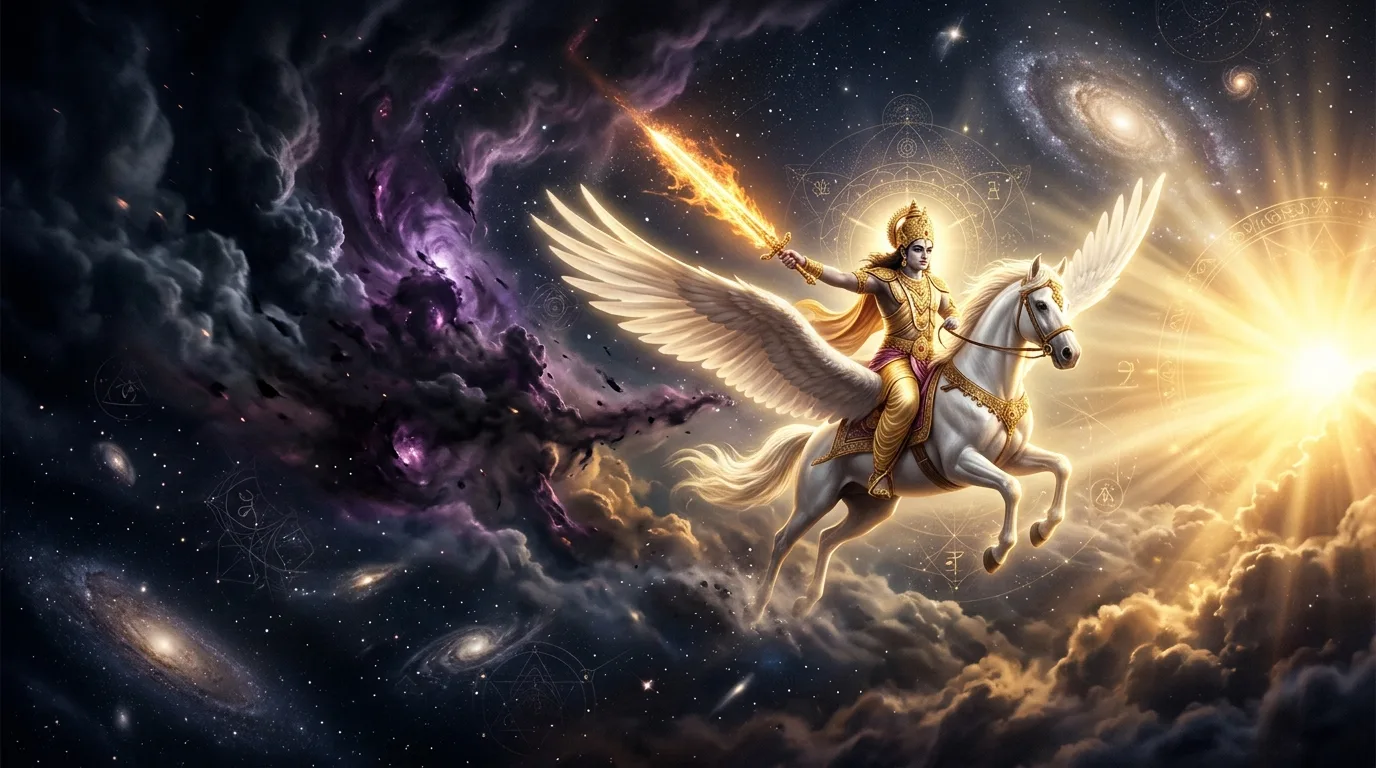
The 2,000-Year-Old Warning That Crushed Empires: The Earth’s Laughter in the Vishnu Purana
Drafted with the help of AI from the original texts named in the article; I read and correct every article after it is published. How we use AI
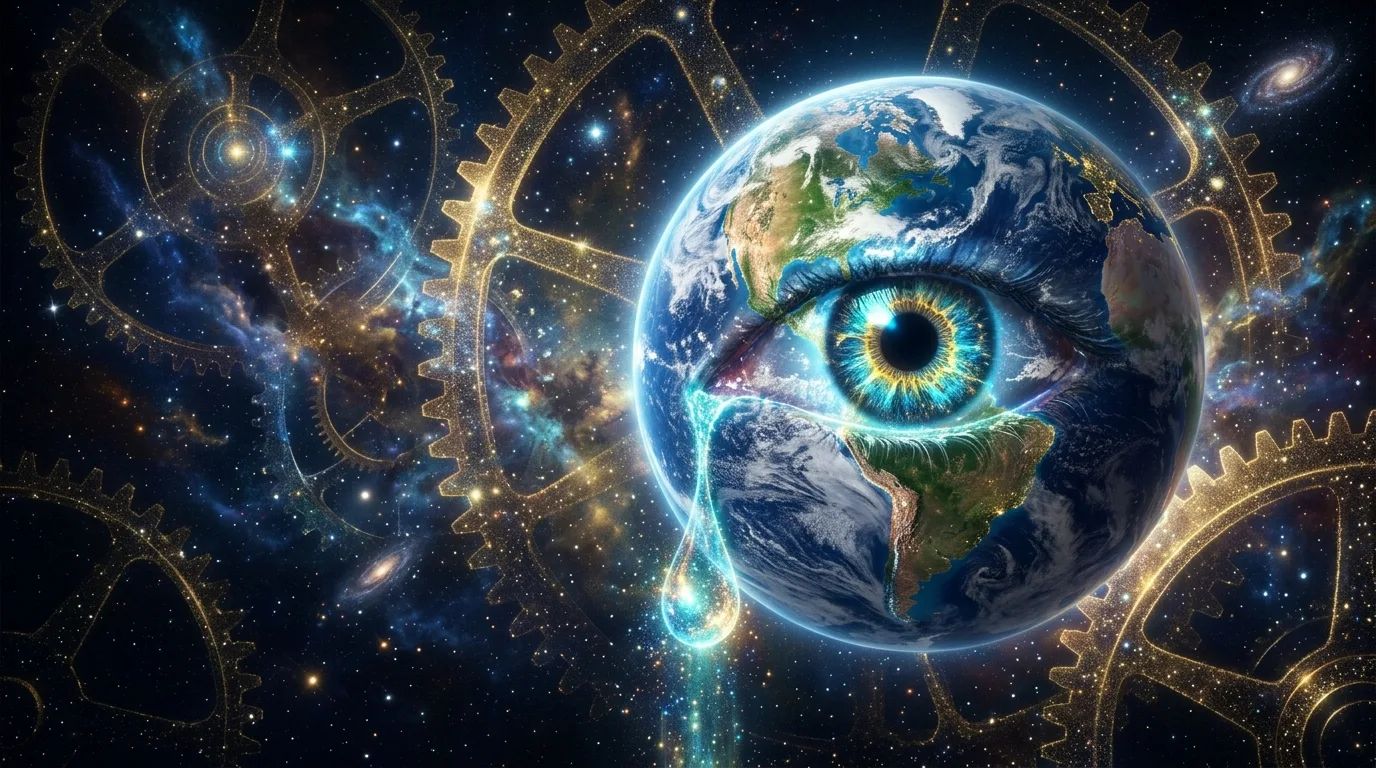
Explore the profound philosophy of the Vishnu Purana's Bhumi Gita, where the history of ancient empires is used to shatter human ego and the illusion of power.
In this article
If one were to casually explore modern retellings of "Puranic history," the landscape is often dominated by narratives glorifying the ancient kings of the Solar (Suryavansha) and Lunar (Chandravansha) dynasties. These texts are frequently mined to boast about the massive scale, wealth, and territorial conquests of ancient Indian empires. However, this article examines how reading the classical texts through this purely political and prideful lens completely misses their actual, intended purpose. By exploring Book 4 of the Vishnu Purana, specifically the profound shift that occurs in Chapter 24 with the "Bhumi Gita" (The Song of the Earth), we will uncover a sophisticated philosophical mechanism designed not to praise human empires, but to systematically dismantle the illusion of earthly power.
What the Text Actually Says
Book 4 of the Vishnu Purana presents itself as a monumental, almost exhausting ledger of royal lineages. In this section, Sage Parashara meticulously narrates to his disciple Maitreya the histories of hundreds of kings across thousands of years. The text details their conquests, their unimaginable wealth, and their bloody, relentless wars for territorial expansion. For chapter after chapter, the reader is submerged in the grand illusion that these conquerors and their bloodlines would rule the earth forever.
But at the very end of this massive historical record, in Chapter 24, the text executes a profound philosophical rug-pull. After cataloging the invincible conquerors of human history, Parashara reveals that every single one of them has been reduced to dust and ash. It is at this critical juncture that the text introduces the Bhumi Gita—The Song of the Earth.
The Earth herself is personified, and as she looks upon the history of humanity, she begins to laugh. She watches generations of men slaughter each other over borders, listening to them proudly claim, "This earth is mine, and it will belong to my sons." The Earth mocks their supreme arrogance. She notes that she has watched countless mighty emperors—from the legendary Prithu to Mandhata to the ancient Kurus—inevitably turn into the very soil they fought so violently to possess.
Following this laughter, the teaching transitions to its core philosophical premise: the nature of time and the glory of Lord Vishnu. The text argues that historical time (Kala) is merely the breathing of Vishnu. Human history, no matter how grand or destructive, is a microscopic, fleeting ripple on the vast ocean of cosmic time. The ultimate teaching is that the pursuit of earthly dominion is mathematically and philosophically absurd; all physical empires, without exception, are destined for dissolution. The text does not list the kings to glorify them; it lists them to prove inductively how utterly insignificant they are in the face of eternity. The only permanent reality, and the true refuge from the crushing weight of time, is the supreme consciousness of Narayana.
Key Terms Explained
To truly grasp the depth of this teaching, we must examine the specific Sanskrit terminology used in the classical tradition, as English translations often lose the psychological precision of the original words.
- Vamshanucharitam (वंशानुचरितम्): Literally translating to "the recounting of lineages" or genealogies, this is one of the Pancha-lakshana (the five defining characteristics of a valid Purana). Surface-level readers treat Vamshanucharitam as mere historical data or a record of ancestry. However, the deep spiritual tradition treats it as a potent epistemological tool. The recounting of lineages is a meditative device meant to induce a specific realization about the impermanence of biological continuity and political legacy.
- Ahamta (अहंता) and Mamata (ममता): These terms translate to "I-ness" (Ego) and "Mine-ness" (Attachment). In the diagnostic framework of the Vishnu Purana, the disease afflicting the kings is Mamata—the insane delusion that a fragile biological creature with a short lifespan can possess or control a planetary body that is billions of years old. Ahamta is the false identification with the temporary body and status, while Mamata is the projection of that false ego onto the material world.
- Vairagya (वैराग्य): Often translated as dispassion, profound detachment, or objective clarity. This is the intended psychological outcome of reading the royal lineages. Vairagya is not a depressive state of not caring; rather, it is the intellectual and spiritual freedom that arises when one stops treating temporary things as if they were eternal.
- Kala-Rupa (कालरूप): This refers to the Supreme Divine (Vishnu) in the form of Time. In the context of empires and history, Vishnu is not just the preserver of the universe, but the relentless, entropic force of Time that grinds every crown, throne, and monument into dust. Recognizing Kala-Rupa is acknowledging the inescapable boundary condition of material existence.
Traditional Interpretation
Classical commentators recognized the danger of misreading the Puranic histories. Sridhara Svami, one of the most revered commentators on the Puranas, was explicit about how to approach this section of the Vishnu Purana. He warned readers and scholars against reading the genealogies for clan pride, political chest-thumping, or historical boasting.
The traditional interpretive lens applied to Book 4 is Vairagya-janaka, meaning "that which generates dispassion." The orthodox Vaishnava and Advaita Vedanta schools align closely on this point: the world of politics, kings, borders, and nations belongs to the realm of Vyavaharika (transactional or relative reality). Taking this transactional reality too seriously, or believing that political victory equates to ultimate, absolute victory, is considered the highest form of Maya (illusion).
The tradition uses the exhaustive recitation of history as a deliberate meditative tool. By forcing the mind to confront the repetitive, futile cycle of rise and fall, the text breaks our attachment to the temporary world, naturally redirecting the mind toward Bhakti—devotion to the eternal, unchanging reality.
How This Connects
This teaching is not isolated; it resonates deeply with the core philosophical frameworks found throughout Sanatan Dharma.
- The Bhagavad Gita (Chapter 11): The Bhumi Gita serves as the historical equivalent of the Vishvarupa (Universal Form) that Lord Krishna reveals to Arjuna on the battlefield. Just as Arjuna is terrified to see the greatest warriors of his era rushing inevitably into the flaming mouths of Time, Sage Parashara shows Maitreya (and the reader) all kings of all eras being swallowed by the vastness of Time. Both texts use scale to shatter the human illusion of control.
- The Bhagavata Purana (Srimad Bhagavatam): The 12th Canto of the Bhagavatam heavily borrows from and expands upon this exact Bhumi Gita. It uses the laughter of the Earth to specifically highlight the political corruptions, ethical decay, and futile power struggles characteristic of the Kali Yuga. The Earth mocks the future rulers who will exploit her, knowing they too will become the dust they fight over.
Modern Research or Science
While it is crucial to avoid forcing inaccurate "quantum physics" or "simulation theory" parallels onto ancient texts, there is a highly precise and honest modern parallel to the psychological shift engineered by the Vishnu Purana.
In modern psychology and aerospace study, this phenomenon is known as the Overview Effect. Coined by space philosopher Frank White in 1987, the Overview Effect describes the profound cognitive shift reported by astronauts when viewing the Earth from space. When astronauts see our planet as a fragile, borderless sphere suspended in the infinite void, they experience a sudden, overwhelming realization of the triviality of human conflicts. National borders disappear, and the bloody political struggles over territory suddenly seem microscopic, absurd, and petty.
Furthermore, this Puranic approach aligns remarkably well with the modern academic discipline of Big History. Big History examines human events not in isolation, but by placing them within the context of deep geological and cosmic timescales. By zooming out to the scale of billions of years, Big History inherently shrinks the human ego, demonstrating that our entire recorded civilization is but a brief moment in the life of the planet.
Where the Comparison Holds, and Where It Doesn't
Where it Holds: The Vishnu Purana effectively engineered the psychological mechanics of the "Overview Effect" 2,000 years before human space travel was possible. It achieved this using the sheer scale of cosmic time (Yugas and Kalpas) as an intellectual vehicle to lift the reader's perspective out of their immediate political reality, forcing them to look down at human history from a "cosmic orbit." In both the ancient text and modern astronaut psychology, the result is a profound cognitive reframing that dismantles the ego and exposes the absurdity of territorial possession.
Where it Doesn't: Popular internet culture often attempts to map these ancient texts directly onto modern theories like the "Multiverse" or a "Matrix-style Simulation," claiming the ancients possessed literal quantum physics equations. This is an overreach. The Vishnu Purana is not attempting to describe the literal physics of the universe or suggest the physical world is a computer simulation. It is a psycho-spiritual text diagnosing a moral and existential problem (human ego and violence) and prescribing a cure (detachment and devotion). Furthermore, while the Overview Effect is a psychological observation, the Vishnu Purana connects this observation to a theological conclusion—the supreme reality of Lord Vishnu—which is outside the purview of empirical science.
Frequently Asked Questions
What is the central message of the Bhumi Gita? The central message is the absolute futility of claiming ownership over the material world. By personifying the Earth laughing at the kings who fight over her, the text teaches that all empires are temporary, and the human desire for eternal earthly power is an illusion driven by ego.
Why does the Vishnu Purana spend so much time listing kings if they are just going to die? The text uses an inductive, empirical approach. By exhausting the reader with a massive, undeniable list of the greatest humans who ever lived, and then pointing out their 100% mortality rate, it forces a logical realization of impermanence. The list is designed to create 'Vairagya' (dispassion), not historical pride.
Does this mean Sanatan Dharma teaches us to abandon the world and do nothing? No. Cultivating 'Vairagya' means performing one's duties without the toxic attachment ('Mamata') to the results or the delusion of ultimate control. It allows a person to act with clarity and ethics in the transactional world without being destroyed by its inevitable ups and downs.
How does 'Kala' (Time) relate to Lord Vishnu in this context? In this text, Kala is described as a form of Vishnu. While Vishnu is the preserver, in the context of history and empires, His form as Time is the entropic force that ensures no material structure—whether a human body or a global empire—lasts forever.
Sources
- The Vishnu Purana (Specifically Book 4, Chapter 24 regarding the royal lineages and the Bhumi Gita).
- Classical Commentary: Sridhara Svami's traditional Sanskrit commentary on the Puranas, emphasizing the Vairagya-janaka (dispassion-generating) nature of historical genealogies.
- The Overview Effect: Documented psychological phenomenon in aerospace studies, initially coined by Frank White (1987), describing the cognitive shift experienced by astronauts.
- Big History: The modern academic discipline that examines human history within deep geological and cosmic timeframes.
This reflects what the text itself says; the modern-science comparisons above are interpretation, not an established finding.