The True Origin of Day and Night in the Brahma Purana
Drafted with the help of AI from the original texts named in the article; I read and correct every article after it is published. How we use AI
Explore the Brahma Purana's profound claim that Time is not mechanical, but the discarded psychological residue of the Creator's shifting consciousness.
In this article
This article examines one of the most profound and least understood cosmological concepts within Sanatan Dharma: the true nature of time, specifically the cycle of day and night, as described in the Brahma Purana. When modern discussions touch upon Hindu creation accounts, they often reduce them to a simplistic mechanical process or attempt to force them into a sci-fi "simulation theory" or "matrix" framework. However, the ancient texts offer something far more psychologically complex. Rather than viewing the passage of time as the lifeless, mechanical result of a planet spinning on its axis near a star, the Brahma Purana presents time as an emergent property of consciousness. It asserts that the cycles of dawn, day, dusk, and night are the literal, discarded psychological residues of the Creator's shifting emotional and energetic states during the act of emanation.
What the Text Actually Says
When investigating the creation of the universe within Hindu scripture, a common and highly simplified summary is often presented to the public: Brahma is the creator, Vishnu is the preserver, and Shiva is the destroyer. While this trinity is foundational, reducing the actual mechanics of creation to this single sentence strips away the immense philosophical depth of the texts. If we look closely at the Sarga (Creation) chapters of the Brahma Purana—a narrative that is also heavily mirrored in the Vishnu Purana—creation is explicitly not described as a mechanical, architectural building process. Brahma does not act as a cosmic carpenter piecing together physical dust and debris to form worlds. Instead, creation is detailed as an intense, internal psychological metamorphosis. Brahma creates by assuming specific emotional and energetic frequencies, generating lifeforms that correspond to those exact frequencies, and then literally discarding that state of mind into the cosmos.
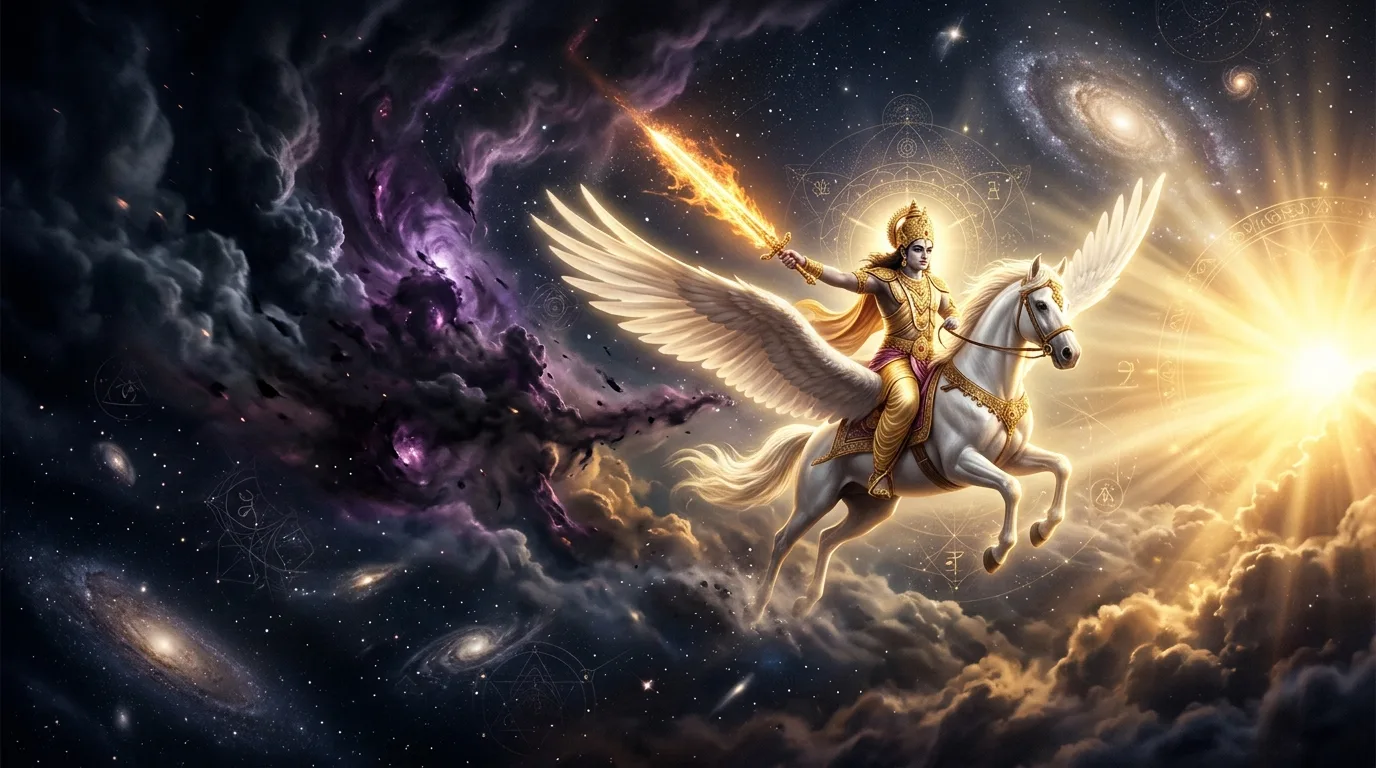
The Brahma Purana outlines a staggering sequence of events regarding the manifestation of time and conscious entities. Brahma desires to create. To do so, he cannot remain in a singular, formless, unmoving state. First, he assumes a state of consciousness that is entirely dominated by Tamas—the heavy, dense, obscure, and inertial quality of nature. From his lower body, while in this state, the Asuras (beings characterized by materialism, density, and ego) are emanated. However, according to the text's internal logic, a single consciousness cannot hold onto functional, opposing frequencies indefinitely. Therefore, having completed this specific emanation, Brahma discards this heavy, Tamasic state of mind. But in Vedic metaphysics, divine energy cannot simply vanish into nothingness; it must go somewhere. The text states that this discarded, dark psychology of the Creator crystallizes into the very fabric of the universe itself: it becomes Night (Ratri). Thus, Night is not merely the absence of the sun; it is the abandoned tamasic mood of God.
Following this, Brahma shifts his consciousness radically. He assumes a state of pure Sattva—characterized by light, clarity, balance, and absolute goodness. From his face, while holding this luminous frequency, the Devas (the shining ones, the cosmic administrators of nature) are emanated. Having completed the creation of these beings of light, he again sheds this state of consciousness. This discarded psychology of pure light does not disappear; it becomes Day (Ahan).
The cycle continues with profound subtlety. Brahma then assumes a state of deep, undisturbed tranquility and stillness. From this serene state of mind, the Pitris (the ancestors) are born. When he discards this infinitely peaceful state, it crystallizes into Twilight (Sandhya). Finally, Brahma assumes a state of Rajas—characterized by passion, kinetic action, and desire. From this restless state, Humanity (Manushyas) is born, eternally bound to action and ambition. When he discards this passionate state, it becomes Dawn or Daybreak (Jyotsna).
The unspoken but overwhelming teaching here is that the environment we live in is not a dead, empty vacuum. Time itself—the alternating rhythms of day, night, dawn, and dusk—is not merely the mechanical effect of celestial bodies in a void. Time is the recycled, leftover psychology of God. The physical phenomena we experience daily are the shadows of the Creator's shifting consciousness.
Key Terms Explained
To fully grasp the depth of this scripture, we must understand the specific Sanskrit terminology used, as English translations often lose the core mechanical meaning of the words.
- Sarga (सर्ग): This word is loosely translated as "creation" in most English texts. However, its root srij literally means "to emit," "to let go," or "to pour forth." This is a crucial distinction. The universe was not built or constructed (kriti); it was exhaled or emanated. This linguistic detail proves that Sanatan Dharma views creation as an organic emanation of consciousness from within, rather than a mechanical assembly of external parts.
- Tanum Tyajati (तनुं त्यजति): Translated directly, this phrase means "He abandons the body" or "He discards the body." In modern English usage, "body" almost exclusively implies a physical, flesh-and-blood corpse. But in Vedic metaphysics, Tanu refers to a psychic sheath, an active energetic vehicle, or a specific frequency of consciousness. When the text says Brahma "abandons the body," it means he is shedding mental states and energetic frequencies like garments once their creative purpose is fulfilled.
- Guna (गुण): The Gunas are the fundamental "threads" or operational modes of nature. There are three: Sattva (illumination, clarity, and balance), Rajas (kinetic action, passion, and movement), and Tamas (inertia, heaviness, and obscuration). The Brahma Purana's creation account demonstrates that the Gunas exist prior to physical matter. Matter is simply coagulated Gunas; the primary reality is psychological and energetic.
- Ahoratra (अहोरात्र): This term refers to the continuous cycle of Day and Night. By explaining Ahoratra through the shedding of Brahma's mental states, the text redefines the day-night cycle not as solar time dictated by a sun, but as the alternating pulsation of cosmic Sattva (light/day) and cosmic Tamas (obscuration/night).
Traditional Interpretation
Classical commentators across different philosophical schools within Sanatan Dharma, particularly in the Samkhya philosophy and Advaita Vedanta traditions, view this passage not as a primitive myth, but as a flawless macroscopic map of the microscopic human mind. In these traditions, the macrocosm (the universe) and the microcosm (the individual) are reflections of one another.
Just as a human being goes through daily psychological cycles—experiencing deep, ignorant, heavy sleep (Tamas/Night), active, passionate, and often stressful wakefulness (Rajas/Dawn), and moments of lucid, balanced clarity (Sattva/Day)—creating different thoughts, actions, and consequences in each state, the Cosmic Mind does the exact same thing on a universal scale. The individual mind sheds moods that color their personal reality; the Cosmic Mind sheds moods that become universal reality.
Furthermore, traditional ritualists point to this exact story in the Puranas to explain the supreme sanctity of Sandhyavandanam (the twilight prayers performed at dawn and dusk). Why are dawn and dusk considered the most spiritually potent times of day in Hinduism, more so than high noon or midnight? Because, according to the Brahma Purana, Twilight (Sandhya) is the physical manifestation of the Creator's most tranquil, ancestral, and undisturbed state of mind. When a practitioner meditates at twilight, they are not just taking advantage of cooler weather; they are literally sitting inside the most peaceful psychological residue of God. It is the atmospheric condition most conducive to spiritual stillness because the time itself is stillness.
How This Connects
The revelation that the universe is constructed from the discarded psychology of the divine connects seamlessly with other major frameworks within Sanatan Dharma, elevating it from an isolated Puranic story to a core Vedic truth.
This concept perfectly interconnects with the Pancha Koshas (the five sheaths of existence) detailed in the Taittiriya Upanishad. The Upanishad explains that individual souls wear layers of psychology and energy (sheaths of bliss, intellect, mind, vital energy, and finally physical matter). The Brahma Purana applies this same logic to the universe itself: the environment is made of the discarded energetic layers (sheaths) of the Cosmic Being.
It also profoundly evolves the concept found in the Purusha Sukta of the Rig Veda. The Rig Veda describes the universe forming from the physical division and sacrifice of the Cosmic Man (Purusha)—his mind became the moon, his eyes the sun, his breath the wind. Where the Rig Veda uses a physical, bodily metaphor to explain that everything is a piece of the divine, the Brahma Purana upgrades this to a purely psychological division. The universe is formed not from the physical limbs of God, but from the division and discarding of the Cosmic Mind. It is the exact same teaching, shifted from a physical allegory to a cognitive one.
Modern Research or Science
While one must be careful not to conflate ancient theology with hard quantum physics, there is a fascinating and highly relevant parallel in the realm of advanced Cognitive Science and the Philosophy of Mind. Currently, one of the leading edges of cognitive theory is a framework called "Conscious Realism," prominently championed by cognitive scientist Dr. Donald Hoffman.
Conscious Realism argues against the standard materialistic view that space and time are fundamental, pre-existing physical realities that exist independently of observers, and that consciousness somehow accidentally evolved within this physical cage. Instead, Conscious Realism posits that consciousness is the fundamental reality. According to this theory, spacetime and physical objects are not objective realities; they are merely "user interfaces"—emergent properties and simplified data structures created by interacting conscious agents. In this view, space and time are generated by consciousness to allow conscious agents to interact, much like icons on a computer desktop hide the complex reality of the circuit boards underneath.
The Brahma Purana making the claim thousands of years ago that Time (specifically the cycle of Day and Night) is a byproduct of conscious acts and shifting mental states, rather than a pre-existing physical framework, is a staggering philosophical parallel to the absolute cutting-edge of modern cognitive science. Both assert that consciousness creates spacetime; spacetime does not create consciousness.
Where the Comparison Holds, and Where It Doesn't
It is crucial for intellectual honesty to assess where this comparison is valid and where it must be constrained.
The comparison absolutely holds in its foundational philosophical premise: the primacy of consciousness. Both the Brahma Purana and modern theories like Conscious Realism agree that the physical environment (time, space, form) is downstream from consciousness. They both reject the idea of a "dead" universe where matter is the ultimate reality. The idea that what we perceive as physical phenomena (like the passage of a day) is actually the output of a conscious state is a profound resonance.
However, where the comparison diverges is in methodology, scope, and intent. Donald Hoffman's Conscious Realism is a mathematical model based on evolutionary game theory and cognitive psychology, aiming to explain why human perception hides reality for the sake of evolutionary fitness. The Brahma Purana is a metaphysical and theological text aiming to explain the spiritual origin of diverse cosmic beings (Devas, Asuras, Humans, Pitris) and to guide the soul toward liberation (Moksha). We must not claim that the sages who composed the Brahma Purana were conducting evolutionary game theory mathematics, nor should we claim that modern cognitive scientists are proving the literal existence of Devas and Asuras. The scriptural claim is a metaphysical revelation; the modern scientific claim is a model of perception. They rhyme beautifully, but they are not the same language.
Frequently Asked Questions
1. Does the Brahma Purana deny that the Earth rotates? No. The texts of Sanatan Dharma, specifically the Surya Siddhanta and other Jyotisha (astronomical) works, contain extensive mathematics regarding planetary motion. The Brahma Purana's explanation of day and night is metaphysical and psychological, explaining the spiritual essence and origin of these time cycles, not denying their physical, observable mechanics.
2. Why did Brahma create the Asuras (demons) first? According to the sequence, Brahma first assumed a state of Tamas (inertia/obscuration), from which the Asuras emerged. Philosophically, this indicates that the foundational layer of material creation requires density and resistance. Before light and action can operate, a dense foundation must exist. It reflects the natural order of moving from dense potential to active expression.
3. What is the practical benefit of knowing this? Understanding that time is a psychological residue transforms how a practitioner approaches daily spiritual routines. It provides the deep, underlying rationale for why specific times, like Twilight (Sandhya), are used for meditation—you are aligning your microcosm with the macrocosmic state of perfect tranquility.
4. Are these cycles repeating? Yes. In Hindu cosmology, time is cyclical, not linear. The shifting of cosmic Gunas (Sattva, Rajas, Tamas) is eternal. The macrocosmic day and night of Brahma operate on massive timescales, constantly pulsing between active emanation and dormant withdrawal.
Sources
- The Brahma Purana: Specifically the Sarga (Creation) chapters detailing the emanation of beings from the mental states of Brahma. (This process is also echoed in the Vishnu Purana, Book 1, Chapter 5).
- The Taittiriya Upanishad: For the concept of the Pancha Koshas (the five sheaths of existence).
- The Rig Veda (Purusha Sukta): For the foundational concept of the universe originating from the division of the Cosmic Being.
- Dr. Donald Hoffman, Cognitive Science: For the modern scientific framework of "Conscious Realism," which models spacetime as a user interface generated by consciousness.
This reflects what the text itself says; the modern-science comparisons above are interpretation, not an established finding.