Why Science Fails: The Shiva Purana's Ancient Warning About the Human Intellect
Drafted with the help of AI from the original texts named in the article; I read and correct every article after it is published. How we use AI
"Discover the ancient warning from the Shiva Purana about the limits of human intellect, Gödel's theorems, and why science can't measure the infinite."
In this article
Let me ask you a mind-bending question. What happens when the smartest people in the room—the ones with all the data, all the degrees, and all the formulas—finally run out of answers?
Do they admit they don't know? Or do they lie?
We live in an era where we are absolutely obsessed with the human intellect. We genuinely believe that given enough time, bigger telescopes, and more powerful particle colliders, modern science will eventually measure, calculate, and figure out the entire universe. We treat logic as the ultimate skeleton key to reality.
But what if I told you that thousands of years ago, long before modern laboratories existed, ancient sages mapped out the exact, precise point where human intelligence spectacularly fails?
Today, I want to take you deep into one of the most profound, psychologically devastating narratives in Sanatan Dharma. On the surface, it sounds like a wild mythological fairy tale about gods fighting. But when you look closer, it is an incredibly advanced philosophical analysis of epistemology (how we know what we know) and the terrifying danger of the human ego.
Grab a cup of coffee, sit back, and let’s dive into a truth that might just change how you view knowledge forever.
What the Text Actually Says: The Epistemological Collapse
To understand this, we have to open the Shiva Purana, specifically the Vidyeshvara Samhita (Chapters 5–9). Here, we find the famous account of the Lingodbhava—the manifestation of the infinite cosmic pillar of fire.
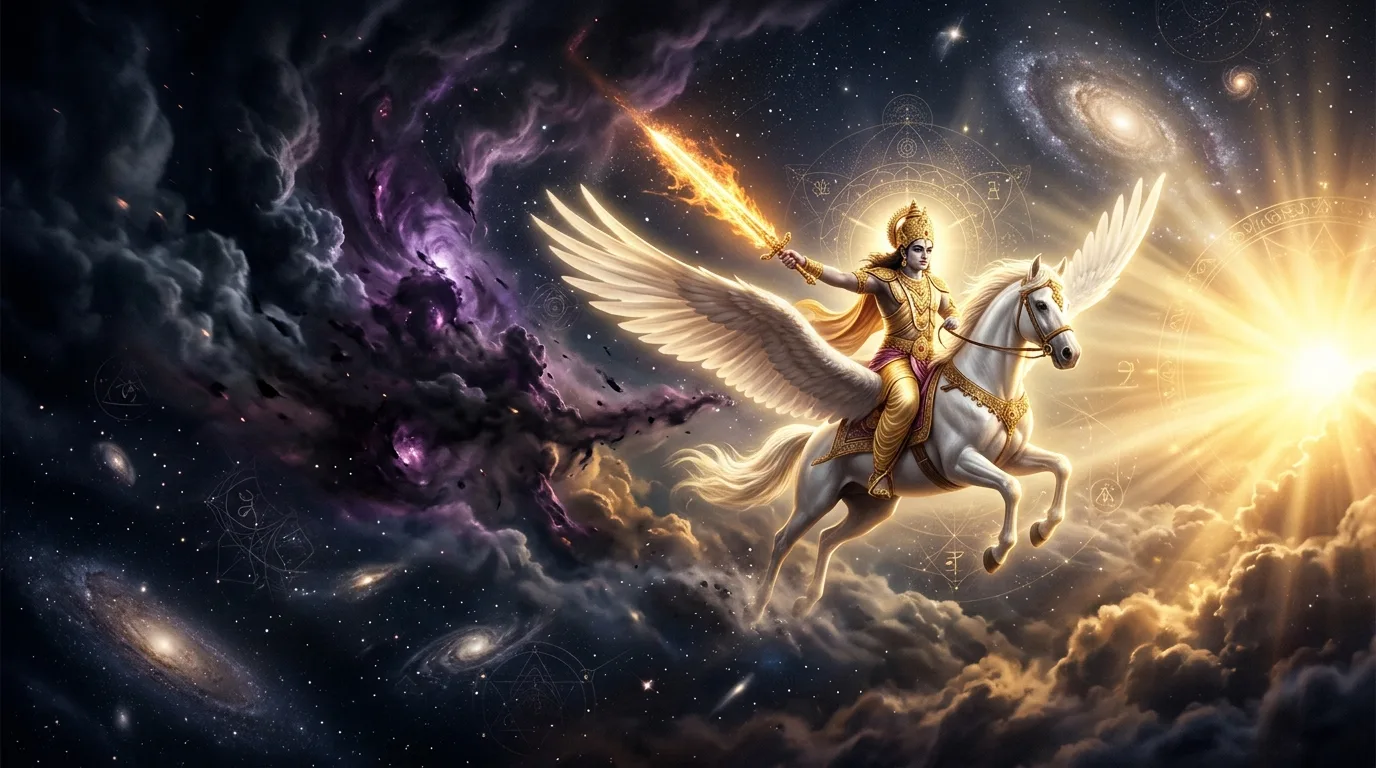
The story begins with a catastrophic power struggle. Lord Brahma, the Creator of the universe, and Lord Vishnu, the Preserver, are locked in a devastating war over who is the supreme, ultimate reality. Their cosmic battle is so fierce that it threatens to annihilate the very universe they are supposed to govern.
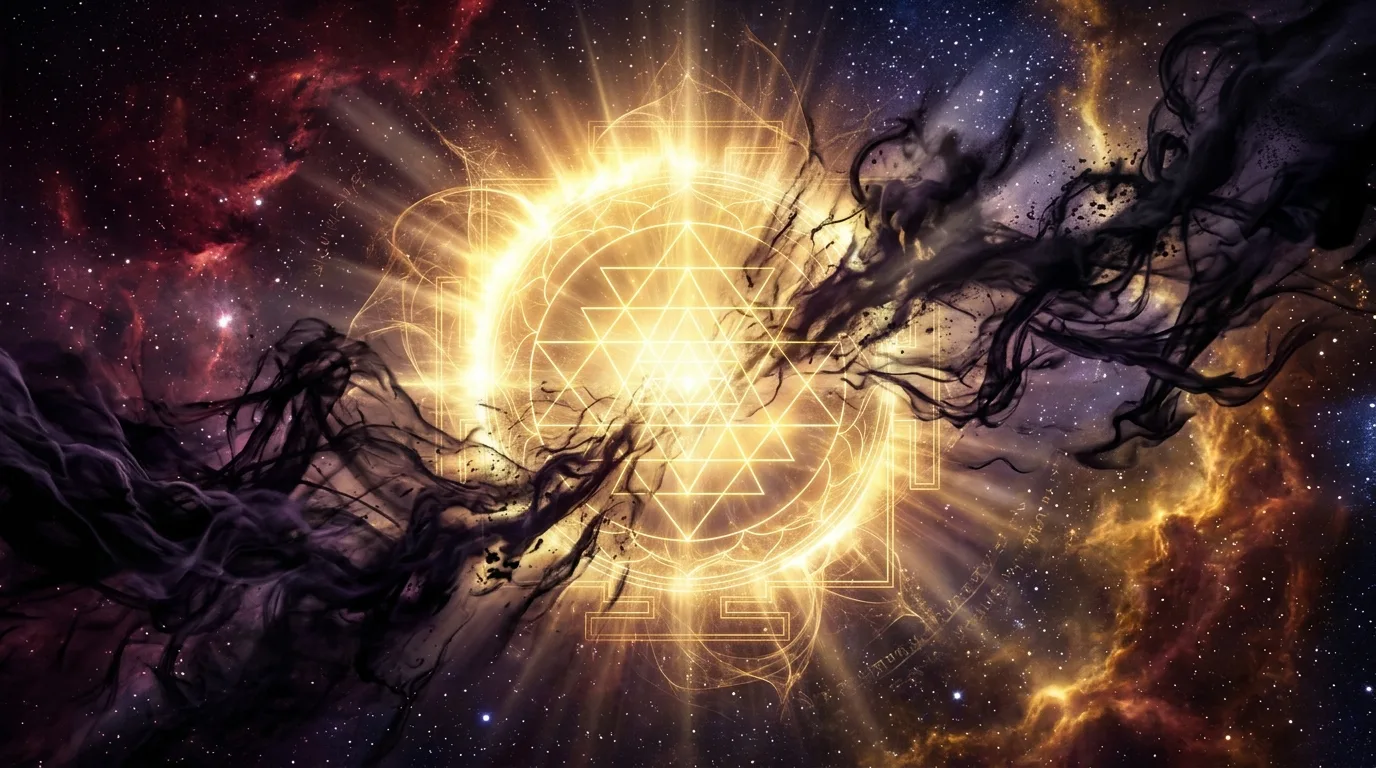
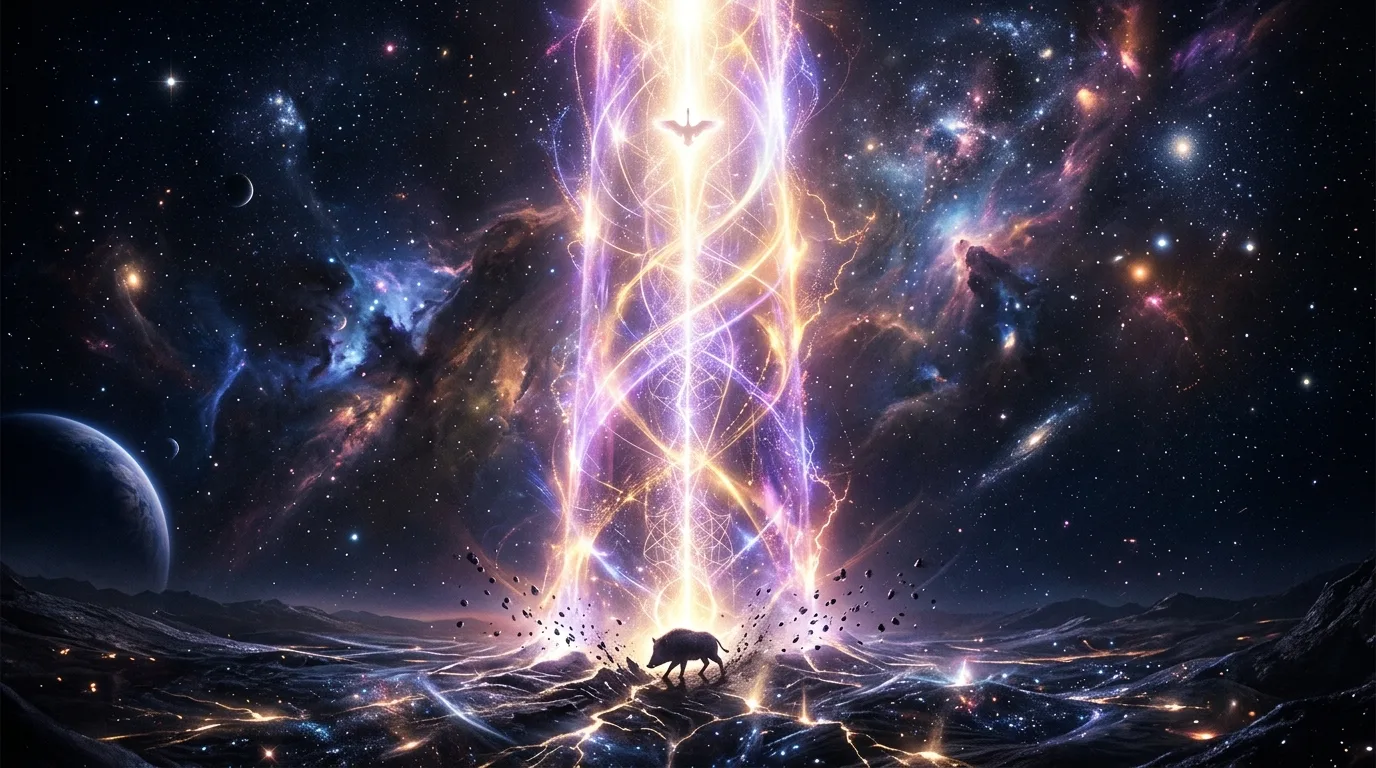
Suddenly, to stop the destruction, a blazing, infinite pillar of fire (Jyotirlinga) erupts directly between them. It pierces through all known dimensions. It has no visible beginning, and absolutely no visible end.
Brahma and Vishnu agree to a truce and a challenge: whoever can find the end of this pillar will be declared the Supreme Reality.
This is where the symbolism gets incredibly deep.
Brahma takes the form of a Swan (Hamsa) and flies upward to find the top of the pillar. In Sanatan philosophy, Brahma represents the Intellect (Buddhi) and abstract, theoretical thought. The swan flying endlessly upward is a metaphor for the human intellect trying to conceptualize the ultimate limit of reality through pure logic and theory.
Vishnu takes the form of a Boar (Varaha) and digs downward to find its root. Vishnu represents Material Reality and sustenance. The boar digging into the earth is the perfect representation of empirical, material exploration—the scientific method trying to find the fundamental, physical building blocks of the universe.
Millions of years pass. They search and search. Both completely fail. The Infinite, by definition, cannot be measured by finite beings.
But the most critical part of this teaching isn't their failure; it is how they react to it.
Vishnu (representing empirical exploration) returns exhausted. He looks at the infinite, admits his absolute failure, and surrenders to the mystery. This is the honesty of true observation.
Brahma (representing the Intellect), however, refuses to admit defeat. As he flies upward, seeing no end in sight, he spots a Ketaki flower falling from the top. Driven by panic and ego, he convinces the flower to lie for him. Brahma returns to the bottom and falsely claims he has found the top, presenting the Ketaki flower as his "proof."
At this very moment, the pillar bursts open, and Lord Shiva reveals Himself. He blesses Vishnu for his absolute, humbling honesty, decreeing that Vishnu will be worshipped equally to Him.
But Shiva curses Brahma for his arrogance and his fabricated truth. He decrees that Brahma will never be worshipped in temples.
This isn't a story of a petty god getting angry. It is a devastating critique of how we acquire knowledge. The text is stating unequivocally that the Supreme Reality cannot be measured by physical sciences (Vishnu) or theoretical logic (Brahma). And when the intellect fails, its greatest danger is fabricating grand theories rather than admitting its own limitations.
Key Terms Explained
To really grasp the depth here, we need to understand the precise Sanskrit terminology the text uses. These aren't just names; they are highly specific philosophical concepts.
- Nishkala (निष्कल): Derived from Nir (without) and Kala (parts or attributes). This is the Absolute Reality that cannot be divided, fragmented, or categorized. Think about how your brain works: you only understand things by breaking them down into parts (Kala). You understand a car by looking at its engine, wheels, and chassis. Because the intellect requires parts to function, it is structurally impossible for the intellect to grasp the Nishkala Shiva, which has no parts.
- Sakala (सकल): This means "with parts" or "with form." It is the manifested reality that we can observe, measure, categorize, and interact with. Science operates entirely in the realm of the Sakala.
- Stambha (स्तम्भ) / Jyotirlinga (ज्योतिर्लिङ्ग): The Cosmic Axis. It represents the Arupa (formless) reality intersecting violently with our world of form. Geometrically, it represents a line extending infinitely in both directions—a paradox that completely breaks the dualistic, measuring minds of Brahma and Vishnu.
- Tirobhava (तिरोभाव): The cosmic illusion or concealment. This is the temporary veil of ignorance that made Brahma and Vishnu (who are finite manifestations in this context) believe that they possessed the capacity to measure the Infinite in the first place.
- Anugraha (अनुग्रह): Grace or Revelation. Notice that Shiva doesn't appear because Brahma and Vishnu worked really hard. He only reveals His true form from within the pillar after the limitations of the ego and the intellect are completely exhausted. The Ultimate Truth isn't discovered; it reveals itself.
Traditional Interpretation
If you ask a traditional scholar of Shaiva Siddhanta philosophy about this event, they won't tell you it's a historical report of a literal bird and a literal pig in space.
They view this as the cosmic blueprint of manifestation itself. It illustrates the transition of ultimate reality from Arupa (the formless, unmanifest potential), to Rupa-Arupa (form-and-formless, represented by the infinite Linga), to Rupa (pure form, when Shiva steps out of the Linga).
Classic commentators focus heavily on Brahma's punishment. In a related puranic cycle, Shiva actually cuts off Brahma's fifth head. What does that fifth head represent? Ahamkara—the Ego, the sense of "I-ness" and pride.
The tradition interprets this entire narrative as a strict psychological mandate: if you want to experience pure, unadulterated consciousness (Shiva), the ego of your intellect must be completely annihilated. You cannot logic your way to God, and you cannot fake it.
How This Connects to Other Texts
This idea isn't isolated to the Shiva Purana. It forms the backbone of Sanatan Dharma's highest teachings.
It perfectly mirrors the beautiful story in the Kena Upanishad. In that text, the powerful Vedic gods—Agni (Fire), Vayu (Wind), and Indra (King of Gods)—are celebrating a victory, thinking they are the ultimate powers. Suddenly, Brahman (the Supreme Reality) appears before them as a mysterious spirit (Yaksha).
The Yaksha places a single, fragile blade of grass in front of them. Agni tries to burn it and fails. Vayu tries to blow it away and fails. The specific forces that govern the mechanics of the universe are shown to be completely powerless before the Source of the universe.
Both stories teach the exact same profound lesson. It also connects deeply to the Vedantic meditative principle of Neti, Neti ("Not this, Not this"). When Vishnu digs and Brahma flies, everything they find is just more "stuff." They must realize that whatever they can reach, whatever they can measure, is not the ultimate.
Modern Research or Science: The Limits of the System
Now, let's talk about why this ancient text is shockingly relevant today. Does modern science have anything to say about this?
Actually, it does. There is a profound, genuine parallel here to the epistemological limits of modern mathematics and physics.
In 1931, a brilliant mathematician named Kurt Gödel published his Incompleteness Theorems, which completely shattered the world of mathematics. Before Gödel, scientists believed that with a good enough logical system, you could prove or disprove absolutely every mathematical truth.
Gödel proved mathematically that within any sufficiently complex logical system, there are truths that are entirely true, but which cannot be proven by the rules of that system. The system cannot measure or validate itself from the inside.
Look at the parallel. Brahma (the architect/creator of the system) and Vishnu (the preserver/operator of the system) cannot measure the Nishkala Shiva (the reality that contains and transcends the system). Logic has a hard boundary.
Furthermore, think about Brahma’s lie with the Ketaki flower. This mirrors a frequent, highly debated critique in modern theoretical physics. When brilliant mathematicians and physicists reach the very edge of observable reality—like trying to understand what happens inside a black hole or before the Big Bang—they lack empirical data (Vishnu's digging has stopped).
What happens? The intellect (Brahma) takes over. The temptation arises to create incredibly complex, mathematically elegant, but currently completely untestable fabrications (like certain highly speculative string theory models) rather than simply saying, "We have reached the limit of our tools, and we do not know."
The Shiva Purana warned us against this exact intellectual trap thousands of years ago.
Where the Comparison Holds, and Where It Doesn't
As someone who deeply respects both scripture and science, I have to be honest with you here. It is very popular on the internet to claim that "ancient Hindus invented quantum physics" or "the Shiva Purana is a textbook on astrophysics."
We need to be careful.
Where it holds: The epistemological parallel is breathtakingly real. The Shiva Purana and Gödel's Incompleteness Theorems both correctly identify that a system built on logic and measurement cannot measure the infinite container it exists within. Furthermore, the psychological warning against the ego fabricating untestable truths when it reaches the edge of its knowledge is a timeless, perfectly accurate critique of human nature that applies to modern theoretical science.
Where it doesn't hold: The Shiva Purana is not a literal science textbook, and we shouldn't force it to be one. It is a text of theology, philosophy, and psychology. Gödel's theorems are rigorous mathematical equations applied to formal logic systems; the Lingodbhava is a mytho-poetic framework applied to consciousness and spiritual reality. We do a disservice to the beauty of the Purana when we try to reduce Shiva to a math equation. It is a profound philosophical resonance, not a literal equivalence.
Frequently Asked Questions
Q: Who is the supreme god in Hinduism based on this story? While this specific story in the Shiva Purana highlights Shiva as the unmanifest infinite source, Sanatan Dharma is vast. Other texts, like the Vishnu Purana, will frame Vishnu as the ultimate reality. The deeper takeaway isn't a tribal "my god is bigger than yours" argument, but rather that the Ultimate Reality (Brahman) is beyond the grasp of the intellectual mind, regardless of the name you use.
Q: What is the spiritual meaning of the Shiva Linga? Contrary to many modern misconceptions, the core philosophical meaning of the Linga (as shown in this story) is the Stambha—the formless, infinite cosmic axis. It represents the point where the unmeasurable, infinite reality intersects with our measurable, physical world.
Q: Why isn't Lord Brahma worshipped in temples? According to this Puranic narrative, Brahma was cursed for allowing his ego (Ahamkara) to fabricate a lie when his intellect failed to grasp the infinite. Philosophically, it reminds us that an intellect polluted by arrogance and falsehood cannot lead you to the divine.
Q: Does modern science prove the Shiva Purana? No. Science measures the physical universe (Sakala). The Shiva Purana deals with the reality beyond physical measurement (Nishkala). However, scientific principles like Gödel's theorems show striking philosophical parallels regarding the limits of logic.
Sources
- Shiva Purana, Vidyeshvara Samhita (Chapters 5–9) – The primary narrative of the Lingodbhava.
- Kena Upanishad – For the parallel narrative of the Vedic gods being unable to grasp Brahman.
- Gödel's Incompleteness Theorems – The established mathematical theorems demonstrating the limits of formal logical systems.
This reflects what the text itself says; the modern-science comparisons above are interpretation, not an established finding.