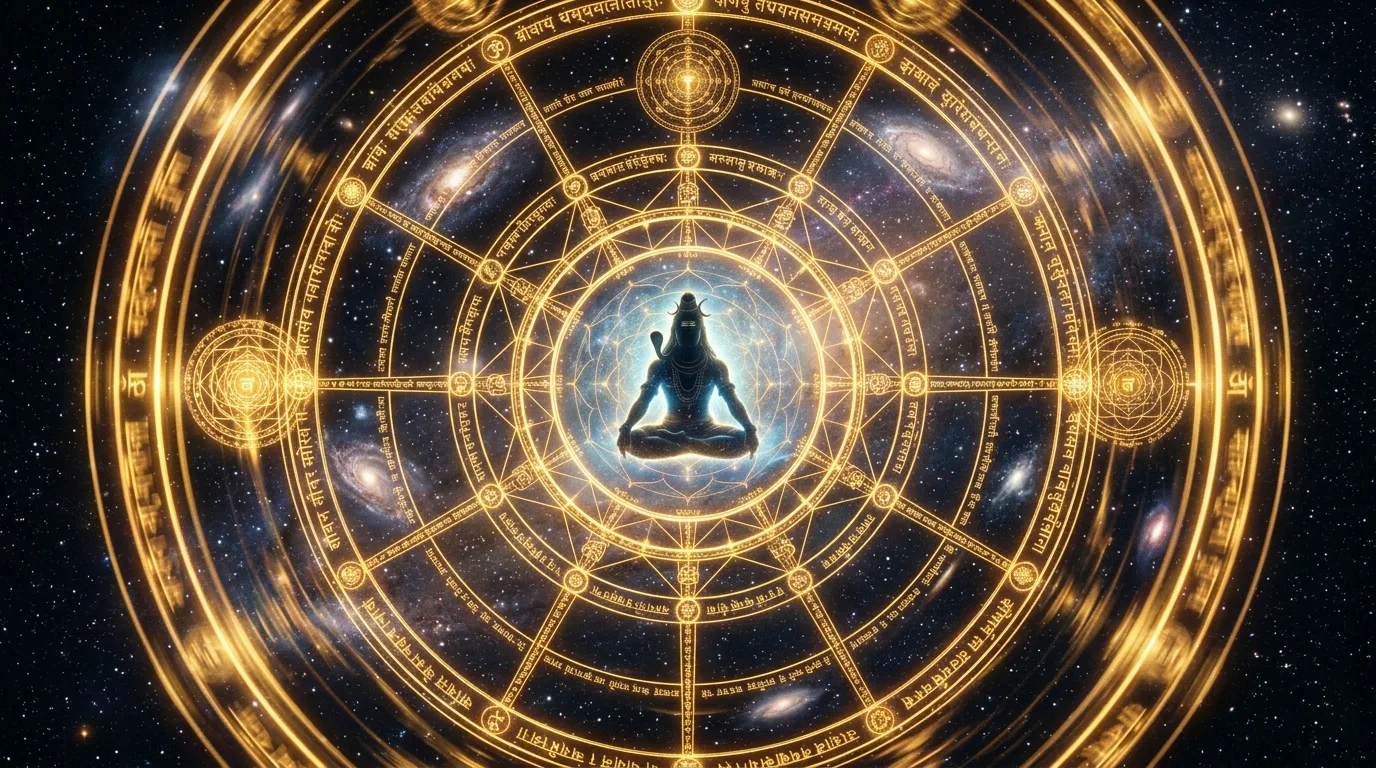
The Ultimate Subject: The Epistemology of the Soul in the Brihadaranyaka Upanishad
Drafted with the help of AI from the original texts named in the article; I read and correct every article after it is published. How we use AI
Explore Yajnavalkya's profound debate on the Unknowable Knower, the Ultimate Subject, and its striking resonance with the Hard Problem of Consciousness.
In this article
The nature of consciousness and the existence of the soul are among the most fiercely debated topics in human history. While modern discourse often frames this as a conflict between faith-based religion and empirical science, the classical philosophical traditions of India approached this mystery through rigorous logic and epistemology. This article examines one of the most profound philosophical tournaments in ancient history, recorded in the Brihadaranyaka Upanishad. We will explore how the sage Yajnavalkya, rather than offering dogmatic beliefs, dismantled the very premise of trying to objectively "prove" the soul. By defining the soul as the "Ultimate Subject"—the eternal witness that can never be witnessed—this ancient text presents an epistemological framework that continues to resonate powerfully with modern philosophical inquiries into the nature of consciousness.
What the Text Actually Says
The philosophical peak of the Brihadaranyaka Upanishad—the oldest and largest of the Upanishads—occurs in its third chapter, widely known as the Yajnavalkya Kanda. The setting is not a quiet hermitage, but a high-stakes, deeply intense philosophical tournament hosted by King Janaka of Videha. The King offers a staggering prize to the supreme knower of Brahman: one thousand cows, each with horns plated in pure gold. Before the debate even commences, the sage Yajnavalkya steps forward and instructs his disciple to drive the cows away, claiming the prize by sheer intellectual authority. Enraged by this audacity, the greatest scholars of the era step up to systematically dismantle his philosophy.
What follows is a ruthless dissection of reality. The profound teaching on the epistemology of the soul emerges when a formidable scholar named Ushasta Chakrayana challenges Yajnavalkya. Ushasta demands an empirical, objective proof of the soul. He asks Yajnavalkya to explain the Brahman that is immediate and direct—the Self that is within all things. Essentially, Ushasta is asking: "Show me the soul. Prove it exists as a distinct entity I can comprehend."
Yajnavalkya's response represents a monumental shift in human thought. He declares that the soul cannot be shown, measured, or known as an object of perception. He states: "You cannot see the seer of seeing, you cannot hear the hearer of hearing, you cannot think the thinker of thinking, you cannot understand the understander of understanding. He is your Self, which is in all things."
The core of this teaching is that the soul is the Ultimate Subject. Everything else in the universe is an object. Physical matter, physiological processes, thoughts, emotions, memories, and even the intellect itself—all of these can be observed. Because they can be observed, they are objects of experience. The soul, however, is the singular entity doing the observing. The precise moment you attempt to "look" at the soul or conceptualize it, you are turning it into an object of observation, which means it is no longer the soul; it is simply another thought or sensation appearing in the mind. The soul is the eternal "Witness" that can never be witnessed.
Later in the same tournament, Yajnavalkya faces an even more rigorous challenge from the female sage Gargi Vachaknavi. Gargi pushes the debate from epistemology (how we know) to cosmology and ontology (the structure of reality). She asks what the fabric of space and time is woven upon, using the metaphor of warp and woof (the vertical and horizontal threads of a loom). She relentlessly questions him, tracing the regression of reality through earth, water, fire, air, and space. When pushed to the ultimate edge of existence, Yajnavalkya reveals the Akshara (the Imperishable). He declares that this ultimate foundation of reality is not a physical substance or a primordial particle, but the very consciousness that sees, hears, and knows, while remaining entirely unseen, unheard, and unknown itself.
Key Terms Explained
To truly grasp the depth of this debate, we must understand the precise Sanskrit terminology used in the text. These are not merely poetic words, but highly specific philosophical classifications.
- Drashtā (द्रष्टा): Often translated simply as "The Seer," this term specifically denotes the pure subject, the ultimate locus of consciousness. It is the silent, unchanging witness behind the physical eyes, behind the optic nerve, and behind the mechanical processing of the brain. The Drashta does not act; it merely illuminates the actions and perceptions of the mind and body.
- Vijnātā (विज्ञाता): This translates to "The Knower." Yajnavalkya uses this term to deliver his ultimate rhetorical question: "Vijnātāram are kena vijānīyāt?" ("By what should one know the Knower?"). This specific phrasing completely collapses the idea that God or the Soul is a "thing" to be studied. If the Knower is the tool used for knowing, you cannot use the tool to grasp the tool itself.
- Sākṣhād Aparokṣhād (साक्षादपरोक्षाद्): Sakshad means direct or immediate; Aparoksha means unmediated (literally, "not away from the eyes," meaning not dependent on the external senses). Ushasta demands an experience of the soul that is not filtered through the eyes, ears, or mind. Yajnavalkya proves that only pure subjectivity—the sheer fact of "I am"—possesses this unmediated reality. Everything else is mediated by sensory organs.
- Akshara (अक्षर): Translating to the "Imperishable" or "Immutable." In the cosmological debate with Gargi, this term describes the ontological bedrock of reality. It is crucial to understand that Akshara does not mean a tough, unbreakable physical material. It means that which does not decay or change because it exists entirely outside the constraints of space, time, and causality.
- Neti, Neti (नेति नेति): Translating to "Not this, not this." This is Yajnavalkya’s supreme analytical tool, the process of via negativa (the negative way). You arrive at the truth of the soul via rigorous negation. Is my physical body the soul? No, I can observe it changing. Is my anger the soul? No, I can observe it rising and passing away. By systematically stripping away every single object of experience, what remains as the undeniable, un-negatable residue is the pure subject.
Traditional Interpretation
Classical Indian philosophy is not a monolith, and different schools of Vedanta have interpreted Yajnavalkya's profound declarations in distinct ways, leading to rich theological traditions.
- Advaita Vedanta (Non-dualism - Adi Shankaracharya): Adi Shankaracharya leans heavily on this exact dialogue to establish the concept of Nirguna Brahman (Brahman or Ultimate Reality without attributes). Because Yajnavalkya strips the soul of all perceivable qualities through the process of Neti, Neti, Shankara argues that the individual soul (Atman) and the supreme reality (Brahman) are identical. They are both pure, featureless consciousness, completely devoid of material, psychological, or distinct personal traits. In Advaita, the "Unknowable Knower" is the only true reality; all objects are ultimately an illusion (Maya).
- Vishishtadvaita Vedanta (Qualified Non-dualism - Ramanujacharya): Ramanujacharya offers a different lens, focusing heavily on another debate within this same tournament involving the scholar Uddalaka Aruni. In that debate, Yajnavalkya introduces the concept of the Antaryamin (The Inner Controller). Ramanuja argues that while Yajnavalkya rightly proves the soul is a pure subject distinct from material objects, the Supreme Lord (Narayana) exists inside the individual soul. The Lord controls the soul from within, just as the soul animates the body. Thus, Ramanuja maintains a subtle but absolute distinction between the individual soul and God, even while acknowledging the soul's non-material nature.
How This Connects
The philosophical earthquake triggered by Yajnavalkya in the court of King Janaka became the foundational logic for numerous subsequent spiritual texts in the Sanatan Dharma tradition.
- The Kena Upanishad: The epistemological framework established by Yajnavalkya is the direct structural foundation for the Kena Upanishad. Its famous opening verses declare: "That which the eye does not see, but by which the eye sees... That which the mind does not think, but by which the mind thinks... know that alone to be Brahman." This is a direct continuation of the "seer of seeing" logic.
- Drig-Drishya Viveka (The Seer and the Seen): This later Vedantic text is entirely built upon Yajnavalkya's premise. It acts as a systematic, step-by-step manual that categorizes absolutely everything in reality as either Drishya (the seen/the object) or Drig (the seer/the subject). It meticulously proves that the intellect, the ego, and the subconscious mind are just subtle objects illuminated by the true Self.
- The Bhagavad Gita: When Lord Krishna explains the nature of the soul in Chapter 2, describing it as uncuttable, unburnable, and unwettable, He is relying on Yajnavalkya’s definition of the Akshara (the Imperishable) established in the debate with Gargi. Furthermore, Chapter 13 of the Gita introduces the concept of Kshetra (the field, representing all objects and the body) and Kshetrajna (the knower of the field, the pure subject). This is a direct philosophical descent from Yajnavalkya's distinction between the observer and the observed.
Sources
- The Brihadaranyaka Upanishad: Specifically Chapter 3 (Yajnavalkya Kanda), detailing the debates with Ushasta Chakrayana and Gargi Vachaknavi.
- The Kena Upanishad: Referenced for its continuation of the "seer of seeing" philosophical framework.
- The Bhagavad Gita: Referenced for chapters 2 and 13 (Kshetra and Kshetrajna).
This reflects what the text itself says; the modern-science comparisons above are interpretation, not an established finding.