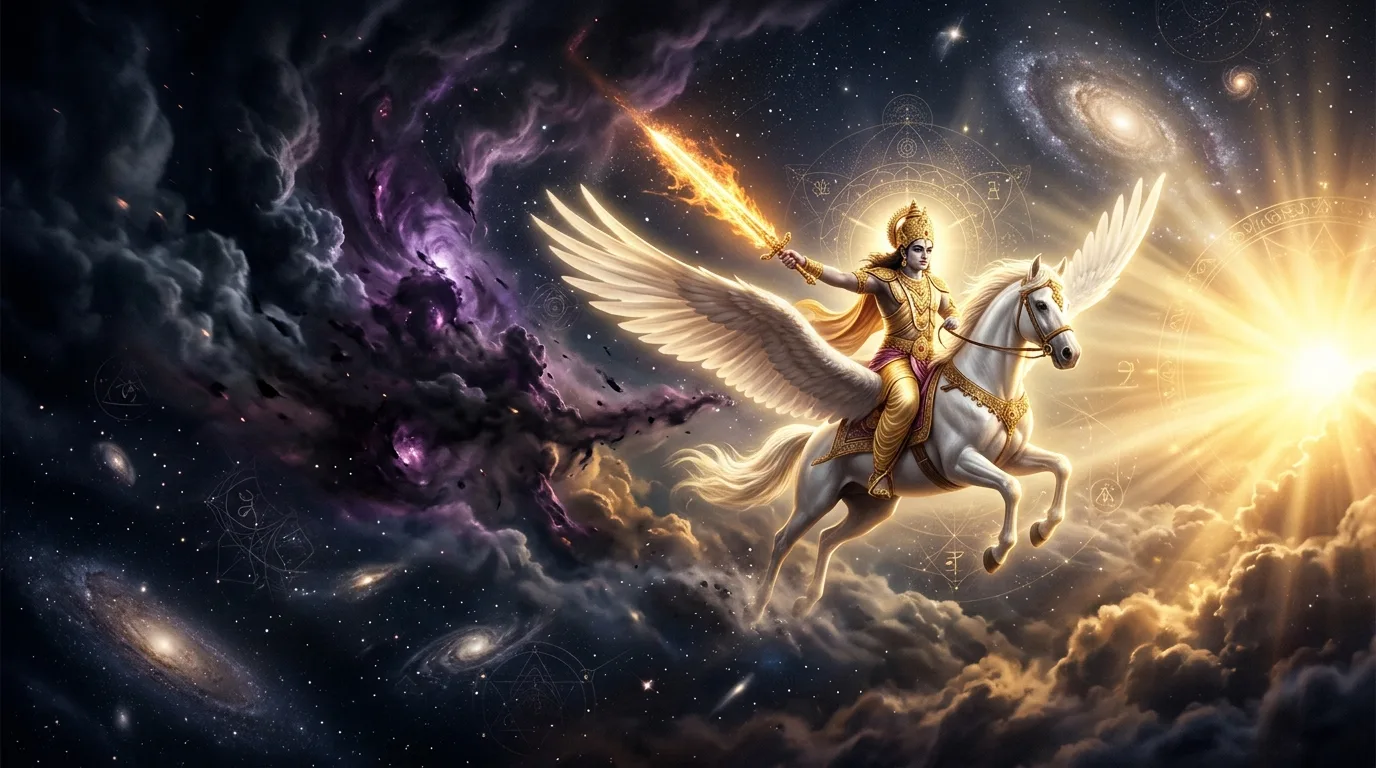
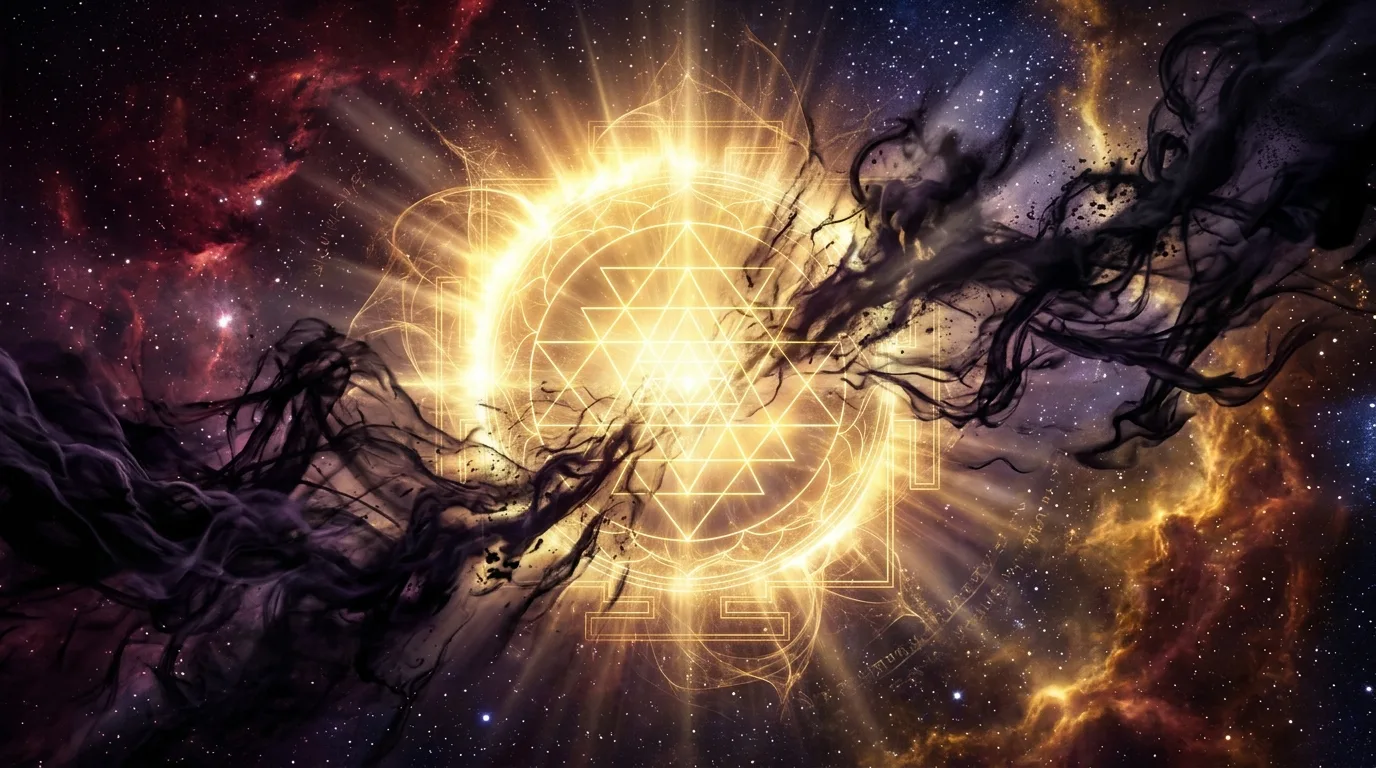
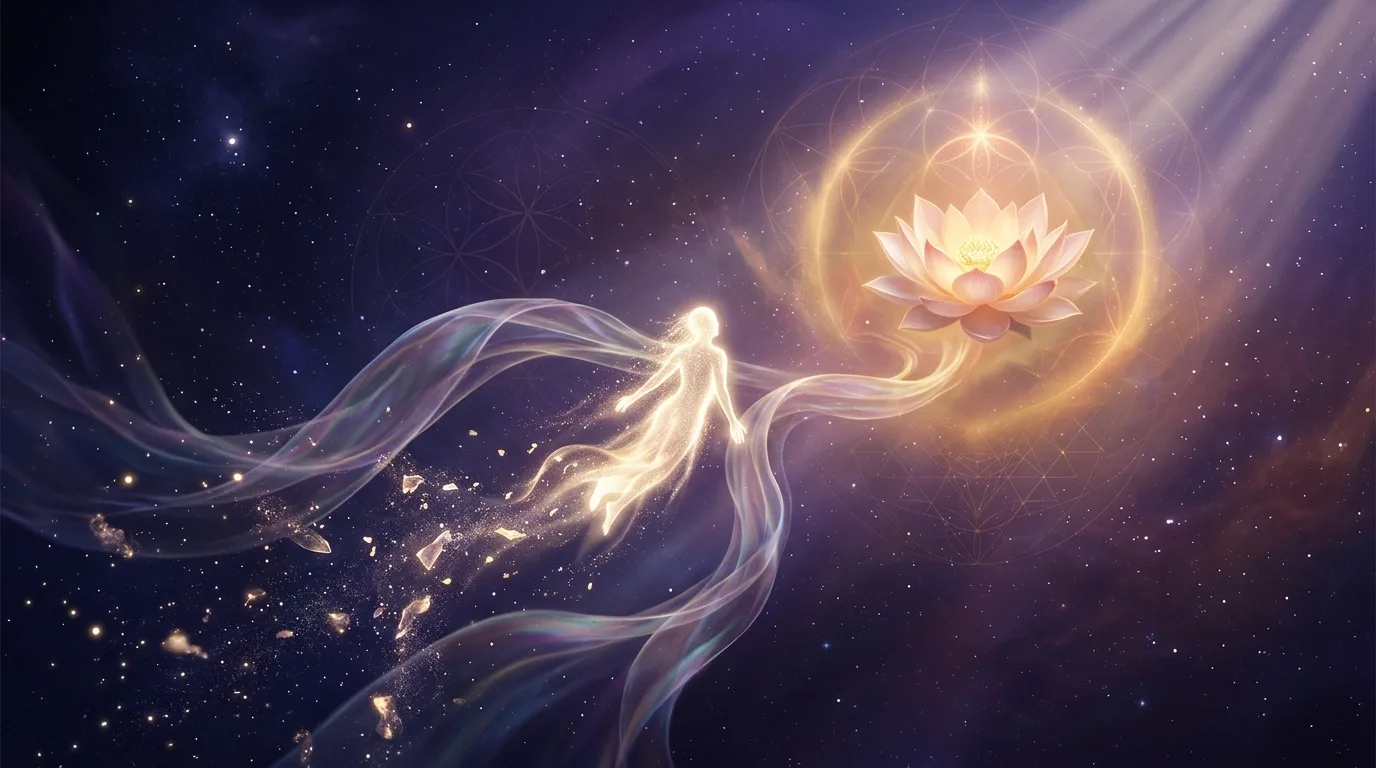
The Ancient Cosmology of the Padma Purana: Mapping the Edge of Reality
Drafted with the help of AI from the original texts named in the article; I read and correct every article after it is published. How we use AI
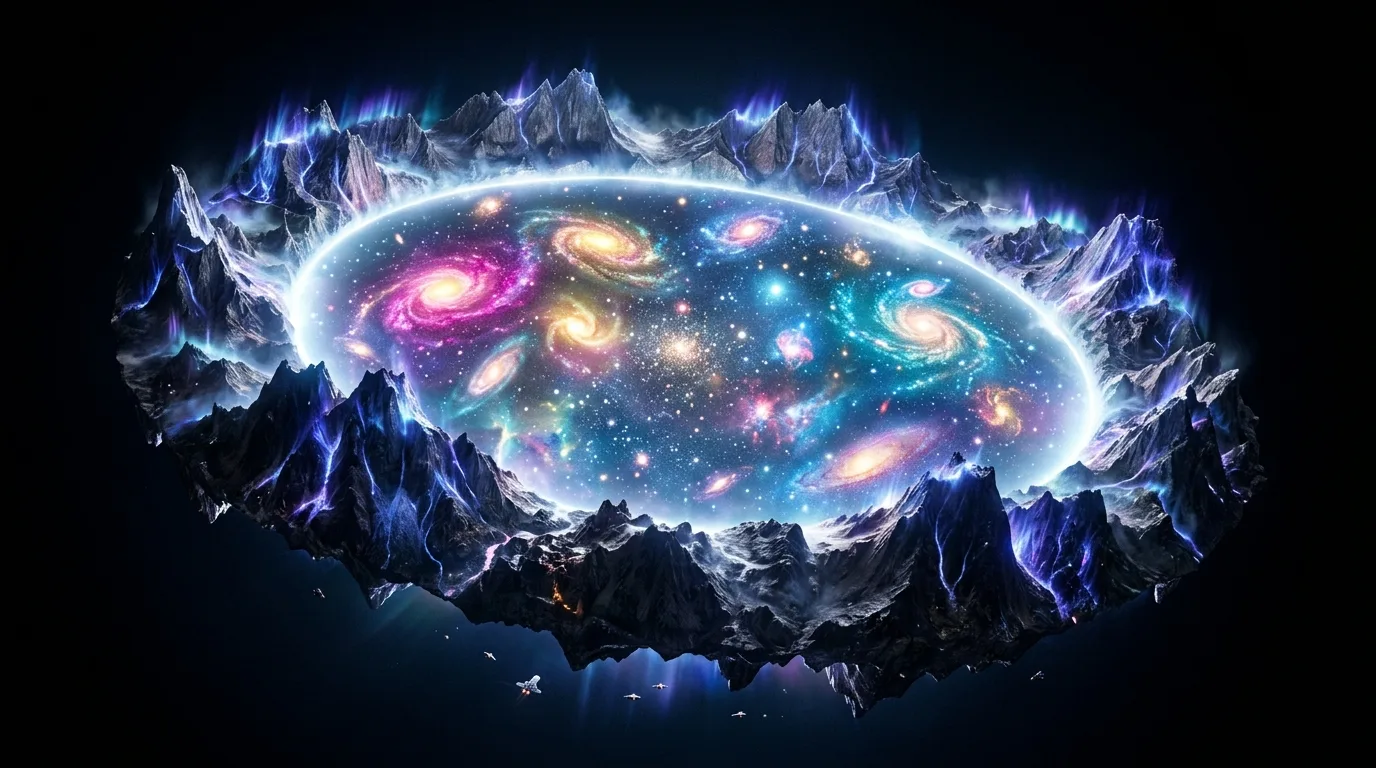
Explore the Padma Purana's cosmological map, where physical geography ends at the Lokāloka boundary and reality dissolves into cosmic intelligence.
In this article
Most modern content creators approach classical Hindu cosmology—with its flat discs, concentric oceans, and central mountains—and either dismiss it as primitive cartography or aggressively try to force it to match modern terrestrial globes. Both approaches fundamentally miss the profound philosophical intent of these texts. The Padma Purana does not treat geography merely as a physical map of dirt, water, and continents. Instead, it treats geography as a structural map of reality itself. In this deep dive, we will travel to the absolute edge of the observable universe as described in the ancient scriptures to explore a mind-bending ancient proposition: what happens when you reach the absolute end of physical space, and why the ultimate boundary of our universe isn't made of matter at all.
What the Text Actually Says
The most intricate details regarding the cosmos in the Padma Purana are found in the Svarga Khanda and Bhumi Khanda. According to these sections, if a traveler were to journey continuously outward from our Earth (Bhū-maṇḍala), they would cross a series of alternating, concentric circles of vast landmasses and exotic oceans. However, this physical geography is not infinite. It eventually comes to a definitive stop.
At the absolute limit of the observable universe stands a colossal, ring-shaped mountain range known as Lokāloka. The Purana explicitly states that this mountain range serves as the absolute boundary of light. On the inner side of this mountain lies the illuminated, measurable, and observable universe. On the outer side lies total, absolute void and impenetrable darkness.
But the geography of the Padma Purana does not end at this darkness. Beyond the dark void lies the actual "shell" of our universe. The text conceptualizes our universe as being shaped like an egg, known as the Brahmāṇḍa. What is truly revolutionary is the text's description of what lies outside this egg. The universe is encased in seven distinct, nested envelopes or layers, known as the Saptāvaraṇa.
Ancient geography here shatters modern material expectations. These protective layers are not made of ice, rock, or plasma. The first shell encasing the universe is made of pure Water, and it is ten times thicker than the universe itself. The next shell is Fire, ten times thicker than the water shell. This is followed by Air, which is ten times thicker than the fire shell, and then Ether (Ākāśa—the fabric of space).
However, it is the final three layers where physical matter completely ceases to exist. The fifth shell encasing the universe is made of Ahaṅkāra (Cosmic Ego, or the principle of "I-ness"). The sixth shell is Mahat-tattva (Cosmic Intelligence). The seventh and final outermost shell is Prakṛti (Unmanifested Raw Nature). The Padma Purana teaches something extraordinarily profound: as you travel to the outer limits of geographical space, physical matter literally dissolves into psychology and consciousness. The physical universe is not expanding into an empty void; it is physically encased inside a cosmic mind.
Key Terms Explained
To truly grasp this philosophical geography, we must understand the precise Sanskrit terminology used in the texts:
- Brahmāṇḍa (ब्रह्माण्ड): Often casually translated simply as "universe," it literally translates to "The Egg of Brahma." The use of the word "egg" is crucial. It implies that the universe is a closed, growing, incubated system with distinct, definitive boundaries, rather than an infinite, formless, expanding expanse.
- Lokāloka (लोकालोक): This is a brilliant linguistic compound of Loka (World / Where light falls / The observable) and Aloka (Non-world / The unlit / The unobservable). It is not just a physical mountain made of rocks; it acts as the epistemological event horizon of human perception.
- Saptāvaraṇa (सप्तावरण): Formed from Sapta (seven) and Avaraṇa (covering, shield, or veil). These are not merely "layers." An avaraṇa implies something that intentionally cloaks or hides the ultimate reality outside of it. It acts as an isolation barrier separating the illusion inside the egg from the ultimate truth outside.
- Daśaguṇa (दशगुण): Meaning "ten-fold." The Padma Purana is highly mathematically specific here, stating that every outer envelope is exponentially larger (10x) than the one it contains, creating a staggering, mind-numbing scale of cosmic nesting.
- Mahat-tattva (महत्-तत्त्व): The Great Principle. This represents cosmic intellect or universal intelligence. It can be thought of as the fundamental "source code" or logic engine from which all physical reality is subsequently compiled and rendered.
Traditional Interpretation
How did classical sages and traditional commentators view this map? They did not view it as a physical map to be navigated with advanced spacecraft. Instead, they read it through the foundational Vedic maxim: “Yathā Piṇḍe Tathā Brahmāṇḍe” (As is the microcosm/body, so is the macrocosm/universe).
The structure of the universe is a mirror of the structure of the human being. The seven cosmic shells (Avaraṇas) perfectly mirror the sheaths (Koshas) of the human body found in Vedanta philosophy—ranging from the physical body (Annamaya Kosha) to the energy body, the mental body, and the intellectual body.
Therefore, traditional yogic schools interpret this geography as a literal roadmap for spiritual liberation (Moksha). To escape the endless cycle of rebirth, a soul cannot simply build a rocket and leave Earth. The true journey is inward and upward: you must shed your physical form, pierce through the boundary of your own cosmic ego, and finally break through the cosmic intellect to merge back into the Absolute. In this tradition, geography is intimately tied to spiritual ascension.
How This Connects
This framework of the universe fundamentally contextualizes and grounds other major texts within Sanatan Dharma. For example, it directly parallels the teachings of the Yoga Vasistha, which famously asserts that the entire physical universe is a mental simulation or a waking dream (Jagrat-Svapna). The Padma Purana provides the exact structural geography for that very simulation. By stating that the physical elements are encased within a massive sphere of cosmic intelligence (Mahat), it explains the mechanics of how a universe is projected within a mind.
Furthermore, this connects deeply to the Bhagavad Gita (Chapter 7, Verses 4-5), where Lord Krishna describes His energies. He categorizes Earth, Water, Fire, Air, Ether, Mind, Intellect, and Ego as His "lower" nature, which perfectly aligns with the elements and shells of the Saptāvaraṇa. He then distinguishes this from His "higher" nature, the underlying, sustaining consciousness.
Modern Research or Science
While reading ancient texts as modern physics textbooks is a flawed approach, there are two striking and honest philosophical parallels between the Padma Purana’s cosmology and modern astrophysics:
- The Cosmological Horizon: The Lokāloka mountain range perfectly describes the modern astrophysical concept of the "Observable Universe." Because light has a strict speed limit, there is a literal, physical boundary in space beyond which we cannot see, regardless of how powerful our telescopes become. Beyond that boundary is darkness to us. This mirrors exactly what Lokāloka represents: the absolute, impassable limit of light and observability.
- Information Theory / Digital Physics: The transition at the edge of the universe from physical elements to abstract concepts like Ego and Intelligence finds a philosophical parallel in modern "Digital Physics," particularly in the work of theoretical physicist John Archibald Wheeler. His "It from Bit" theory proposed that at its most fundamental, microscopic boundaries, the universe isn't made of solid matter; it is made of information, binary logic, and quantum states. The Purana’s assertion that the outer shell of physical reality is pure Mahat (intelligence/information) is a stunning conceptual resonance.
Where the Comparison Holds, and Where It Doesn't
Honesty is crucial when engaging with scriptural science. The comparison holds beautifully in its epistemological limits: both ancient sages and modern astrophysicists agree that human observability has a strict boundary (Lokāloka / Cosmological Horizon). Both frameworks also share a profound philosophical conclusion that at the absolute edge or foundation of reality, "solid matter" ceases to be the primary building block, giving way to information, mathematics, or "intelligence."
However, the comparison does not hold if we attempt to claim that ancient Indians possessed quantum supercomputers or literally mapped the cosmic microwave background radiation. The Padma Purana relies on the philosophical framework of Sāṅkhya—the science of emanation, reasoning that creation unfolded from the subtle to the gross (Involution). Traveling to the edge of space is a metaphor for traveling backward in time and causality. The text is providing a metaphysical, cognitive, and spiritual map of how consciousness renders reality, not an empirical, physical map of exoplanets.
Frequently Asked Questions
1. Is the Lokāloka mountain a real physical mountain on Earth? No. In Puranic cosmology, Lokāloka is not a terrestrial mountain you can climb. It represents a massive cosmological boundary, the absolute event horizon where the observable, illuminated universe ends.
2. What does Brahmāṇḍa literally mean? It translates to "The Egg of Brahma." This term defines the universe as a closed, finite, and incubated system with distinct boundaries, contrary to the idea of a completely infinite, formless void.
3. How does this text relate to modern Simulation Theory? The Padma Purana states that the outermost layers encasing physical reality are Cosmic Ego and Cosmic Intelligence (Mahat-tattva). This creates a structural model where physical matter is a projection occurring inside a larger "mind" or logic engine, mirroring the core premise of modern simulation theory.
Sources
- The Padma Purana (Specifically detailed in the Svarga Khanda and Bhumi Khanda)
- Sāṅkhya Philosophy (For the conceptual framework of Prakṛti, Mahat, and Ahaṅkāra)
- Modern Observational Astronomy (The concept of the Cosmological Horizon)
- Digital Physics (John Archibald Wheeler's Information Theory and "It from Bit" framework)
This reflects what the text itself says; the modern-science comparisons above are interpretation, not an established finding.