What the Kalki Purana Really Teaches About the End of Kali Yuga
Drafted with the help of AI from the original texts named in the article; I read and correct every article after it is published. How we use AI
A complete look at the Kalki Purana: how corrupted speech sparks decay, why weapons teach non-duality, and why the avatar refuses to rule worldly kingdoms.
In this article
- The Family Tree of Moral Decay
- The Four Quarters of Kali Yuga and the Danger of Monoculture
- Parashurama's Mountain Gurukula and the Divine Regalia
- The Encounter at Sinhala-dvipa and the Consecration of Desire
- The War of Virtues and the Burning of Vishasana
- The Paradox of Koka and Vikoka
- When Weapons Preached Non-Duality
- Waking the Sleeping Kings and the Final Abdication
- Seven Sanskrit Terms That Anchor the Narrative
- How the Commentators Read the Text
- Echoes Across Classical Literature
- Where Modern Systems Science Resonates
- What the Scripture Does Not Say
- Frequently Asked Questions
- Sources
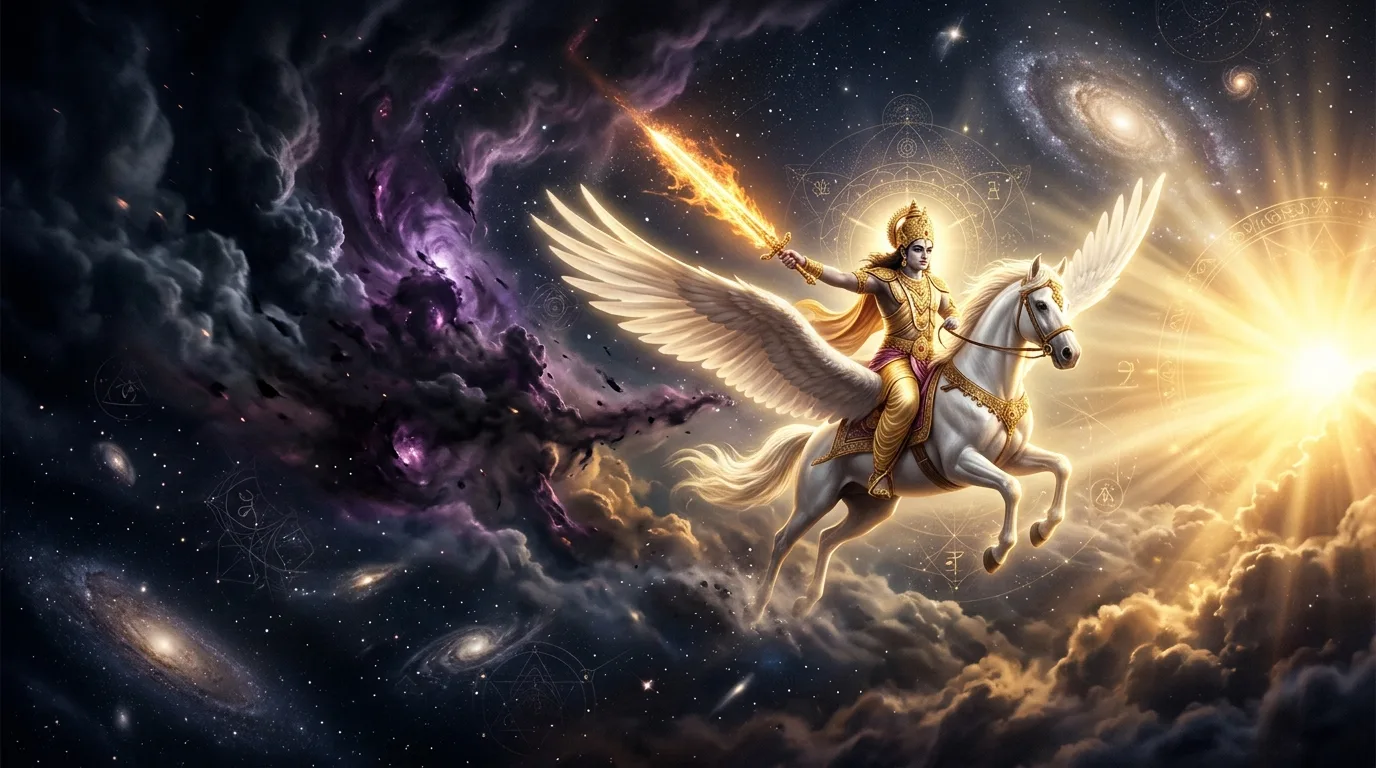
If you spend any time on social media or watch modern cinematic adaptations of ancient epics, you have probably seen a very specific depiction of the tenth avatar. A warrior appears on a flying white horse, brandishes a blazing sword, and slashes through evil armies to reset human history like a reboot button in a video game. It looks exciting on a screen, but it leaves an empty feeling behind. Does human history really end with a sudden cinematic explosion, or is civilization's unraveling much quieter, slower, and far closer to home?
When I sat down to read the original Sanskrit verses of the Kalki Purana, I found an entirely different world. The text does not describe an overnight cataclysm. It describes a slow, collective decay of human cognition, beginning with how we speak to one another and ending in a uniform consumer culture where everyone thinks alike. The avatar does not come to conquer the earth or set up an earthly dictatorship. He purifies the environment, wakes up ancient human stewards who had been preserved in quiet reflection, and walks away into the forest.
The Sri Kalki Purana is traditionally classified as an Anubhagavata, a specialized supplementary text to the Srimad Bhagavata Mahapurana, attributed to Krishna Dvaipayana Vyasa. Spanning three sections and thirty-five chapters, it takes the form of a dialogue in the sacred forest of Naimisaranya between the sage Suta Gosvami and an assembly of eighty-eight thousand seekers led by Shaunaka. When you read what Suta Gosvami actually recited, the narrative turns out to be far more penetrating than any modern comic book.
The Family Tree of Moral Decay
In the first chapter of the Kalki Purana, verses fourteen through twenty-two, the text does something unexpected. It does not introduce Kali, the personification of the dark age, as an alien demon bursting through the sky. Instead, it traces his ancestry through a precise family tree of moral collapse.
The lineage begins with Adharma, which means living in direct defiance of natural order. Adharma marries Mithya, which translates to falsehood or systematic deceit. When lawlessness pairs with untruth, their child is Dambha, or vanity and institutional hypocrisy. After all, when people abandon genuine truth, they must perform virtue loudly to keep their status intact.
Dambha unites with Maya, or duplicity, and their union gives birth to Lobha, insatiable greed, and Nikriti, the impulse to cheat. When greed encounters the hard reality of finite physical resources, frustration is inevitable. That frustration gives birth to Krodha, uncontrolled rage, which marries Himsa, intentional cruelty. From this marriage of cruelty and wrath, Kali Purusha is finally born.
The text is telling us that civilizational decay is not an external accident. It is an organic, multi-generational sickness that takes root when simple truthfulness is abandoned. But the text does not stop there. It gives Kali a wife named Durukti, which literally means foul, abusive, or weaponized speech. From the union of the dark age and corrupted communication come two children: Bhaya, existential terror, and Mrityu, death. Their children, in turn, are Niraya, the state of living hell, and Yatana, chronic, relentless agony.
The physical description of Kali Purusha in verses eighteen through twenty is equally deliberate. He is described as holding his genitals with his left hand, an ancient visual metaphor for total enslavement to animal impulse and a complete loss of self-restraint. His skin is slick and dark like greasy soot. He has the sunken belly of a crow, a wide ravenous mouth, and a flicking tongue that is never satisfied. He smells like decomposing waste, and he makes his residence in five specific places: gambling, intoxication, the exploitation of women, slaughter, and hoarded gold.
Notice how modern this diagnosis feels. Before institutions collapse and before cities burn, communication rots. When everyday speech turns malicious and dishonest, anxiety and chronic distress follow as a natural psychological consequence.
The Four Quarters of Kali Yuga and the Danger of Monoculture
In verses thirty-seven and thirty-eight of the first chapter, Suta Gosvami explains how the dark age unfolds across four distinct phases:
एवं तु प्रथमे पादे कलेः कृष्णविनिन्दकाः ।
द्वितीये तन्नामहीनास्तृतीये वर्णसङ्कराः ।
एकवर्णाश्च तुर्ये च विस्मृताच्युतसत्क्रियाः ॥
evaṁ tu prathame pāde kaleḥ kṛṣṇa-vinindakāḥ |
dvitīye tan-nāma-hīnās tṛtīye varṇa-saṅkarāḥ |
eka-varṇāś ca turye ca vismṛtācyuta-satkriyāḥ ||
In the first quarter of the age, people become open cynics. They actively mock the divine and ridicule the idea of higher meaning. In the second quarter, spiritual amnesia sets in, and sacred memory quietly slips away from daily life. In the third quarter, vocational boundaries and ethical duties become confused, leaving people unsure of what their life's work truly is.
The fourth quarter brings the most striking diagnosis of all. Suta Gosvami calls it Eka-varna, which literally means a single, undifferentiated color. Many modern readers assume this means a utopian society without divisions, but the verses that follow clarify that it means the exact opposite. It describes a rootless, homogenized monoculture where all unique temperaments, sacred callings, and spiritual depth have been flattened into one uniform consumerist mass.
The text describes the specific social symptoms of this final phase with startling clarity:
First, loud talking and endless argument are mistaken for genuine scholarship. The louder someone shouts, the wiser they are assumed to be.
Second, sheer wealth becomes the only yardstick for virtue and saintliness. If a person has money, society assumes they must also possess character.
Third, sacred pilgrimage is reduced to a shallow physical checklist. People travel great distances merely to bathe in distant waters, completely ignoring the inner purification that the pilgrimage was meant to provoke.
Fourth, genuine family bonds dissolve. Men abandon their aging parents and brothers, maintaining relationships only with their in-laws or with those who offer immediate commercial and transactional advantage.
The scripture does not describe an era dominated by rigid ancient social structures. It describes an era where all traditional distinctions have been dissolved by market pressures, leaving behind an anxious crowd of people who all desire the same trivial objects.
Parashurama's Mountain Gurukula and the Divine Regalia
When the avatar finally appears in the village of Shambhala, he does not arrive as an emperor surrounded by imperial luxury. He is born as the fourth son of an unassuming, pious Brahmana named Vishnuyashas and his wife Sumati.
After completing his sacred thread ceremony, young Kalki leaves his home and ascends Mount Mahendra. Waiting for him on that mist-covered peak is Bhagavan Parashurama, the immortal warrior-sage who had previously taught Bhishma, Drona, and Karna.
Parashurama does not immediately hand him weapons. He puts Kalki through years of intense discipline, instructing him in the four Vedas, the sixty-four traditional arts, and the ethics of warfare known as Dhanurveda. Parashurama makes it clear that the dark age cannot be conquered by physical muscle alone. If you fight an entropic disease with mere violence, you only multiply the entropy.
Following his guru's instructions, Kalki performs deep tapasya dedicated to Lord Shiva. Pleased with his purity, Shiva grants him three divine gifts:
The first is Devadatta, a brilliant white steed that embodies the quality of Sattva, representing pure mobility, clarity, and unhindered vitality.
The second is Ratnamaru, a sword whose name signifies discriminative discernment, the razor-sharp faculty of buddhi that separates truth from illusion.
The third is Shuka, an all-knowing parrot who embodies Vedic wisdom and serves as Kalki's philosophical ambassador and intelligence scout.
These three gifts reveal the internal logic of the text. To navigate a world poisoned by deceit and confusion, you do not need heavier artillery. You need clear life energy, keen intellectual discernment, and truthful communication.
The Encounter at Sinhala-dvipa and the Consecration of Desire
Before any military campaign takes place, the Kalki Purana takes an unexpected detour. In chapters four through seven, Kalki travels south to the island of Sinhala-dvipa to meet Princess Padmavati, the earthly incarnation of Lakshmi.
Padmavati possessed an extraordinary boon granted by Lord Shiva. Any worldly king who looked upon her with lustful, possessive desire was instantly transformed into a woman on the spot.
When monarchs arrived from across the world to claim her at her Svayamvara, their minds were filled with aggressive entitlement. The moment their eyes fell on her, their masculine pride vanished. They found themselves transformed into women, experiencing firsthand the vulnerability of being looked at as a prize to be seized.
When Kalki arrives, his mind is entirely free from transactional desire. He does not view Padmavati as an object of conquest. When their eyes meet, the spell breaks. Kalki gently touches the transformed kings, and their male forms are restored. More importantly, their psychological delirium is cured.
This episode acts as a spiritual filter. The scripture insists that uncurbed desire, or kama, must be elevated into selfless devotion, or bhakti, before any lasting civilizational renewal can occur. A hero who has not conquered his own predatory instincts has no business trying to clean up the world.
The War of Virtues and the Burning of Vishasana
When the confrontation between order and decay finally unfolds in chapter twenty-one, the text presents a battle that looks entirely different from mundane warfare. The army of light is composed of personified virtues, while the forces of Kali are made up of psychological vices:
एवं प्रवृत्ते संग्रामे धर्मः परमकोपनः ।
कृतेन सहितो घोरं युयुधे कलिना सह ॥
evaṁ pravṛtte saṅgrāme dharmaḥ parama-kopanaḥ |
kṛtena sahito ghoraṁ yuyudhe kalinā saha ||
Dharma, the cosmic order, stands side by side with Krita, the spirit of the Golden Age, to confront Kali directly. Behind them, specific virtues engage their exact psychological opposites:
Prasada, which means inner serenity and mental clarity, shatters the skull of Lobha, insatiable greed, whose war chariot was pulled by starving, feral dogs.
Abhaya, pure fearlessness, disarms Krodha, uncontrolled rage. The text notes that rage is simply a mask for hidden vulnerability, so when genuine courage appears, rage has nothing left to stand on.
Sukha, spiritual contentment, strikes down Bhaya, existential terror, with the simple slap of an open palm.
Mud, joyful gratitude, beats Niraya, the psychological state of living hell, using only its bare hands.
Dharma and Krita then march toward Kali's capital city, named Vishasana, which translates literally to the place of slaughter or institutional cruelty. They set the corrupt citadel on fire. Kali is badly scorched, his family network falls apart, and he retreats into an unmanifest crack between time cycles. The text points out that Kali is not permanently erased from the cosmos. Because time is cyclical, the potential for decay must remain dormant until the next turn of the great wheel. But his active power over human minds is brought to a complete halt.
The Paradox of Koka and Vikoka
Just when it seems that the battle is won, Kalki is challenged by two demon brothers named Koka and Vikoka, the sons of Vrikasura.
Verses fourteen through thirty of chapter twenty-one describe a bizarre and stubborn feedback loop: Kalki cuts off Vikoka's head with a crescent arrow, but the instant his brother Koka looks at the fallen body, Vikoka springs back to life, completely healed. Kalki then turns and crushes Koka's head with his mace. The moment Vikoka looks at Koka, Koka instantly revives.
No matter how many times Kalki strikes them down, the gaze of the living twin resurrects the dead one.
These twin demons represent the feedback loop of dualistic obsession. Think of fear and hatred in human politics, or personal ego and nagging self-doubt. You cannot eliminate hatred while feeding your fear, and you cannot dismantle doubt while inflating your ego. Each emotion looks at the other, confirms its reality, and brings it back to life.
Lord Brahma descends from the heavens to give Kalki the precise formula needed to break the cycle: First, they cannot be killed by any forged blade or projectile weapon, because weapons belong to the world of division and distance. Second, they must be struck down at the exact same instant. Third, they must be destroyed through direct, bare-handed contact, breaking the visual line between them.
Kalki immediately dismounts from his horse, drops his sword Ratnamaru, and steps forward empty-handed. With his bare fists, he strikes both demons simultaneously. Denied the mutual gaze that kept their cycle of resurrection alive, the twins collapse and dissolve forever.
When Weapons Preached Non-Duality
The most unexpected scene in the entire Kalki Purana occurs in chapter fifteen. After the armies of the corrupt kings are defeated, their grieving queens and wives take up armor, draw their swords, and march onto the battlefield to avenge their husbands.
Kalki stops his men and refuses to raise his hand against them. He explains that attacking grieving women violates every principle of righteous conduct. As the furious queens rush forward, ready to strike him down, an astonishing event takes place: the swords, spears, and arrows in their hands suddenly come alive, turn around, and speak to the women in clear Sanskrit verses:
असौ पतिर्मे भार्याहम् अस्य पुत्राप्तबान्धवाः ।
स्वप्नोपमास्तु तन्निष्ठा विविधाश्चेन्द्रजालवत् ॥
न शस्त्राणि वयं नार्यः संप्रहार्या न च क्वचित् ।
शस्त्रप्रहर्तृभेदोऽयम् अविवेकः परात्मनः ॥
asau patir me bhāryāham asya putrāpta-bāndhavāḥ |
svapnopamās tu tan-niṣṭhā vividhāś cendrajālavat ||
na śastrāṇi vayaṁ nāryaḥ saṁprahāryā na ca kvacit |
śastra-prahartṛ-bhedo'yam avivekaḥ parātmanaḥ ||
The weapons declare: "You say, 'He was my husband, I am his wife, these are our children and relatives.' But these temporary identities are like dreams, like the tricks played by a traveling magician. We are not truly weapons, and you are not targets or attackers. The sharp division you feel between the weapon, the one who strikes, and the one who falls is born entirely from spiritual ignorance, forgetting that the one supreme consciousness lives within all beings."
Upon hearing this direct philosophical truth from the very steel in their hands, the women freeze. Their grief and anger dissolve into quiet clarity. Kalki steps forward, smiles, and instructs them in Naiskarmya, the practice of staying established in actionless awareness while living in the world. The women attain the highest liberation, a state of spiritual freedom rarely reached even by lifelong forest ascetics.
In the Kalki Purana, the final conflict does not conclude with slaughter. It concludes when the illusion of an enemy dissolves in the light of non-dual understanding.
Waking the Sleeping Kings and the Final Abdication
Modern storytellers usually assume that when an avatar wins a great war, he crowns himself emperor and rules the world forever. The Kalki Purana presents the opposite idea: the divine presence acts as a catalyst for restoration, not a permanent earthly monarch.
After the purification of the land, Kalki travels deep into the Himalayas to a secluded sanctuary known as Kalapa-grama. There, two great royal sages have been resting in yogic suspended animation across countless generations: Maharaja Maru, a direct descendant of the Solar Dynasty of King Rama, and Maharaja Devapi, the elder brother of King Shantanu from the Lunar Dynasty of the Mahabharata.
Kalki wakes them from their meditative trance. He does not take the throne for himself. Instead, he consecrates Maru as the king of Ayodhya, re-establishing the Solar tradition of administrative righteousness. He consecrates Devapi as the king of Hastinapura, re-establishing the Lunar tradition of cultural and social harmony.
Having restored genuine human leadership, re-established the four pillars of Dharma, and divided local responsibilities among his four sons, Kalki gathers the residents of Shambhala. He offers them gentle parting advice, bids them farewell, and dissolves his physical form back into the transcendent abode of Vaikuntha.
He does not build a dynasty around his own personality. He restores human agency, hands responsibility back to worthy human beings, and departs.
Seven Sanskrit Terms That Anchor the Narrative
To understand the worldview of the Kalki Purana, it helps to examine the precise vocabulary the author chose. These words carry philosophical nuances that simple translations often miss:
First, Kalki. The name comes from the Sanskrit root kalka, which refers to dross, sediment, deceit, or accumulated moral filth. Combined with the suffix, it means the destroyer of accumulated residue. Kalki is not an ornamental title; it describes a cleansing principle that removes the mental and energetic pollution that builds up over millennia.
Second, Durukti. Formed from the prefix duh, meaning corrupt or distorted, and ukti, meaning spoken words. The text makes Durukti the wife and generative partner of Kali. It shows that civilizations do not collapse from physical poverty first; they collapse when their language becomes manipulative, dishonest, and toxic.
Third, Eka-varna. Combining eka, meaning single or uniform, and varna, meaning natural inclination, temperament, or vocational orientation. In the final quarter of Kali Yuga, humanity does not achieve enlightened equality; it collapses into an undifferentiated, standardized mass devoid of sacred direction.
Fourth, Vishasana. Derived from the root shas, meaning to butcher or slaughter. By naming Kali's capital city Vishasana, the text suggests that any culture built entirely on the exploitation and slaughter of living creatures has placed Kali at its center.
Fifth, Indrajalavat. Combining indrajala, a magician's web of illusions, and the suffix vat, meaning in the manner of. This term is used by the personified weapons to describe the physical battlefield, reminding the grieving queens that the apparent separation between killer, weapon, and victim is an illusion cast over the one Self.
Sixth, Kalapa-grama. Kalapa means a bundle, gathering, or collection of preserved energies, and grama means a sanctuary or domain. It is the hidden Himalayan sanctuary where the living seeds of human wisdom are protected from the entropic decay of the dark age until they are needed again.
Seventh, Naiskarmya. Composed of nis, meaning free from, and karma, meaning action and reaction. It represents the realization of complete inner stillness even while engaged in worldly duty, the exact teaching Kalki shares with the grieving warrior women.
How the Commentators Read the Text
Classical commentators approached the Kalki Purana from two distinct yet complementary perspectives: the literal historical view and the internalized yogic allegory.
In the Vaishnava tradition, commentators like Shridhara Svami and Jiva Gosvami interpreted the narrative as a literal future reality, known as Bhavisyat-lila. Shridhara Svami pointed out that Kalki appears during a cosmic junction point, or Yuga-Sandhi, when human language has degraded so severely that verbal spiritual instruction no longer works. When people can no longer hear the truth, purification must take place directly on the physical and energetic level.
Jiva Gosvami emphasized in his Krama-sandarbha that Kalki's form is made entirely of Shuddha-Sattva, or unadulterated spiritual light. Because his nature is devoid of personal malice, the physical defeat of corrupt armies is interpreted as an act of cosmic compassion. Dying in the presence of the avatar purges centuries of accumulated negative impressions, granting the soul immediate release.
Alongside this historical view, the Natha and Advaitic traditions developed an internal, contemplative reading known as Adhyatma-drishti. In this view, the battlefield is the human mind: Shambhala, derived from the root sham, meaning peace, is the quiet space within the spiritual heart. Vishnuyashas represents the purified intellect that gives birth to higher awareness. The white horse Devadatta is the harnessed life-breath, or prana, moving with perfect balance. The sword Ratnamaru is sharp discriminative wisdom, cutting through delusion. The city of Vishasana represents our compulsive attachment to physical cravings. The twins Koka and Vikoka represent the twin poles of the restless mind: attachment and aversion. They constantly revive one another until the practitioner strikes them down simultaneously with the silent fist of deep meditation.
In the twentieth century, Sri Aurobindo offered an evolutionary perspective on the ten avatars. He suggested that the avatars trace the direct progression of earthly consciousness: from aquatic life in Matsya, to amphibious life in Kurma, land mammals in Varaha, transitional forms in Narasimha, small human forms in Vamana, emotional warriors in Parashurama, ethical rulers in Rama, mental masters in Krishna, and quiet spiritualizers in Buddha. In this evolutionary progression, Kalki represents the descent of higher spiritual force into the physical subconscious, clearing away the stubborn biological residue that prevents humanity from realizing its divine potential.
Echoes Across Classical Literature
The narrative of the Kalki Purana does not stand in isolation. It harmonizes with several other major pillars of classical Sanskrit literature:
In the Srimad Bhagavata Purana, Canto twelve, chapter two, verses sixteen through twenty-four directly anticipate the story. The Bhagavata confirms that Kalki will be born in Shambhala to the Brahmana Vishnuyashas, that he will ride the horse Devadatta, and that he will awaken King Devapi and King Maru from their sanctuary in Kalapa-grama.
In the Mahabharata, within the Vana Parva, chapter one hundred and ninety, the sage Markandeya provides a matching description to King Yudhishthira. Markandeya explains that a noble Brahmana named Kalki Vishnuyashas will arise to put an end to banditry, restore ethical governance, and re-establish the sacred rhythms of sacrifice and mutual responsibility.
In the Vishnu Purana, Book four, chapter twenty-four, the astronomical timing of the transition is laid down. The text states that the golden age returns when the Sun, the Moon, and the planet Jupiter enter the constellation of Pushya simultaneously.
And in the Bhagavad Gita, chapter four, verses seven and eight, Krishna establishes the universal principle behind every divine descent: whenever righteousness declines and lawlessness runs rampant, the divine manifests to protect the good, dismantle corruption, and re-establish ethical harmony across the ages. Kalki is simply the final periodic expression of that ancient promise.
Where Modern Systems Science Resonates
When we look at the diagnosis in the Kalki Purana through the lens of modern sociology and systems theory, some fascinating structural parallels emerge.
Consider the work of Joseph Tainter in The Collapse of Complex Societies, alongside the structural demographic research of Peter Turchin. Both scholars demonstrate that civilizations do not typically fall because of outside invaders. They collapse because their internal institutions become overly complicated, self-serving, and fragile. As the cost of maintaining bureaucracy rises, social trust drops, institutional hypocrisy increases, and the public loses faith in leadership. The genealogical descent described in the Kalki Purana, moving from hypocrisy to institutional cheating, uncurbed greed, and final systemic collapse, reads like an ancient formulation of that exact process.
Modern information theory and digital sociology offer another striking parallel. The text's insistence that Kali's primary partner is Durukti, or corrupted speech, anticipates what we observe in algorithmic communication networks today. When digital platforms monetize outrage, sensationalism, and verbal hostility, the quality of shared information drops rapidly. When language is weaponized, public trust evaporates, leading directly to widespread social anxiety and existential dread.
Furthermore, the paradox of Koka and Vikoka serves as an accurate model of positive feedback loops in cybernetics and behavioral psychology. In deeply polarized societies, extremist camps feed on each other's rhetoric. The outrage of one group validates the aggression of the other, creating a self-sustaining cycle that cannot be broken by ordinary political arguments. Just as Brahma instructed Kalki, such cycles can only be stopped when the underlying division itself is addressed directly and simultaneously.
What the Scripture Does Not Say
Because the Kalki Purana deals with civilizational renewal, it has become a magnet for wild online rumors, sensational YouTube videos, and unfounded claims. If we want to maintain intellectual honesty and respect the scripture, we must be clear about what the text does not say.
First, the Kalki Purana does not contain modern military predictions. It does not speak of nuclear warheads, ballistic missiles, or stealth fighter jets. Claiming that an ancient Sanskrit verse predicted modern weapon systems is an irresponsible stretch of language that damages the credibility of genuine scholarship.
Second, the horse Devadatta is not an extraterrestrial spacecraft, and the sword Ratnamaru is not a handheld laser weapon. These pop-culture theories treat ancient spiritual literature like cheap science fiction, stripping away the rich psychological and allegorical meaning embedded in the text.
Third, the text does not name specific modern calendar dates. It does not state that the world will end in 2026, 2030, or any other near-term year. According to the traditional astronomical chronology laid out in the Surya Siddhanta and the Bhagavata Purana, a full Kali Yuga spans 432,000 solar years. Since the era is traditionally understood to have begun around 3102 BCE following the departure of Krishna, roughly 5,127 years have elapsed so far. We are still in the early stages of the cycle. The apocalyptic descriptions in the Purana describe the final culmination of an immense cosmic movement, not a breaking news alert for next week.
The table below summarizes the key distinctions between popular modern claims and what the original scripture actually states:
| Topic Under Discussion | Popular Modern Internet Claim | What the Sanskrit Text Actually States |
|---|---|---|
| The Steed Devadatta | An interstellar UFO or alien craft | A divine white horse representing Sattva-guna and pure mobility |
| Nature of the Final War | Global nuclear holocaust | A confrontation of virtues against vices, ending in non-dual teaching |
| The Final Human Society | A rigid ancient caste order | A homogenized, commercial monoculture devoid of sacred callings |
| The Destiny of Kalki | An autocratic world dictator | A catalyst who restores human kings and promptly abdicates |
| Predicted End Date | Imminent collapse in specific years | A cycle spanning 432,000 solar years, with thousands of years remaining |
Frequently Asked Questions
Why does Kalki refuse to rule the earth after defeating Kali?
In ancient Indian political philosophy, the avatar is a cosmic restorative catalyst, not a worldly king. Kalki's mission is to clear away accumulated cultural and energetic debris so that human beings can govern themselves righteously. By waking King Maru and King Devapi from Kalapa-grama and enthroning them, he restores legitimate human governance and demonstrates that divine power does not exist to build personal earthly empires.
What is the deeper meaning of Koka and Vikoka?
Koka and Vikoka represent the self-reinforcing nature of dualistic mental patterns, such as fear and anger, or ego and doubt. The text explains that neither twin can be killed with projectile weapons because weapons belong to the world of division. They must be destroyed simultaneously with bare hands, symbolizing the collapse of psychological duality through direct, unified awareness.
What does Eka-varna mean in the fourth quarter of Kali Yuga?
Eka-varna literally means a single color or temperament. Rather than representing an enlightened society without social barriers, the text explains that it refers to a shallow consumer monoculture. People lose touch with their unique inner vocations and sacred temperaments, collapsing into an undifferentiated mass driven entirely by material wealth and superficial status.
Is Kali Yuga ending in the next few years?
No. Classical Puranic texts, including the Bhagavata Purana and Surya Siddhanta, assign 432,000 solar years to Kali Yuga. With approximately 5,127 years having passed since the era began in 3102 BCE, the vast majority of the cycle remains. The dramatic events described in the Kalki Purana represent the culmination of a vast cosmic rhythm rather than an imminent calendar deadline.
Sources
- Primary Classical Scriptures:
- Sri Kalki Purana, attributed to Krishna Dvaipayana Vyasa, 3 Amsas, 35 Chapters.
- Srimad Bhagavata Mahapurana, Canto 12, Chapter 2.
- Mahabharata, Vana Parva, Chapter 190, dialogue between Markandeya and Yudhishthira.
- Vishnu Purana, Book 4, Chapter 24.
- Bhagavad Gita, Chapter 4, Verses 7 and 8.
- Classical Commentaries:
- Bhavartha-dipika by Shridhara Svami on the Bhagavata Purana.
- Krama-sandarbha by Srila Jiva Gosvami.
- Modern Academic References:
- Joseph Tainter, The Collapse of Complex Societies, Cambridge University Press.
- Peter Turchin, War and Peace and War: The Rise and Fall of Empires.
- Information and systems theory regarding positive feedback loops and linguistic entropy.
This reflects what the text itself says; the modern-science comparisons above are interpretation, not an established finding.