The Enlightenment Trap: Why Perfect Peace is Actually a Spiritual Trap
Drafted with the help of AI from the original texts named in the article; I read and correct every article after it is published. How we use AI
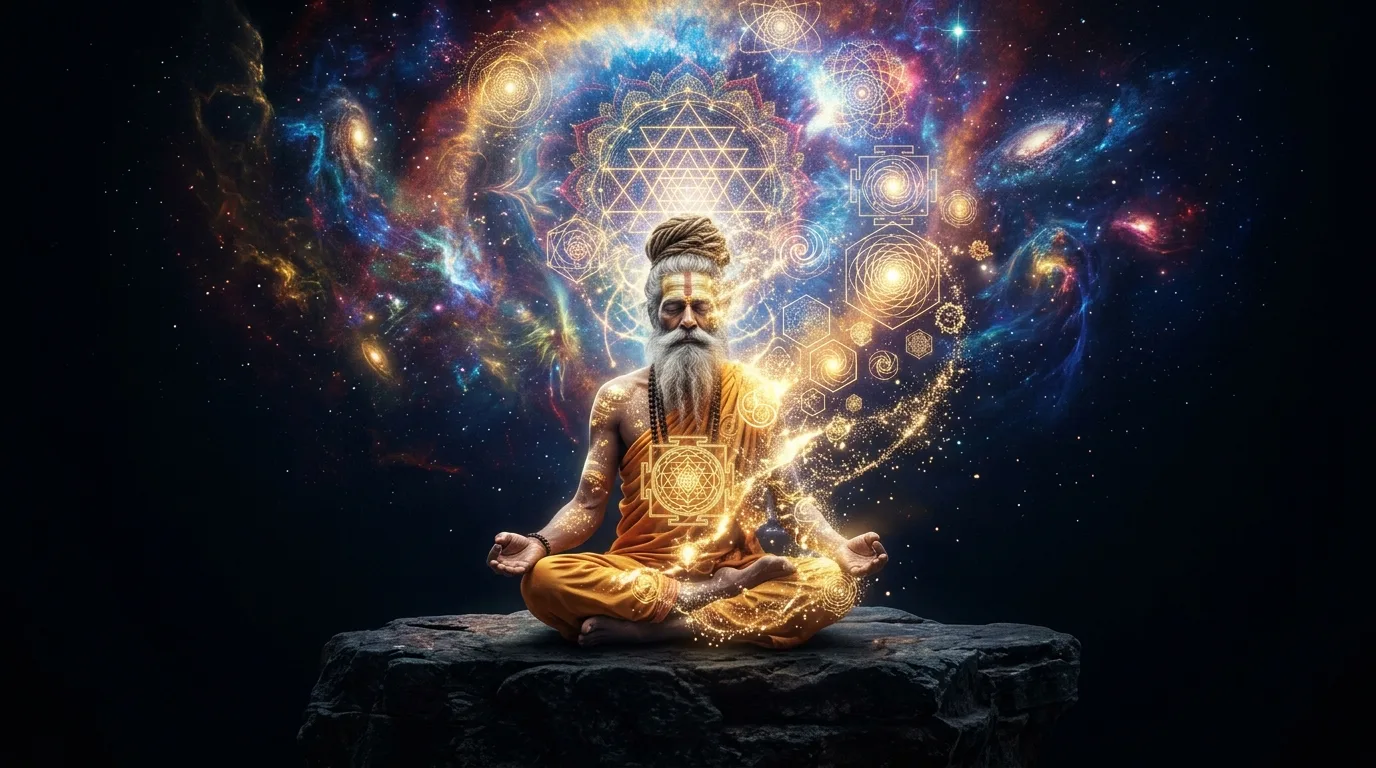
Modern spirituality sells 'perfect peace' as the ultimate goal. But a 5,000-year-old scripture reveals why enlightenment is just the waiting room.
In this article
I need to tell you a secret that might completely shatter everything you think you know about spirituality. If you have spent years on meditation cushions, trying desperately to empty your mind, kill your ego, and reach that elusive state of "perfect, detached peace," you might want to sit down for this.
We have been sold a massive, foundational lie about what spiritual awakening actually looks like. If you scroll through the internet today, "enlightenment" is almost always packaged as the ultimate destination: a calm, emotionless state where you merge into the formless, omnipresent universe and finally stop feeling the messy pain of human attachment.
But what if I told you that absolute nothingness and perfect peace are not the final destination at all? What if they are merely the waiting room?
A 5,000-year-old text contains a hidden, mind-bending chapter that completely dismantles the modern spiritual hierarchy. It reveals that the universe's most educated, perfectly peaceful Yogi was so violently humbled by the chaotic, heartbreaking love of a group of village women that he begged to lose his "enlightenment" entirely.
Let's bypass the surface-level stories and dive into the actual, radical philosophical core of the highest spiritual state ever documented.
What the Text Actually Says
To understand this, we are going deep into the Srimad Bhagavatam, specifically Canto 10, Chapter 47, famously known as the Bhramar Gita (The Song of the Bee).
The setup is devastating. Lord Krishna has left the rural, idyllic village of Vrindavan for the political capital of Mathura. The Gopis (the cowherd women of Vrindavan) are left behind, experiencing catastrophic, world-ending psychological and spiritual agony in His absence.
Seeing their pain, Krishna sends a messenger to console them. Enter Uddhava.
Uddhava is not just a guy. He is Krishna's cousin, a master of intellect, a star student of Jupiter (Brihaspati), and an incredibly advanced practitioner of Jnana Yoga (the yoga of knowledge). Uddhava has achieved what most modern spiritual seekers dream of: he has realized the formless, omnipresent Absolute. He is perfectly peaceful. He does not cry. He is entirely detached from the drama of human emotion.
Uddhava arrives in Vrindavan with the ultimate "mindfulness" advice. He essentially tells the weeping women: "Why are you crying for a physical person? You are attached to His form. Close your eyes, detach from your emotions, and meditate on the formless, unmanifest energy of the universe that is inside your own hearts."
What happens next is the total collapse of Uddhava's sterile, intellectual worldview.
The Gopis do not debate him with complex philosophy. They do not quote scriptures at him. Instead, a bumblebee flies by. One of the Gopis (traditionally understood to be Radha) begins speaking to this bee in a state of delirious, heartbroken intoxication. Through this "Song of the Bee," she systematically destroys Uddhava's entire theology of detachment.
The Gopis present a brutally flawless psychological argument against meditation. They tell Uddhava: "Meditation requires the instrument of a mind. Humans are only equipped with one mind. We do not have our minds anymore; Krishna took them with Him to Mathura. Therefore, we literally lack the psychological apparatus required to practice your meditation."
They expose the hypocrisy of his "omnipresent" God. If the Absolute is truly everywhere, then He is also present in the beautiful, personal form of the boy they love. Why should they abandon the ultimate sweetness of a personal relationship to stare into a blank, tasteless void?
By the end of this chapter, the highly educated, perfectly peaceful Uddhava realizes that his "enlightenment" is utterly dry and empty compared to the ocean of their feeling. He abandons his role as a teacher. He falls to the ground and prays to the universe to be reincarnated as a simple blade of grass in Vrindavan, just so the dust from the feet of these "uneducated" village women might fall on his head.
Key Terms Explained
To really grasp the depth of what is happening here, we have to understand the precise Sanskrit terminology the text uses. These aren't just words; they are specific technologies of consciousness.
- Vipralambha / Viraha Bhakti: This is usually loosely translated as "Devotion in Separation." But technically, it is the profound spiritual technology of absence generating hyper-presence. Think about it: when someone you love is physically sitting next to you (Sambhoga), your mind can still wander. You might check your phone or get distracted. But in Vipralambha—when they are gone—the agonizing absence monopolizes every single atom of your consciousness. The separation forces the mind to reconstruct the Absolute internally with such terrifying intensity that the "absence" becomes a much higher, more inescapable form of union.
- Jnana-Mishra-Bhakti vs. Shuddha-Bhakti: Uddhava possessed Jnana-Mishra-Bhakti—which is devotion mixed with the intellectual desire to understand God and remain peaceful. He wanted to keep his ego intact as an "observer." The Gopis possessed Shuddha-Bhakti—pure, unalloyed devotion. Shuddha-Bhakti is entirely reckless. It doesn't care about personal liberation, peace, or understanding the math of the universe. It only cares about the pleasure of the Beloved.
- Sayujya-Mukti: This is the liberation of merging into the formless light (Brahman). In classical Advaita (non-dualism), this is the highest goal. But in the Bhagavatam's framework, pure devotees consider Sayujya-Mukti to be worse than hell. Why? Because if you merge into the formless and lose your individual identity, you lose the ability to experience the dynamic, interactive taste (Rasa) of love. You become the sugar, but you can no longer taste the sugar.
- Divyonmada: Divine madness. From a mundane, external perspective, the Gopis look clinically insane—they are crying and talking to a bumblebee. But from the text's perspective, this is the absolute zenith of human consciousness. It is the state where the limited cognitive mind has been entirely overridden and hijacked by the Hladini Shakti (the Supreme's own internal pleasure potency).
Traditional Interpretation
Classical giants of philosophy like Sri Jiva Goswami (in his masterwork, the Bhagavata Sandarbha) and Visvanatha Chakravarti Thakur point out a crucial secret about this chapter that most modern readers miss entirely: Krishna did not leave Vrindavan to punish the Gopis. He left to upgrade them.
Jiva Goswami explains the physics of Rasa (spiritual taste). When Krishna was physically present in the village, the Gopis' experience of Him was inherently limited by physical space and time. He could only be in one place at a time. By suddenly leaving them, He intentionally induced Vipralambha (the agony of separation).
This agonizing pain acted as a spiritual crucible. It violently burned away their reliance on His external, physical form and forced the Absolute to manifest entirely inside their internal consciousness. Because of this extreme separation, their capacity to hold the Infinite expanded. They began seeing Him everywhere—in the trees, the rivers, the sky. The text insists that this "pain" of separation was actually a highly specialized, intensely concentrated form of bliss (Ananda).
How This Connects
This isn't just a random emotional story isolated in one chapter; it is the ultimate fulfillment of the Srimad Bhagavatam's entire thesis, which it establishes on page one.
- The Atmarama Verse (SB 1.7.10): Early in the first canto, the Bhagavatam makes a shocking claim: Even sages who are Atmaramas (completely self-satisfied, fully enlightened, free from all material desires and resting in perfect peace) are inexplicably drawn to the personal qualities of the Supreme Lord (Hari). The Bhramar Gita is the live-action demonstration of this exact verse. Uddhava is the enlightened Atmarama; the Gopis represent the inescapable gravitational pull of Hari that shatters his detachment.
- Reversing the Upanishadic Hierarchy: Many ancient Upanishads, and later philosophers like Adi Shankara, structure reality like a ladder: you use the personal form of God (Saguna Brahman) as a lower stepping stone to eventually reach the ultimate, formless, featureless Absolute (Nirguna Brahman). The Bhagavatam completely inverts this ladder. It argues mathematically that the formless Brahman is merely the glowing, external aura (the effulgence) of Bhagavan (the Supreme Person). Uddhava had only reached the glowing aura; the Gopis had captured the Person Himself.
Modern Research or Science
Is there any scientific framework to understand what happens to a human brain in this state of Divyonmada (divine madness) or extreme emotional hyper-focus? Yes.
There is a fascinating parallel in modern cognitive psychology and neuroscience regarding "Flow States" and the Salience Network.
Neurologically, the human brain has a "Default Mode Network" (DMN). This network is responsible for your ego, your self-referential thoughts, and your constant sense of "I" and "me." When a human being becomes utterly monopolized by a singular, high-salience emotional focus—such as profound, all-consuming love or catastrophic grief—the Salience Network overrides the system, and the Default Mode Network dramatically shuts down.
In this state, the individual literally loses their sense of self. They transcend normal cognitive limits because the "ego" mechanism has been turned off by the sheer force of their focal point.
Where the Comparison Holds, and Where It Doesn't
Here is where we must be strictly, intellectually honest.
The comparison holds beautifully in mapping the mechanics of consciousness. The Bhagavatam accurately mapped the absolute limits of human psychological capacity—the complete surrender of the ego to an all-consuming emotional focal point—thousands of years before cognitive science invented terms like the Default Mode Network.
However, where the popular internet retellings go wrong is trying to reduce the Bhagavatam to just biology. Science views this "hyper-focus" as a closed neurochemical loop—a flood of dopamine and oxytocin within a physical, dying brain.
The Srimad Bhagavatam does not view this as a chemical trick. It explicitly posits this state as an ontological reality. The Gopis are not just experiencing a dopamine loop; their souls are directly interfacing with the Hladini Shakti (the fundamental spiritual energy of bliss that powers the cosmos). You cannot say "neuroscience proves the Gopis are right." The honest parallel is that science observes the biological shadow of a spiritual reality that the Bhagavatam describes at the level of the soul.
Frequently Asked Questions
1. Does this mean meditation and seeking peace are useless? Not at all. The text acknowledges that attaining the peaceful, detached state of Brahman (like Uddhava) is a massive, incredibly difficult spiritual achievement. The point is not that peace is bad, but that it is the beginning of the highest spiritual life, not the end of it.
2. Who exactly was Uddhava? Uddhava was a prince of the Vrishni dynasty, Krishna's cousin, and a direct disciple of Brihaspati (the guru of the demigods). He represents the absolute pinnacle of intellectual and yogic achievement possible in the material universe.
3. Why is losing your identity in the 'formless universe' considered a trap? In the philosophy of pure devotion (Bhakti), love requires two: the lover and the Beloved. If you permanently merge your identity into the formless void (Sayujya-Mukti), you lose your individual existence. Without an individual self, you can no longer participate in the dynamic exchange of love.
4. What is the ultimate takeaway for a modern person? The ultimate reality hack isn't successfully emptying your mind of the world. It’s allowing your mind to be completely hijacked by the Absolute. True spirituality isn't about avoiding the pain of attachment; it's about attaching yourself to something so infinite that even the pain becomes a form of liberation.
Sources
- Srimad Bhagavatam (Bhagavata Purana): Specifically Canto 10, Chapter 47 (The Bhramar Gita).
- Bhagavata Sandarbha: By Sri Jiva Goswami (for the philosophical mechanics of Rasa and Vipralambha).
- Cognitive Neuroscience: Research into the Default Mode Network (DMN), the Salience Network, and the neurobiology of Flow States and extreme emotional hyper-focus.
This reflects what the text itself says; the modern-science comparisons above are interpretation, not an established finding.