The Cosmic Vision in the Bhagavad Gita: Ego and the Universal Form
Drafted with the help of AI from the original texts named in the article; I read and correct every article after it is published. How we use AI
Explore the ontological terror of Bhagavad Gita Chapter 11. Understand the Vishvarupa, the destruction of ego, and the Block Universe theory parallel.
In this article
This article examines the profound ontological terror and the ultimate destruction of human ego as depicted in Chapter 11 of the Bhagavad Gita. Far from the sanitized, comforting spirituality often marketed today, this scripture delivers a shattering epistemological shock through the revelation of the "Vishvarupa" (the Cosmic Vision). We will explore the ancient Sanskrit metaphysics of Time as a devouring force, unravel why the realization of human insignificance is presented as the ultimate cure for anxiety, and analyze why J. Robert Oppenheimer famously quoted this specific terrifying revelation upon witnessing the first atomic bomb detonation.
What the Text Actually Says
The Bhagavad Gita, nestled within the great epic Mahabharata, reaches its metaphysical climax in Chapter 11, known as the Vishvarupa Darshana Yoga. Modern pop-spirituality frequently packages the Divine as a cosmic parent offering endless reassurance. The Gita ruthlessly shatters this pacifying illusion. On the precipice of a devastating fratricidal war, the warrior Arjuna is paralyzed by a crisis of conscience. He begs his charioteer, Lord Krishna, to reveal His true, sovereign, absolute form (Ishvara-rupa). Krishna obliges, but not by offering a serene vision of warm light.
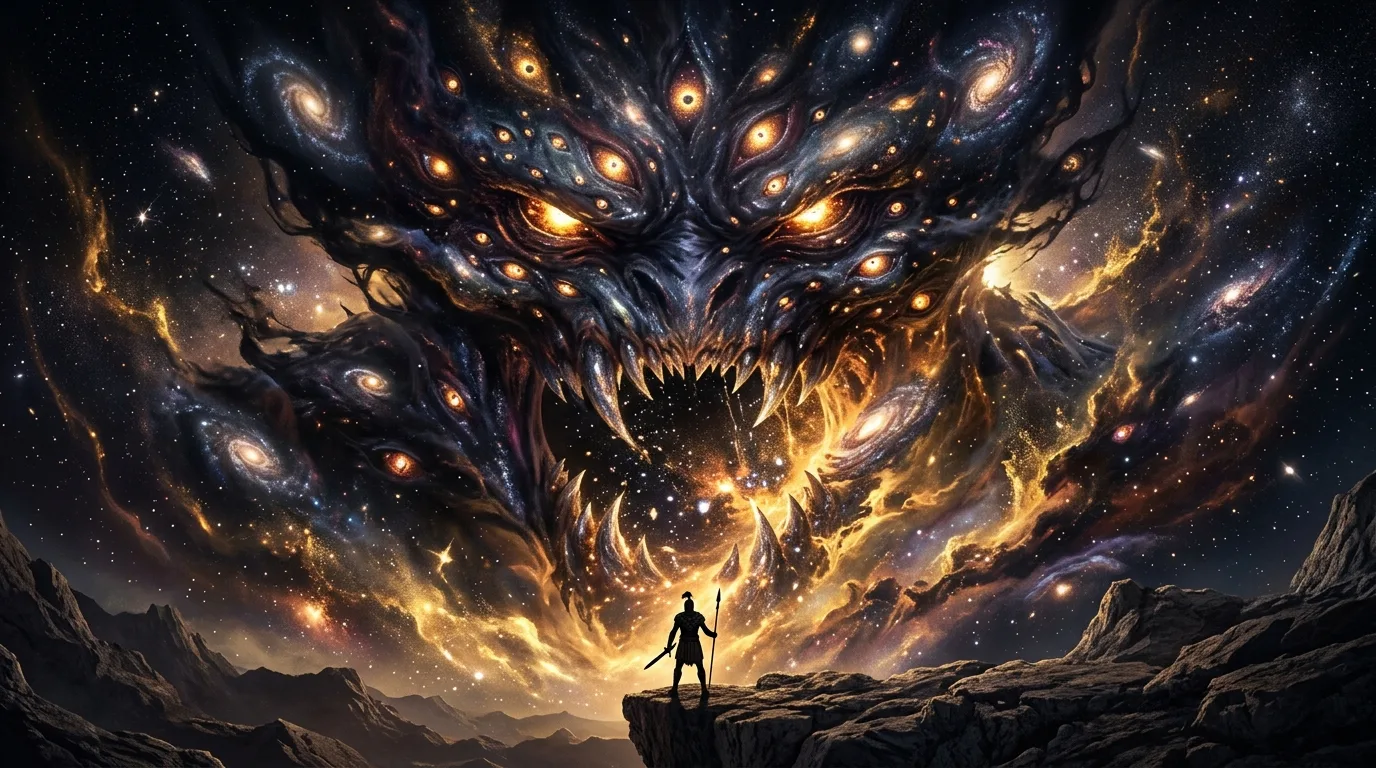
To allow Arjuna to comprehend this reality, Krishna grants him the Divya Chakshu (divine eye), temporarily suspending Arjuna's localized, human cognitive limitations. What Arjuna witnesses is the raw, unedited, and utterly terrifying mechanics of the universe. He sees an infinite entity spanning all conceivable dimensions. However, the core revelation is not merely the staggering vastness of this entity; it is the ruthless, devouring, inescapable nature of Time. Arjuna watches in horror as the opposing armies, including his own revered elders and great generals like Bhishma and Drona, rush headlong into Krishna’s blazing, tusked mouths. He sees their heads being crushed between the cosmic teeth.
Overwhelmed, his hairs standing on end, Arjuna loses his composure completely and begs the Divine to revert to a familiar, human form. It is in this moment of absolute dread that Krishna delivers the most chilling and ultimately liberating truth of the Gita, articulated in Verse 11.32: "Kalo 'smi loka-kshaya-krit pravriddho" (I am Time, the mighty destroyer of worlds, here engaged in destroying these people).
Krishna reveals a cosmic timescale where all these warriors are already dead. The universe operates on a continuous, inescapable cycle of creation and annihilation. Arjuna’s initial crisis—his refusal to fight because he believed he held the ultimate power of life and death over others—is exposed as a profound cognitive error rooted in the arrogance of his own ego (Ahamkara). He erroneously thought he was the ultimate Doer (Karta). The cosmic vision corrects this by demonstrating that Dharma (duty) is not about controlling the universe, which is impossible, but about aligning with its irresistible flow. Karma (action) is radically redefined: it is not imposing your will on reality, but recognizing yourself as a mere instrument in a macro-system vastly larger than human comprehension.
Key Terms Explained
To truly grasp the depth of this chapter, we must understand the precise Sanskrit terminology the text employs, as loose English translations often dilute their immense philosophical weight.
- Vishvarupa (विश्वरूप): While frequently translated as "Universal Form," a more accurate philosophical translation is "The Form that is All-Pervading Reality." It is not a singular shape within the universe; it is the totality of the cosmos itself—past, present, and future—experienced simultaneously as a single, terrifyingly alive organism. It is the architecture of existence made visible.
- Divya Chakshu (दिव्यचक्षु): Commonly translated as "Divine Eye." It is crucial to understand that this is not a physical "third eye" in the middle of the forehead. In the context of the Gita, it represents a radical shift in epistemology. It is a temporary suspension of the human brain's sequential, localized processing of time and space, granting Arjuna the capacity to perceive reality in its absolute, non-linear, eternal state.
- Kala (काल): This word translates directly to "Time." However, in Chapter 11, Kala is not merely a measurement of duration; it is Time personified as the ultimate destructive force. It is the inescapable engine of cosmic entropy. Time is the force that eventually consumes everything that is created, making it the supreme equalizer and destroyer.
- Nimitta-matram (निमित्तमात्रम्): This translates to "a mere instrument" or, in philosophical terms, "the efficient cause." In Verse 11.33, Krishna commands: nimitta-matram bhava savya-sachin ("Be merely an instrument, O Arjuna"). This is the absolute pinnacle of Karma Yoga. It demands acting with maximum intensity and flawless execution of duty, entirely stripped of the delusion that you are the primary architect or owner of the outcome.
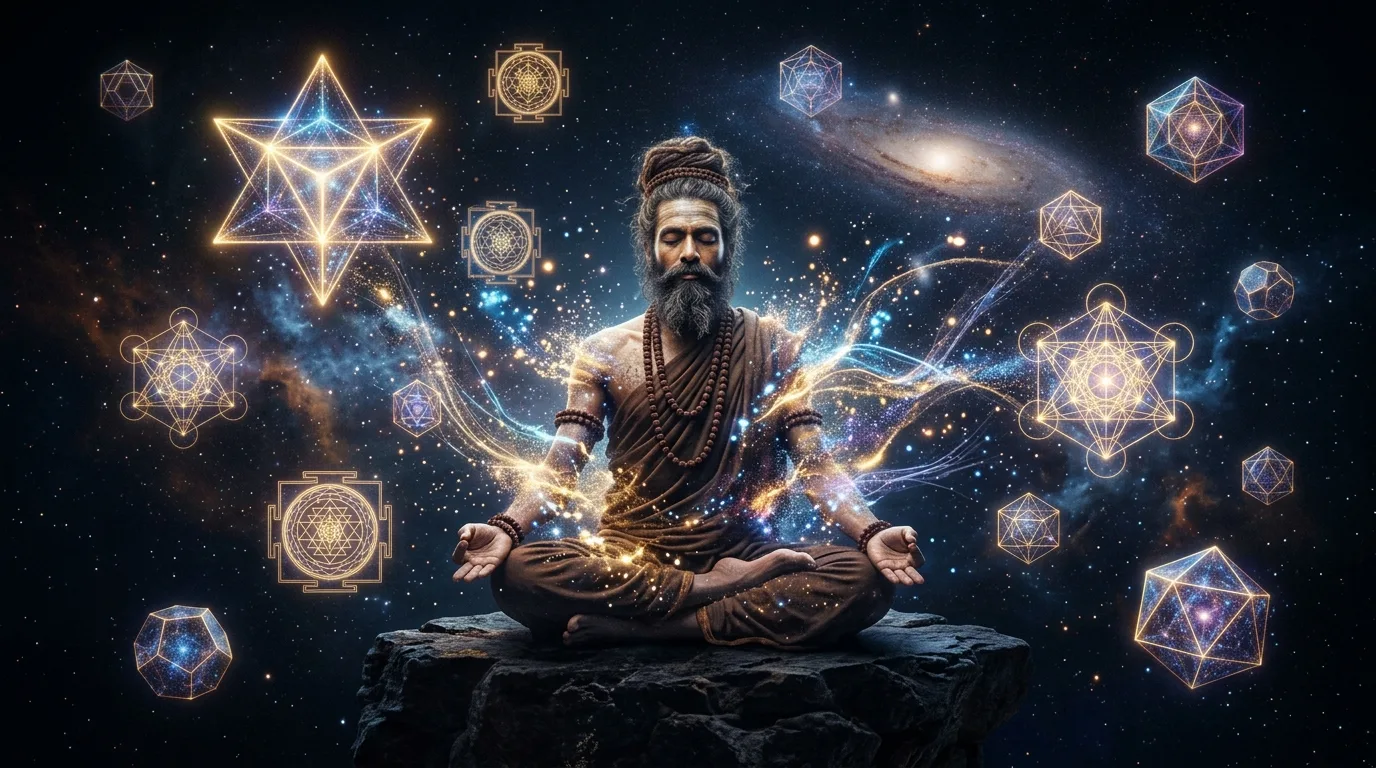
- Ahamkara (अहंकार): Literally the "I-maker." This is the psychological mechanism—the ego—that causes an individual consciousness to identify with the physical body and mind. Ahamkara creates the powerful delusion of separation, making an individual believe they are an independent agent whose personal desires and actions dictate the fate of the world.
Traditional Interpretation
The classical schools of Vedanta have pondered this terrifying vision for centuries, offering profound, albeit distinct, philosophical lenses through which to understand it.
- Advaita Vedanta (Adi Shankara): The non-dualist school interprets the ontological terror of Chapter 11 as the ultimate exposure of the unreality of the individual ego. For Shankara, the terror Arjuna feels is not just fear of death, but the deep psychological terror of the ego facing its own fundamental insignificance and impending dissolution into the Absolute. The vision is a diagnostic tool meant to cure Arjuna of his ignorance (Avidya) regarding agency. The ultimate truth revealed is that you are not the doer; the singular reality of Brahman is the only truth.
- Vishishtadvaita (Ramanujacharya): The qualified non-dualist school focuses on the absolute sovereignty and majesty of Ishvara (the Supreme Lord). Ramanuja posits that the entire universe—comprising both conscious souls and unconscious matter—constitutes the literal "body" of the Lord. The Vishvarupa is the definitive empirical proof that absolutely nothing exists independently of Narayana. Consequently, the only rational, logical response to confronting this overwhelming majesty is complete, unconditional surrender (Sharanagati) to His cosmic will.
- Dvaita (Madhvacharya): The dualist school emphasizes the absolute, eternal difference between the individual soul (Jiva) and God. In this framework, the cosmic vision demonstrates the infinite, unfathomable power of Vishnu juxtaposed against the utter, fragile dependence of the Jiva. The fear Arjuna experiences is seen as a necessary and appropriate step in spiritual evolution. It forces the soul to develop true, grounded reverence (Bhakti) mixed with awe, recognizing the insurmountable gap between human frailty and divine omnipotence.
How This Connects
The revelations of Chapter 11 do not exist in isolation; they are the nexus connecting various profound streams of Sanatan Dharma.
- Nishkama Karma (Chapter 3): Earlier in the Gita, Krishna introduces the abstract theory of Nishkama Karma—action performed without attachment to the fruits or results. Chapter 11 provides the visceral, visual proof for why this theory is mandatory. You must act without attachment to the results because, as the Vishvarupa graphically demonstrates, you do not actually control those results anyway. Cosmic Time (Kala) governs the grand outcomes. Attachment to results is therefore not just spiritually limiting, but fundamentally irrational.
- The Purusha Sukta (Rig Veda): The staggering visual description of the Vishvarupa directly references and animates one of the oldest hymns in existence, the Purusha Sukta of the Rig Veda (Book 10, Hymn 90). The hymn describes the cosmic being with thousands of heads, eyes, and feet, encompassing the earth and extending beyond it. The Gita takes this ancient, abstract Vedic poetry and turns it into a dynamic, terrifying, living force directly interacting with a human being.
- Shiva as Mahakala/Nataraja: The devouring, destructive aspect of Krishna revealed in Chapter 11 conceptually bridges Vaishnava and Shaiva theology. Krishna's manifestation as Kala (Time/Death) operates identically to Shiva's cosmic dance of destruction, the Tandava. Both represent the profound understanding that preservation and destruction are not opposing forces, but two inseparable faces of the exact same ultimate reality. Creation requires destruction, and both are divine.
Modern Research or Science
While theology and science operate in different domains, the epistemological shock described in the Gita finds fascinating, albeit distinct, parallels in modern physical theories and historical events.
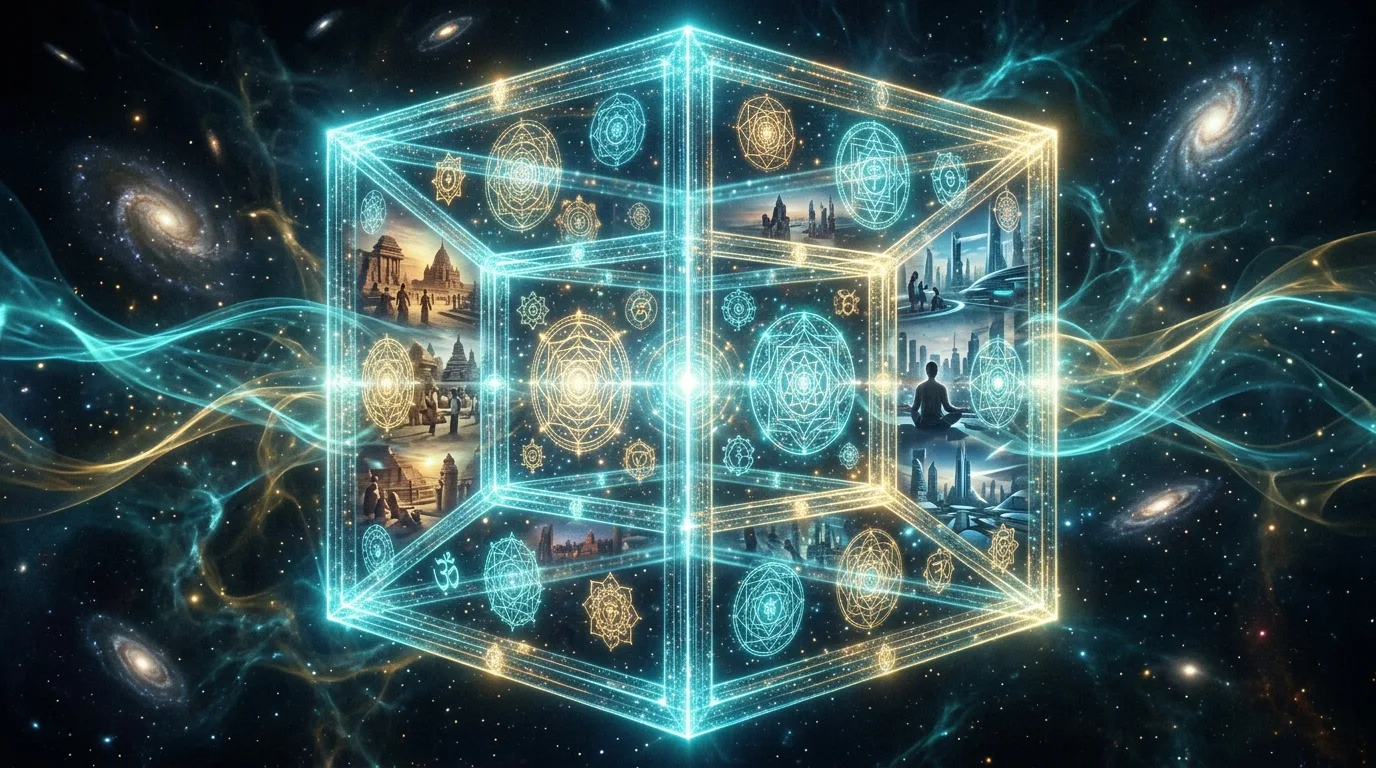
- Physics - The Block Universe Theory: In Einstein's theory of general relativity, physicists often conceptualize time and space through the "Block Universe" framework. This is a four-dimensional structure where the past, present, and future exist simultaneously and equally. The human experience of time flowing linearly is seen as a localized psychological phenomenon. Arjuna's vision—where he sees warriors who are alive in his present already being consumed by Death in the "future"—serves as a striking philosophical and poetic parallel to a pan-dimensional, non-linear experience of time.
- History - J. Robert Oppenheimer: The theoretical physicist and director of the Manhattan Project deeply studied Sanskrit. Upon witnessing the terrifying Trinity test detonation in 1945, he famously recalled verse 11.32: "Now I am become Death, the destroyer of worlds." Oppenheimer recognized that by unlocking the power of the atom, humanity had tapped into the fundamental, ruthless forces of cosmic destruction (Kala) that the Gita explicitly describes. The dread he felt mirrored Arjuna's dread: the terror of encountering a force that vastly exceeds human scale and moral control.
- Philosophy - Compatibilism: The philosophical framework of the Gita presents a highly sophisticated ancient version of compatibilism—the reconciliation of Free Will and Determinism. The macro-events of the universe (the rise and fall of empires, the ultimate fate of the warriors) are strictly determined by the vast laws of Karma and Time. However, Arjuna retains absolute free will in his micro-experience: he can choose to act out of wisdom, recognizing himself as an instrument (Nimitta-matram), or he can choose to act out of ignorance, driven by his ego's resistance to the inevitable.
Where the Comparison Holds, and Where It Doesn't
It is vital to draw these parallels carefully, recognizing the boundaries between ancient metaphysics and modern science.
The comparison to the Block Universe holds beautifully as a conceptual metaphor. Both frameworks suggest that our localized, linear perception of time is incomplete, and that a "higher" perspective reveals past, present, and future coexisting. However, the connection stops at the metaphysical intent. The Block Universe is a mathematical model devoid of moral meaning or consciousness. The Vishvarupa is profoundly conscious, deeply moral, and inherently purposeful, designed specifically to shatter human ego and teach duty.
Similarly, Oppenheimer's quotation was incredibly apt, but the context of the dread differs. Oppenheimer's terror was rooted in the horror of human agency—the fear that mankind had built a weapon that could destroy itself. Arjuna's terror in the Gita is the exact opposite: it is the shock of realizing that human agency is actually negligible, and that the Divine machinery of Time handles the ultimate destruction independently of human desires.
Frequently Asked Questions
1. Why is the Bhagavad Gita's vision considered terrifying? It is terrifying because it forces the human mind to confront its absolute insignificance. It strips away the comforting illusions of control and exposes the ruthless, inescapable power of Time (Kala) that endlessly creates and destroys all things, including those we love.
2. What does it mean to be a "mere instrument" (Nimitta-matram)? It means acting in the world with total dedication and skill, but without the psychological burden of believing you control the final outcome. You do your duty (Dharma) flawlessly because it is your role in the cosmic play, not because you can bend the universe to your personal will.
3. Did Oppenheimer really understand the Bhagavad Gita? Yes, Oppenheimer was a serious student of Sanskrit and read the Gita in its original language. His quotation of Chapter 11 was not a superficial pop-culture reference; it was a deeply educated reflection on encountering a primal, world-ending force of nature that echoed the concept of Kala.
4. How does the Block Universe relate to the Gita? Both concepts challenge the human perception of time as a strictly linear flow. Einstein's relativity suggests past, present, and future exist simultaneously as a block; similarly, the Divine Eye (Divya Chakshu) allowed Arjuna to see the future deaths of the warriors happening in his present moment, suggesting a reality where time is a complete, unrolling tapestry rather than a moving dot.
Sources
- The Bhagavad Gita (Specifically Chapters 2, 3, and 11)
- The Rig Veda (Book 10, Hymn 90 - Purusha Sukta)
- General Theory of Relativity and the philosophical framework of the Block Universe in theoretical physics.
- Historical records of J. Robert Oppenheimer's statements regarding the Trinity Test.
This reflects what the text itself says; the modern-science comparisons above are interpretation, not an established finding.