The Brahmachakra: The Vedic Blueprint of the Cosmic Wheel
Drafted with the help of AI from the original texts named in the article; I read and correct every article after it is published. How we use AI
Explore the Shvetashvatara Upanishad's concept of the Brahmachakra and Lord Shiva as the Mayin (Architect).
In this article
Long before modern astrophysics and Silicon Valley philosophers began debating whether our universe is a highly complex computational construct, ancient Indian sages were already mapping out the algorithmic architecture of reality. The Shvetashvatara Upanishad, one of the primary foundational texts of Sanatan Dharma, offers an astonishingly intricate framework that completely bypasses the surface-level mythological tropes of Lord Shiva as a mere "Destroyer." Instead, this profound scripture positions Him as the absolute, transcendent source of all reality—the Cosmic Architect who writes the underlying code of the universe but remains untouched by its computational limits. This article dives deep into the ancient concept of the Brahmachakra (The Cosmic Wheel), analyzing what the text explicitly states about the nature of our projected reality and how it resonates with modern philosophical inquiries.
What the Text Actually Says
The Shvetashvatara Upanishad does not demand blind faith; it begins with an existential symposium. In Chapter 1, a group of highly advanced sages gather to debate the ultimate cause of reality, asking: "What is the cause? Is it Brahman? Whence are we born? By what do we live? And on what are we established?" (Shvetashvatara Upanishad 1.1).
To answer this, they systematically analyze and reject every material and abstract constant available to their observation. They dismiss Time (Kala), the inherent nature of things (Svabhava), necessity or cosmic law (Niyati), pure chance (Yadriccha), the basic elements of matter (Bhuta), and even the individual experiencing soul (Purusha). The text reasons that none of these can be the ultimate, foundational cause because they are not independent entities; they are all inherently bound by the strict laws of cause and effect, acting merely as components within a larger system.
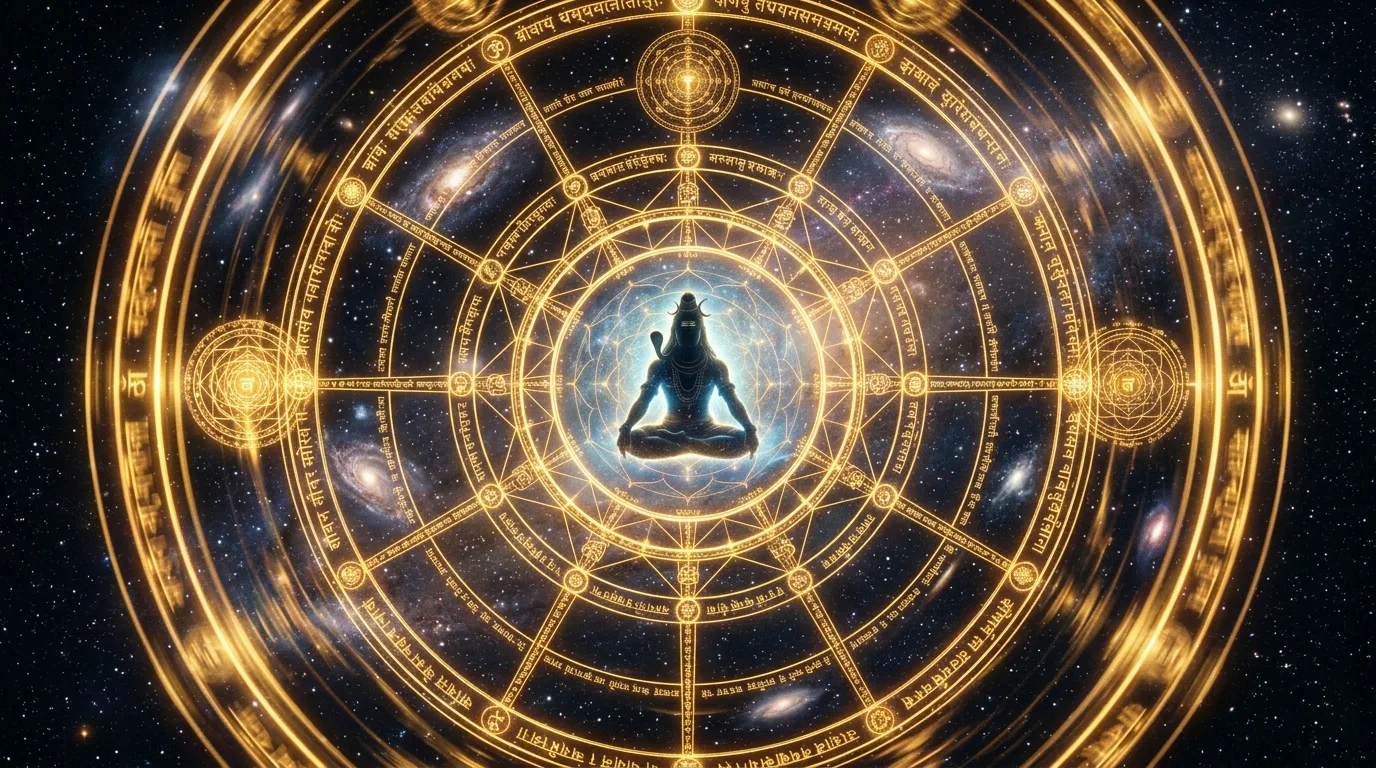
Recognizing the limits of pure intellectual deduction, the sages enter a state of deep meditative vision (dhyana-yoga). Through this cognitive elevation, they pierce the material veil of reality and perceive the ultimate mechanism governing existence: The Brahmachakra, or the Cosmic Wheel of the Absolute. The Upanishad describes the universe not as a random, chaotic collision of matter, but as a hyper-complex, continuously rotating wheel—a closed cyclical system through which individual souls transition.
However, a wheel cannot spin itself. It requires a static, unmoving hub and a conscious operator to turn it. Here, the Upanishad introduces a groundbreaking paradigm: the chaotic, ever-changing material universe (Prakriti) is in fact Maya (a projected, magical construct), and Lord Shiva (Maheshvara) is the Mayin—the Grand Illusionist, the Architect, the Operator of the entire mechanism.
To prove that this is a precise ontological framework and not just poetic metaphor, Verse 1.4 of the Shvetashvatara Upanishad provides the exact "blueprint" of this cosmic mechanism, breaking reality down into mathematical and psychological components:
- One Hub: The Supreme Lord, Shiva, serving as the stationary center of all reality.
- Three Tires (Felloes): The three Gunas (Sattva or harmony, Rajas or activity, and Tamas or inertia). These act as the fundamental underlying code or energetic parameters that dictate exactly how matter and mind behave.
- Sixteen Ends: These are the physical and mental interfaces through which the "simulation" is experienced: the 5 gross elements (earth, water, fire, air, space), the 5 organs of perception, the 5 organs of action, and the central processing mind.
- Fifty Spokes: Representing the 50 psychological and emotional conditions of the mind (a highly technical categorization borrowed from Sankhya philosophy, mapping every possible human mental state).
- Twenty Counter-spokes: The 10 senses (perception and action) and their 10 corresponding physical objects in the material world.
- Six Sets of Eight: The 48 variables of human existence, which include the 8 producers of nature, 8 constituents of the physical body, 8 forms of wealth, 8 powers, 8 emotional states, and 8 presiding deities.
The text's core teaching is profound: The universe you experience is a highly structured, mathematically precise machine. You, as the individual soul, are caught on the spinning edge of this wheel, experiencing the dizzying illusion of birth, time, karma, and death. Lord Shiva is the Mayin who engineered this wheel, sitting perfectly still at its hub.
The Upanishad further cements this with a master analogy in Chapter 6, Verse 10, comparing Shiva to a cosmic spider (tantu-nabha). Just as a spider secretes silk from its own body to weave a web, rests within that geometry, and ultimately withdraws it, Shiva projects the universe (Maya) out of His own conscious energy, sustains the structure, and eventually collapses it back into Himself.
Key Terms Explained
To truly grasp the depth of this scripture, we must strip away modern, oversimplified English translations and look at the actual Sanskrit terminology used in the text.
- Māyā (माया) & Māyin (मायिन्): In modern, casual discourse, Maya is frequently mistranslated as "illusion," implying something that is entirely fake or non-existent (like a hallucination). However, in the context of the Shvetashvatara Upanishad (specifically Chapter 4, Verse 10: "Māyām tu prakṛtiṃ vidyān māyinaṃ tu maheśvaram"), Maya translates closer to "magic," "art," or "the power of measurement and projection." It indicates that the universe is real, but it is a projected reality, much like a high-fidelity hologram. The Mayin (The Architect) is the conscious wielder of this projection technology. Shiva, as the Mayin, is not bound by the illusion; He controls the fundamental parameters of the system.
- Brahmachakra (ब्रह्मचक्र): Literally "The Wheel of the Absolute." A Chakra implies rotation, inevitability, cyclic motion, and a closed circuit. It represents the highly algorithmic, repetitive nature of reality—the cycles of cosmic time (Yugas), the cycles of life and death (Samsara), and the strict, inescapable laws of physics and karmic cause-and-effect.
- Devātma-śakti (देवात्मशक्ति): Found in Verse 1.3, this term reveals what the sages actually saw in their meditation. They did not just see empty mechanical space; they witnessed the Devatma-shakti—the "Self-power of the Divine." This signifies that the universe is not running on dead, unconscious physical laws; it is actively fueled by the living, conscious energy (Shakti) of the Lord Himself, though this energy is heavily veiled by its own operational qualities (svagunair nigudham).
- Viśvādhika (विश्वाधिक): Meaning "He who transcends the universe." The text explicitly establishes a paradox: Shiva is fully immanent (present inside every atom of the projection as the sustaining energy) and simultaneously Vishvadhika (transcendent, existing completely outside the boundaries of the cosmos). He is the architect who can step inside the structure, yet remains fundamentally outside of it in base reality.
Traditional Interpretation
Because the Shvetashvatara Upanishad is such a foundational text, different traditional philosophical schools within Sanatan Dharma have intensely debated its ultimate meaning.
- Advaita Vedanta (Adi Shankaracharya): Shankaracharya interprets this text strictly through the lens of absolute non-dualism. In the Advaita view, the Brahmachakra and Maya are ultimately unreal from the highest standpoint of absolute truth (Paramarthika satya). Maheshvara (Shiva) acting as the Mayin is seen as Saguna Brahman (God with attributes)—which is just the absolute, formless consciousness appearing through the lens of human cosmic ignorance (Avidya). When an individual's ignorance drops, the entire wheel, the projection, and the Architect dissolve into pure, undifferentiated consciousness.
- Kashmir Shaivism & Shaiva Siddhanta: These traditions take a radically different approach, interpreting the Shvetashvatara Upanishad highly literally and holding it in supreme esteem. For Shaiva philosophers like Abhinavagupta, Maya is never dismissed as mere "ignorance" that needs to be negated. Instead, it is the real, dynamic, and glorious creative power (Shakti or Vimarsha) of Lord Shiva. The universe is not a mistake or a false trap; it is Shiva's divine play (Lila). The Spider's web is entirely real because it is made of the Spider's own essence. To them, this Upanishad definitively proves that Shiva is both the material cause (the stuff the universe is made of) and the intelligent cause (the mind that designed it).
How This Connects
The Shvetashvatara Upanishad serves as the ultimate bridge in the landscape of ancient Indian philosophy, seamlessly weaving together disparate schools of thought.
Prior to this text, the Sankhya philosophy—widely considered the oldest rigorous scientific and cosmological framework in India—argued that reality consisted of two completely independent, co-eternal principles: Purusha (passive, observing consciousness) and Prakriti (active, blind matter). Classical Sankhya was heavily dualistic and had no philosophical need for a Supreme "God" or Creator.
The Shvetashvatara Upanishad brilliantly hacks the Sankhya system. It absorbs all of Sankhya's highly technical 24 elements (which make up the "spokes" and "tires" of the Brahmachakra), but it completely reshapes the hierarchy. It declares that Prakriti (matter) is not independent at all. Matter is simply Maya (a projection), and there is a Supreme Being (Shiva) who rules over and integrates both the passive consciousness and the active matter.
This exact ontological framework—defining the material universe as a projected Maya and the Supreme Being as the Lord of this Maya—was later lifted directly and popularized by the Bhagavad Gita. In Chapter 7, Verse 14, Lord Krishna states: "Daivi hy eṣhā guṇa-mayī mama māyā duratyayā" ("This divine Maya of Mine, consisting of the three Gunas, is incredibly difficult to cross"). The Shvetashvatara did it first, establishing the absolute source code centuries prior.
Sources
- Shvetashvatara Upanishad: Specifically Chapters 1, 4, and 6, detailing the Brahmachakra, Maya, Mayin, and the cosmic spider analogy.
- Sankhya Karika: For the foundational understanding of the 24 elements and 50 psychological states integrated into the Upanishad's wheel analogy.
- Bhagavad Gita: Specifically Chapter 7, Verse 14, demonstrating the continuation of the Maya/Guna framework.
This reflects what the text itself says; the modern-science comparisons above are interpretation, not an established finding.