Why the World's First Poem Was Born from a Bird's Grief
Drafted with the help of AI from the original texts named in the article; I read and correct every article after it is published. How we use AI
Did Valmiki start as a dacoit? Learn what the Valmiki Ramayana actually says about the sage, the krauncha bird, and how personal sorrow became the first poem.
In this article
If you walk outside on the night of Sharad Purnima, you will see the autumn moon at its brightest. The monsoon clouds have cleared from the sky, the night air feels cool, and across thousands of towns in India, people leave small bowls of sweet milk and rice on their terraces. On this same night, tradition marks Valmiki Jayanti, the birthday of the sage who wrote the Ramayana.
Growing up, I heard the same short summary that almost everyone hears. A violent highway robber named Ratnakara roamed the forests. One day, he met divine sages, tried to rob them, and was challenged to ask his family if they would share his sins. When his family refused, he sat down in remorse, tried to say Rama, could only manage the word Mara, and repeated it until an ant-hill grew over his body. When he emerged, he had become Maharishi Valmiki.
It is a striking story about personal change, but when you open the Sanskrit text of the Valmiki Ramayana itself, you find something completely different.
The real opening of the epic contains no mention of robbery or stolen gold. It begins with a calm walk to a riverbank, a pair of mating cranes, and a sudden, violent arrow that shattered a forest morning. The story of how literature began in ancient India is not a tale of a miraculous overnight trick. It is a careful study of how deep, unselfish grief can turn into speech, balance, and moral clarity.
What the Sanskrit Text Actually Tells Us
The composition of the Ramayana takes place across the first two chapters, or sargas, of the Bala Kanda. Surface summaries often treat the epic as an accidental outburst of emotion, but the original text shows a deliberate two-stage process. The first stage is an ethical inquiry, and the second stage is an emotional breakthrough.
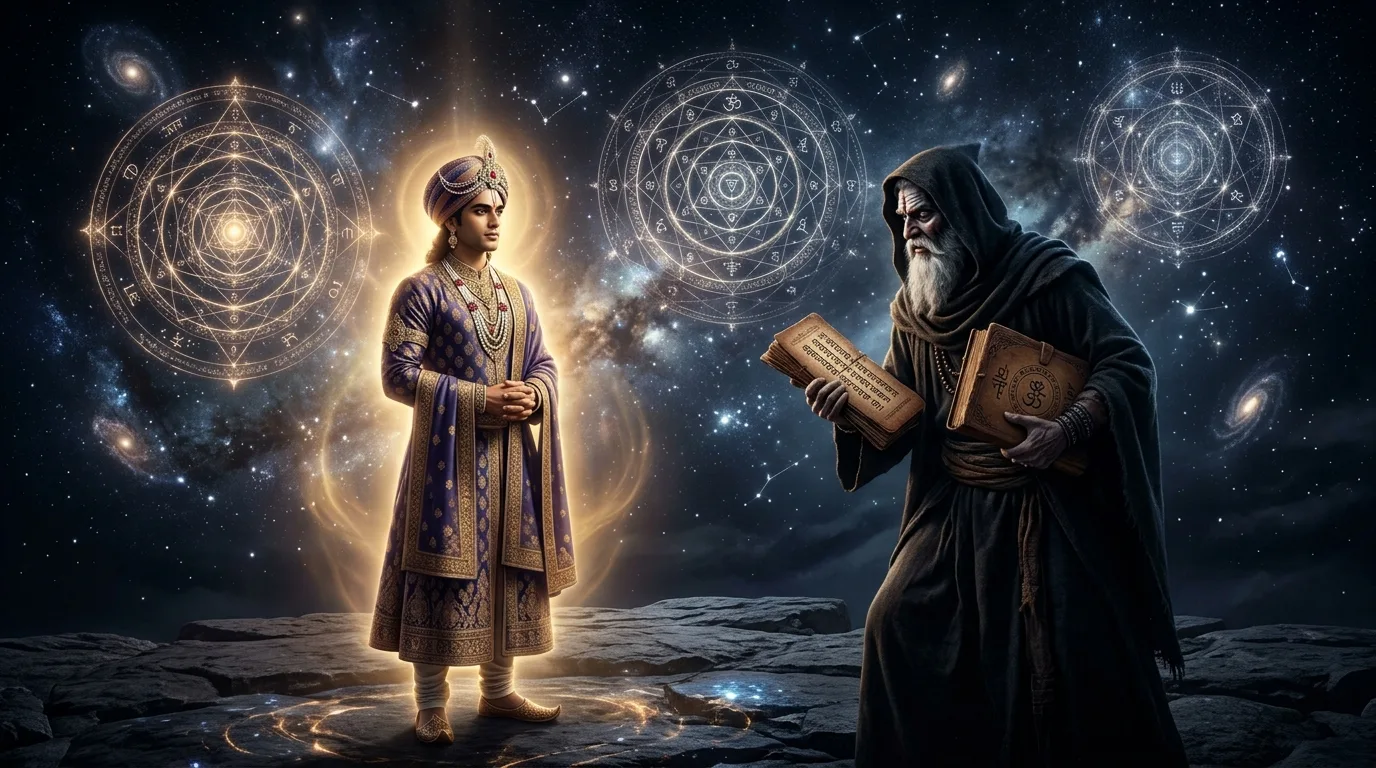
In the first chapter of the Bala Kanda, Valmiki is already an accomplished sage living in a forest hermitage. He receives a visit from the celestial traveler and sage, Devarshi Narada. Valmiki does not ask Narada how to gain wealth, perform complex rituals, or conquer kingdoms. Instead, he asks a precise, sixteen-part question about human integrity:
Ko nv asmin sampratam loke gunavan kas ca viryavan
dharmajnas ca krtajnas ca satya-vakyo drdha-vratah
Valmiki asks whether there is any living human being in the world right now who unites sixteen rare qualities. Is there someone who is deeply virtuous, physically courageous, grounded in righteousness, grateful for even small kindnesses, truthful in speech, and firm in his vows? He asks for someone who is free from petty jealousy, yet formidable enough to defend justice when pushed to the limit.
Narada replies that while such a combination of virtues is exceedingly rare in ordinary human nature, one such person does exist right now. He names Rama, born in the lineage of Ikshvaku. Narada then narrates the life of Rama in seventy-six verses, an account that tradition calls the Sankshepa Ramayana or the Mula Ramayana.
Valmiki listens with full attention, honors his guest, and watches Narada depart into the sky. Yet here is the detail that most popular retellings miss: Valmiki does not pick up a stylus. He does not begin writing. He has received all the historical facts and ethical lessons from Narada, but the story remains trapped in his intellect. It has no living rhythm, no music, and no emotional home.
The transformation happens in the second chapter of the Bala Kanda. Shortly after Narada leaves, Valmiki walks to the nearby Tamasa river to take his midday bath, accompanied by his pupil Bharadvaja. When he reaches the water, he stops and looks at the gentle stream:
Akardamam idam tirtham bharadvaja nisamaya
ramaniyam prasannambu san-manusyo mano yatha
He tells Bharadvaja to look at the water. It is completely free from mud, pure and pleasant, just like the unclouded mind of a good human being. That word for mud-free, akardama, is the key to everything that follows. In the Sanskrit tradition, divine insight cannot reflect in a mind that is muddy with selfish desire or anger.
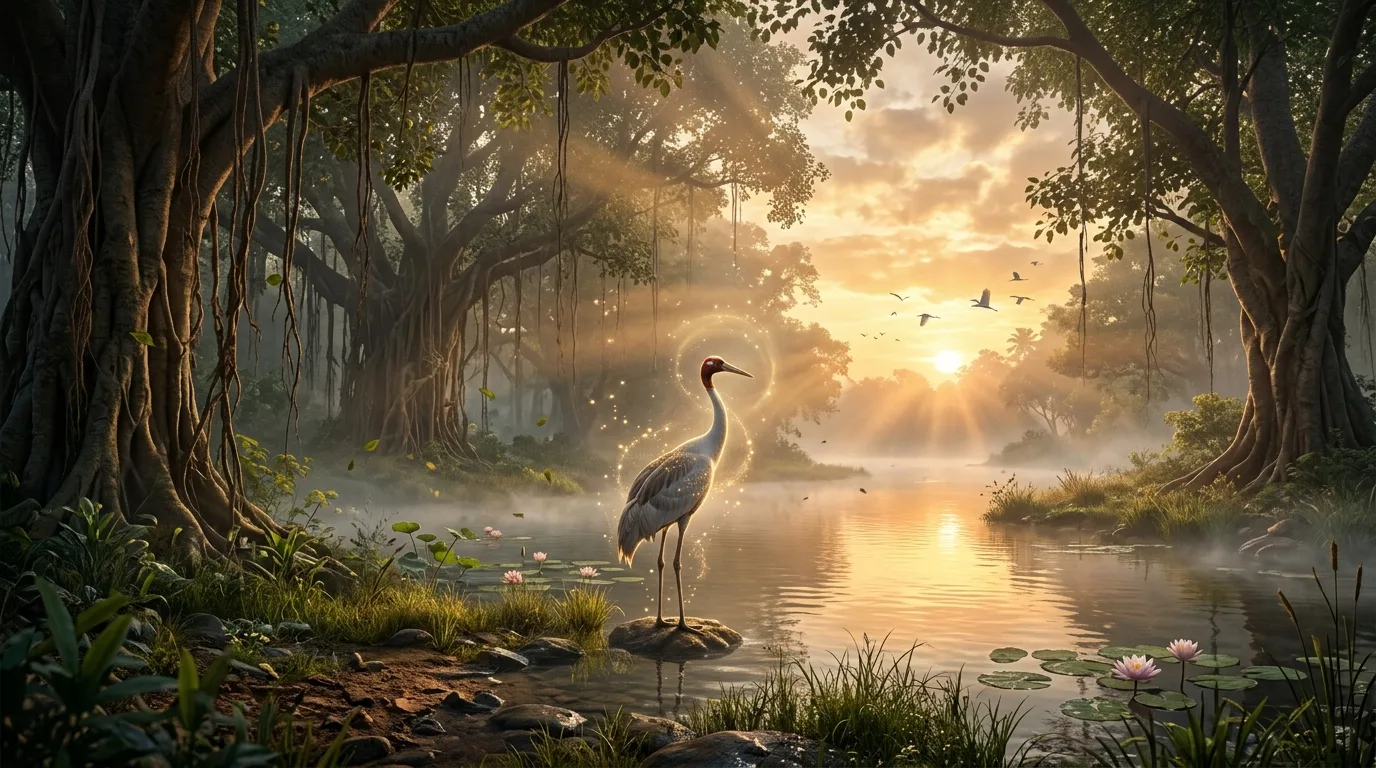
While admiring the peaceful riverbank, Valmiki watches two krauncha birds, which are Sarus cranes. In Indian natural history, these tall, elegant birds are famous for pairing for life. The couple was soaring together in the trees, singing softly to each other, completely wrapped up in their mutual affection.
Without any warning, a forest hunter, a Nishada, stepped from the bushes and shot an iron arrow. The arrow hit the male bird. The creature crashed down to the grass, bleeding heavily and thrashing in agony. The female bird did not fly away to safety. Instead, she circled over her dying partner, crying out in a thin, shrill wail of total heartbreak.
Valmiki stood on the bank, watching this unprovoked cruelty unfold before his eyes. An immense wave of sorrow washed over him. The sight of innocent love destroyed by senseless violence shattered his composure. Without thinking, planning, or counting syllables, an utterance burst from his mouth:
Ma nisada pratistham tvam agamah sasvatih samah
yat kraunca-mithunad ekam avadhih kama-mohitam
The verse translates simply:
Hunter, may you never find a lasting home or peace of mind for endless years, because you struck down one of this pair of cranes while it was lost in love!
The moment the words left his lips, Valmiki was stunned by what he had just said. He had not intended to pronounce a formal curse, nor had he sat down to compose a poem. He turned to Bharadvaja and analyzed the utterance:
Pada-baddho 'ksara-samas tantri-laya-samanvitah
sokartasya pravrtto me sloko bhavatu nanyatha
He observed that what had poured out of him, while he was burning with grief, fell naturally into four equal quarters, contained an equal number of syllables in each quarter, and could be set to the melody of a stringed lute. He declared that because it was born from grief, or shoka, this new form of utterance must be called a shloka.
Valmiki returned to his hermitage, but his mind remained troubled. He worried that by cursing the hunter, he had broken his monastic vow of calm detachment. While he was sitting quietly, Brahma, the Creator, appeared at his hermitage. Valmiki rose, offered traditional hospitality, and sat before the creator god, still murmuring the lines about the dying bird under his breath.
Brahma smiled and explained that the incident had unfolded by divine intent. The creator told Valmiki that the goddess of speech had spoken through him. Brahma commanded him to use this new metrical rhythm to compose the entire life of Rama. To ensure the work was accurate, Brahma granted Valmiki the gift of intuitive sight. Through this inner vision, Valmiki would see every public action, secret thought, and hidden motive of Rama, Sita, Lakshmana, and Ravana. Brahma concluded with a famous promise: as long as mountains stand upon this earth and rivers flow toward the sea, the story of the Ramayana will be told among human beings.
This brings us back to the question about Ratnakara the dacoit. Did Valmiki ever live that life?
In the Valmiki Ramayana, there is no mention of a criminal past. In the Uttara Kanda, in chapter ninety-six, Sita is brought to Rama's court for the final time. Valmiki stands before the king, the royal court, and the great seers of India to guarantee her innocence. He stakes his entire spiritual life on his lifelong honesty:
Pracetaso 'ham dasamah putro raghava-nandana
na smaramy anrtam vakyam so 'ham niskalmasam sthitam
He explicitly tells Rama that he is the tenth son of Sage Pracetas, also identified with the Vedic deity Varuna. He says that in his entire life, he cannot remember ever speaking a single lie, and that he had performed ascetic disciplines for thousands of years.
The beloved story of the highway robber transforming through the name of Rama comes from later texts. It appears in the Adhyatma Ramayana, which is part of the Brahmanda Purana, where Valmiki narrates his early life to Rama during their forest exile. A similar story appears in the Skanda Purana, where the fallen seeker is named Agnisharman. Centuries later, the fifteenth-century Bengali poet Krittivas Ojha and the sixteenth-century hagiographer Nabhadadas popularized the specific name Ratnakara. Goswami Tulsidas also praised this transformation in the Ramacaritamanasa, writing that by chanting the holy name backward, Valmiki became equal to the Supreme Reality.
The classical tradition does not see these two accounts as a contradiction, but as two different levels of teaching. The Valmiki Ramayana preserves the standard of an unclouded mind, showing that divine revelation requires a life of unblemished truth. The Puranas and Bhakti traditions preserve a message of personal redemption, showing that no human being has fallen so far that sincere inner change cannot lift them into wisdom.
Nine Key Words from the Story
To understand why the story of the crane matters so much in Indian culture, we have to look closely at nine foundational terms from the Sanskrit text:
- Shoka: Coming from the root verb meaning to burn or to grieve, this word refers to raw, unshaped existential sorrow. It is the painful, burning pressure in the chest when you witness the unfair destruction of life.
- Shloka: Derived from roots associated with praise and balanced rhythmic sound, a shloka is a structured poetic verse. It represents shoka that has been purified of its chaotic agitation, shaped by rhythm, and brought into musical balance.
- Adi-Kavi: Literally meaning the primordial poet or first seer. The title does not merely mean that Valmiki was the first person in human history to make up verses. It means he was the first to show that ordinary human language can mirror cosmic order and ethical truth without losing emotional honesty.
- Karunya: Often translated loosely as compassion, the word carries a deeper meaning in Sanskrit. It is not cold pity looking down from above. It is the spontaneous capacity to feel another creature's suffering inside your own body, without any barrier of personal separation.
- Kama-mohitam: A compound of kama, meaning love or romantic desire, and mohitam, meaning entranced or bewildered. The cranes were completely absorbed in each other. Under ancient ethical rules, killing any creature while it was in this defenseless state of natural joy was considered the lowest form of cowardice.
- Akardama: Built from the negative prefix and the noun for mud or sediment, this word describes water so clear that you can see every pebble at the bottom. The text uses it as a direct comparison for mental purity. When a person's inner thoughts are free from the sediment of personal greed and malice, true intuition can finally reflect without distortion.
- Sadharanikarana: A foundational concept in classical Indian literary thought, coined by later aesthetic thinkers like Bhatta Nayaka and refined by Abhinavagupta. It refers to the mental shift where an individual, private emotion is stripped of personal clinging and expanded into a universal human truth.
- Anushtubh: The 32-syllable meter divided into four quarters of eight syllables each. In older Vedic hymns, this meter was used for sacred liturgical chants. Valmiki took that sacred structure and released it into human language, making it the standard vehicle for classical epic narrative.
- Valmika: An ant-hill or termite mound. In the Puranic stories, it serves as a powerful symbol of physical stillness. It represents a state where a person sits in contemplation for so long that nature reclaims the outer body while the inner awareness merges with truth.
How Traditional Scholars Read the Scene
For centuries, Indian commentators have studied why the foundational epic of righteousness begins with the death of a wild bird. Commentators such as Govindaraja, who wrote the Bhushana commentary on the Ramayana, pointed out that the opening scene is an exact mirror of the entire epic.
The scene by the Tamasa river contains the complete plot of the Ramayana in miniature:
- The pair of cranes living in joyful devotion represents Rama and Sita living happily in the forests of Dandaka.
- The forest hunter who strikes from hiding represents Ravana, who used deception and trickery to strike when the couple was vulnerable.
- The dying male bird and the inconsolable mate mirror the violent separation of Rama and Sita, Sita's weeping in the ashoka grove, and Rama's grief across the southern wilderness.
- Valmiki's sudden curse represents the moral architecture of the universe, ensuring that Ravana's empire, built on unrighteous power, could not endure.
Govindaraja also documented a celebrated double meaning in the opening verse, a technique in Sanskrit known as shlesha. On the surface, the line is a harsh curse directed at a hunter:
Ma nisada pratistham tvam agamah sasvatih samah
When read literally, it tells the hunter that he will never find a lasting foundation or respect in this world.
Yet in traditional scholarship, the verse is also read as a reverent opening prayer to Lord Vishnu. In the Vedic vocabulary, the syllable Ma is a sacred name for Lakshmi, the goddess of fortune. When combined as Ma-Nishada, it means the resting place or beloved of Lakshmi, which is an ancient title for Vishnu.
Under this sacred reading, the words say:
O Lord, in whom Goddess Lakshmi eternally dwells, may You attain supreme and everlasting glory across all ages, because You have removed the one who was infatuated with unrighteous lust!
Through this dual reading, classical scholars showed that the very first verse to emerge from the sage's lips was simultaneously an ethical condemnation of violence and an invocation to the divine preserver of the universe.
In the ninth and tenth centuries, the philosophers of Kashmir took this analysis even deeper. In his text on poetic suggestion, the Dhvanyaloka, master critic Anandavardhana wrote that the true soul of poetry is aesthetic flavor, or rasa, and that the first verse was born when grief became poetry.
Commenting on this idea, the philosopher Abhinavagupta raised a question that strikes at the heart of human psychology. If Valmiki was drowning in grief, how could he compose an intricate, perfectly balanced poem?
When you or I experience personal grief, our throats tighten. Our eyes fill with tears, our thoughts scatter, and we fall silent or weep. A person in real agony does not produce thirty-two syllables of metered symmetry suitable for musical accompaniment.
Abhinavagupta resolved this puzzle by pointing out that Valmiki's sorrow was completely unselfish.
Valmiki had lost nothing of his own. The crane was not his pet, and his personal safety was not threatened. Because his mind was akardama, entirely free from personal ego and greed, he did not feel self-pity. Instead, he felt pure empathy, a quality the tradition calls hrdaya-samvada, or heart-resonance.
When the raw, biological agony of the dying bird passed through the pure awareness of the sage, it was universalized. It was stripped of its blind, overwhelming pain and lifted into an enduring truth about the sacredness of life. Personal sorrow freezes speech, but unselfish sorrow discovers rhythm. That is how shoka became shloka.
Ancient Hunting Laws and the Power of Sound
Modern readers sometimes wonder why Valmiki was so furious with a hunter, assuming that ancient Indian culture prohibited hunting entirely. It did not. Traditional law recognized both royal hunting and subsistence hunting by forest communities.
Valmiki's reaction was driven by the strict ethical codes recorded in ancient legal texts like the Manu Smriti and the Shanti Parva of the Mahabharata. Classical Indian hunting law drew a sharp line between survival and cowardice. The texts explicitly forbade striking any animal under four specific conditions:
- When an animal is asleep.
- When an animal is drinking water at a riverbank or pool.
- When animals are engaged in mating or absorbed in mutual love.
- When a mother animal is nursing or caring for dependent young.
The forest hunter had broken an ancient rule of fair conduct. He had struck a creature at its moment of total trust and defenselessness. Valmiki's curse was not an outburst of bad temper. It was an ethical judgment against an act that violated the laws of nature.
At the same time, the later Puranic stories about Valmiki's transformation reflect another deep pillar of Indian philosophy: the belief in the transformative power of sacred sound.
In the fifth century, the grammarian-philosopher Bhartrhari wrote in his Vakyapadiya that human consciousness and spoken sound are linked at the deepest level. The Bhakti tradition took this philosophy and applied it to daily human struggles. Texts like the Bhagavata Purana, through stories like that of Ajamila, argued that the name of the divine carries an inherent power to reorder mental habits.
Just as a spark can start a fire whether you drop it deliberately or accidentally, the constant repetition of a sacred vibration gradually burns away old mental knots. By telling the story of a hardened forest dweller who sat until an ant-hill covered his limbs, the Puranic masters were assuring their listeners that no past mistake is permanent. The human mind can always be rebuilt from the inside out.
What Modern Science Says About Shared Pain and Rhythm
When we set aside mythology and look at human biology, the story of the Tamasa river contains striking psychological truths.
Over the last thirty years, cognitive neuroscience has studied how human beings process the suffering of others. Research into mirror neuron systems has shown that our brains activate shared neural circuits when we watch someone else experience physical pain. Brain imaging studies consistently demonstrate that regions like the anterior insula and the anterior cingulate cortex light up both when a person feels pain directly and when they witness pain inflicted on another living creature.
This neurobiological reality matches what Sanskrit aestheticians described as hrdaya-samvada. Our bodies are physically wired to register the distress of the living world around us. Valmiki did not need a philosophical argument to feel the agony of the crane. His nervous system registered the bird's trauma directly.
Furthermore, modern clinical psychology has spent decades studying how expressive writing and rhythm help heal emotional distress. When people experience intense trauma, the emotional centers of the brain can become overwhelmed, making it difficult to construct coherent thoughts. Unexpressed pain often turns inward, leading to anxiety, depression, and physical illness.
Psychologists have found that translating raw, wordless grief into structured language and metered rhythm helps the brain organize disorganized emotions. Rhythm creates a safe container for emotional distress. When Valmiki organized his grief into four equal quarters of eight syllables, he demonstrated the exact process through which human beings take overwhelming emotional pain and turn it into meaning.
Where the Comparison Holds, and Where It Fails
It is tempting for modern writers to jump from these real psychological observations to wild claims. Many popular websites today claim that ancient sages discovered modern neuroscience, or that the thirty-two syllables of the Anushtubh meter resonate at special quantum frequencies that alter physical matter.
Let us be honest and clear: the classical texts make no such claims, and modern science does not support them.
The Anushtubh meter is a poetic and linguistic structure based on the natural cadence of speech, short and long vowels, and melodic adaptability. It works on human emotions because the human brain responds naturally to symmetry, song, and storytelling. It does not manipulate quantum wave functions, nor does it vibrate at mysterious frequencies.
The real connection between ancient insight and modern science lies in human psychology:
- The ancient concept of akardama describes what modern psychology calls emotional regulation and mindfulness, the practice of quieting personal reactivity so one can see reality clearly.
- The transformation of shoka into shloka matches modern findings on expressive communication and the therapeutic power of structured rhythm.
- The traditional rejection of cowardice in hunting aligns with modern evolutionary ethics regarding fair play and the protection of vulnerable life.
Ancient seers were master observers of human consciousness and moral law. We honor their work far more when we study what they actually wrote, rather than forcing their words into modern scientific categories where they do not belong.
Frequently Asked Questions
Was Valmiki really a dacoit named Ratnakara in the original Ramayana?
No. In the Sanskrit Valmiki Ramayana, the sage is introduced as the tenth son of Sage Pracetas. In the Uttara Kanda, he states under oath that he had practiced truth and discipline for his entire life. The story of the dacoit transforming through the holy name appears in later texts, including the Adhyatma Ramayana, the Skanda Purana, and regional works like the Krittivasi Ramayana.
Why is Valmiki Jayanti celebrated on Sharad Purnima?
Sharad Purnima marks the full moon of the autumn month of Ashvina, when the monsoon rains have ended and the sky is completely clear. In the Indian tradition, this cloudless, bright moon symbolizes an unclouded mind, which is the exact state of consciousness needed to receive higher wisdom and poetic vision.
What is the first shloka of the Ramayana and what does it mean?
The first shloka begins with the words "Ma nisada pratistham tvam". On the surface, it is a curse addressed to a hunter who shot a male crane while it was mating, telling him that he will never find lasting peace. Commentators also interpret it as a prayer to Lord Vishnu, praising him for ending the reign of the demon king Ravana.
How did grief turn into poetry at the Tamasa river?
Valmiki observed that his spontaneous reaction to the bird's death had four equal quarters, balanced syllables, and musical rhythm. Because his sorrow was unselfish and free from personal ego, his mind did not freeze in despair. Instead, his natural empathy organized itself into balanced speech, turning grief into the first classical verse.
Sources
- Valmiki Ramayana, Critical Edition: Bala Kanda, chapters 1 and 2; Uttara Kanda, chapter 96.
- Adhyatma Ramayana, embedded in the Brahmanda Purana: Ayodhya Kanda, chapter 6.
- Skanda Purana: Nagara Khanda, chapter 124.
- Dhvanyaloka of Anandavardhana, with the Locana commentary of Abhinavagupta, chapter 1.
- Ramacaritamanasa of Goswami Tulsidas: Bala Kanda.
- Cognitive neuroscience research on empathy, mirror neuron systems, and pain perception in the anterior insula and anterior cingulate cortex.
- Clinical psychology research on expressive writing, emotional regulation, and rhythmic processing.
This reflects what the text itself says; the modern-science comparisons above are interpretation, not an established finding.