The Atheist Who Debated Lord Rama: Unpacking the Philosophy of Jabali in the Valmiki Ramayana
Drafted with the help of AI from the original texts named in the article; I read and correct every article after it is published. How we use AI
Explore the profound debate between Lord Rama and the materialist minister Jabali in the Valmiki Ramayana. Discover ancient India's defense of Dharma and Truth.
In this article
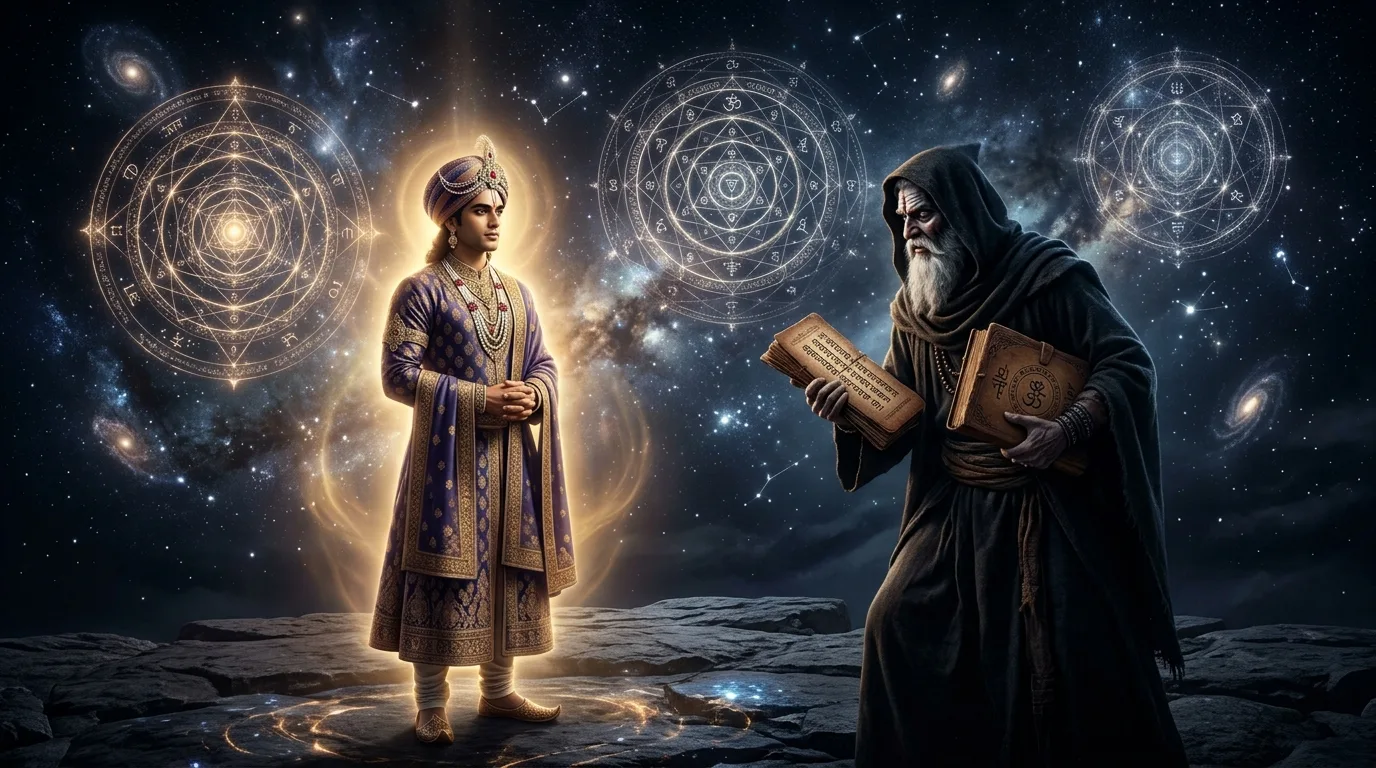
The Valmiki Ramayana is widely celebrated as an epic of devotion, righteousness, and divine destiny. However, hidden within its ancient verses is one of the most profound and startling intellectual debates of the classical world. In a striking episode that shatters modern stereotypes about ancient religious texts being mere echo chambers of blind faith, Lord Rama is confronted not by a fearsome demon, but by a hardcore atheist. This confrontation with Jabali, a senior minister espousing extreme materialist philosophy, forces Rama to articulate the deepest philosophical defense of Truth (Satya) and Dharma. Far from demanding dogmatic obedience, Rama’s response is a masterclass in sociological logic and moral philosophy, proving that the ancient Indian intellectual tradition welcomed intense scrutiny, skepticism, and rigorous debate even in the highest royal courts. This article explores the depths of this remarkable dialogue, stripping away modern simplifications to reveal what the text actually says about the structural integrity of human civilization.
What the Text Actually Says
In the Ayodhya Kanda (specifically Chapters 108 and 109) of the Valmiki Ramayana, an extraordinary philosophical and political crisis unfolds. Lord Rama has been exiled to the Dandaka forest, and in his absence, his father, King Dasharatha, has died of grief. Bharata, Rama's devoted brother, travels deep into the forest with the royal entourage to break the tragic news and beg Rama to return to Ayodhya and claim his rightful throne. Bharata employs every emotional, political, and familial appeal available, but Rama remains steadfast in his vow to honor his late father's word. When Bharata's passionate pleas fail, a senior royal minister named Jabali steps forward.
Jabali is not a traditional priest or an orthodox advisor. He employs the philosophy of the Charvakas or Lokayatas—the ancient Indian school of extreme materialism, empiricism, and atheism. Recognizing that emotional appeals have failed, Jabali attempts to dismantle the very philosophical foundation of Rama's vow.
Jabali presents a remarkably modern, secular, and almost nihilistic argument. He looks directly at Lord Rama and states that Dasharatha was merely a biological vessel, a temporary combination of physical elements that is now dead, destroyed, and gone forever. According to Jabali, there is no afterlife, no immortal soul, and no cosmic law binding the living to the dead. He argues that the concepts of Dharma, heaven, ancestral duty, and religious merit were invented by clever, manipulative men to extract charity, control the masses, and maintain social power.
To prove his point, Jabali uses pure empiricism and devastatingly sharp logic. He argues against the efficacy of Shraddha (ancestral rituals), stating: “If food eaten here by one person feeds a ghost in the afterlife, then a traveler shouldn’t need to carry provisions for a journey; his family can simply eat for him at home!” He argues that just as a seed is completely destroyed to make a plant, the dead are permanently erased. Therefore, suffering in a dangerous forest for the sake of a dead man's illusion is foolish. Jabali urges Rama to abandon this useless idealism, return to Ayodhya, and embrace the pragmatic reality of power and kingship.
Rama’s response to this extreme materialism is not a display of divine wrath, nor is it a blind religious mandate. Instead, it is a masterful, intellectually rigorous defense of ethical integrity and the sociological necessity of Truth. Rama does not argue with Jabali over the physical visibility of heaven; he dismantles the materialist argument by explaining the vital function of Truth in maintaining reality.
Rama explains that Truth (Satya) is the ontological bedrock of human civilization. He argues from a sociological and systemic perspective: a leader’s character dictates the character of the entire society. If a king abandons his given word for political pragmatism, convenience, or power, he signals to the entire nation that betrayal, opportunism, and falsehood are acceptable. If the apex of the social hierarchy operates on deceit, society will inevitably collapse into predatory chaos. Trust, Rama argues, is the only currency that holds families, markets, and kingdoms together. For Rama, Dharma and Truth are the structural integrity of reality itself. To break his vow for the throne would not just be a personal failure; it would infect the kingdom's collective psyche with corruption.
Key Terms Explained
To truly grasp the depth of this debate, one must understand the specific Sanskrit terminology used in the text, as loose English translations often fail to capture their philosophical weight.
- Nastika (नास्तिक): While often loosely translated as "atheist," in classical Indian philosophy, a Nastika does not merely mean someone who denies a creator God (Ishvara). Technically, it refers to one who rejects the epistemic authority of the Vedas, the existence of an afterlife, and the transcendent moral order (Dharma). Jabali explicitly employs Nastika-vada to tempt Rama away from his duty.
- Charvaka / Lokayata (चार्वाक / लोकायत): This is the ancient Indian school of extreme materialism. The term Lokayata implies a philosophy restricted only to this observable world (Loka). They believed strictly in Pratyaksha (direct sensory perception) as the only valid source of knowledge. If you cannot physically see, touch, or measure it, it does not exist. They entirely rejected inference, scripture, and the concept of a soul.
- Satya (सत्य) vs. Anrita (अनृत): Satya is derived from the root Sat, meaning 'existence' or 'being'. It is absolute truth, reality, and cosmic order. It is that which is. Anrita, conversely, is falsehood, disorder, and unreality. Rama argues that Dharma is rooted entirely in Satya—it aligns human action with the very fabric of existence.
- Yadvṛttāḥ santi rājānas tadvṛttāḥ santi hi prajāḥ (यद्वृत्ताः सन्ति राजानस्तद्वृत्ताः सन्ति हि प्रजाः, Ramayana 2.101.9): This critical sociological axiom means, "Whatever the conduct of kings, that becomes the conduct of their subjects." It is the principle that leadership sets the absolute moral baseline for the civilization. A corrupt leader normalizes corruption for everyone beneath him.
- Satyameveshwaro Loke (सत्यमेवेश्वरो लोके): "Truth itself is God in this world." In this profound declaration, Rama does not say that God speaks the truth; he declares that Truth is the ultimate deity. There is no higher Dharma, no higher object of worship, and no higher authority than absolute adherence to Truth.
Traditional Interpretation
Classical commentators and scholars of the Valmiki Ramayana, such as Govindaraja and Maheshvara Tirtha, have offered highly nuanced views of this dialogue. The orthodox tradition generally does not view Jabali as a genuine, practicing Nastika who had infiltrated the royal court. Instead, they argue that Jabali was a deeply wise, loyal minister who utilized the Lokayata philosophical framework as a psychological tactic—a desperate "devil's advocate" (Purvapaksha) maneuver.
According to this interpretation, when Jabali saw that Bharata's tears and moral appeals could not sway Rama, he decided to test Rama by attacking his core belief system, hoping to break his resolve through extreme pragmatism. However, Rama’s reaction is severe. Rama not only dismantles the argument but also openly criticizes his late father, King Dasharatha, for keeping a minister with atheist, nihilistic views in his court.
This traditional reading serves a crucial purpose: it demonstrates that while Sanatan Dharma is remarkably open to all philosophical inquiries, skepticism, and dialectical debates, it strictly rejects nihilism in positions of supreme leadership. A ruler who is completely devoid of a transcendent ethical anchor (Dharma)—who believes only in the material accumulation of power without moral boundaries—is considered highly dangerous to society.
How This Connects
This episode is not an isolated incident; it connects deeply to the broader tapestry of Sanatan Dharma. Rama's absolute defense of Truth perfectly sets the stage for the famous declaration found in the Mundaka Upanishad: "Satyameva Jayate" (Truth alone triumphs). Rama embodies this Upanishadic ideal, choosing the agonizing difficulty of truth over the comfortable illusion of falsehood.
Furthermore, this dialogue sharply contrasts with the ethical landscape of the Mahabharata. In the Mahabharata, statecraft (Niti) often forces complex compromises in truth for the sake of the greater good—the most famous example being Lord Krishna advising Yudhishthira to tell a half-truth regarding the death of Ashwatthama to defeat Drona.
Why the difference? Rama represents Maryada—the absolute, uncompromising boundary of idealistic Dharma suited for the Treta Yuga. Krishna represents Purna/Leela—the dynamic, fluid, and highly complex application of Dharma in a degraded age (Dwapara Yuga) where evil has institutionalized itself. Understanding Rama’s rigid, unyielding defense of Truth against Jabali is essential to understanding why the Ramayana and Mahabharata approach ethical dilemmas so differently.
Finally, the very existence of this chapter highlights the profound intellectual freedom in ancient India. Atheism, skepticism, and materialism were not violently silenced or scrubbed from the holy texts; they were actively articulated, debated, and defeated using superior logic in the highest royal courts.
Sources
- Valmiki Ramayana: Ayodhya Kanda, Chapters 108 and 109 (The core dialogue between Rama and Jabali).
- Mundaka Upanishad: For the concept of Satyameva Jayate (Truth alone triumphs).
- The Mahabharata: Referenced for the contrasting ethical framework of statecraft (Niti) under Lord Krishna.
- Political Philosophy/Ethics: Principles of Kantian Deontology (Categorical Imperative) and Machiavellianism, utilized for the modern comparative analysis of ethical leadership.
This reflects what the text itself says; the modern-science comparisons above are interpretation, not an established finding.