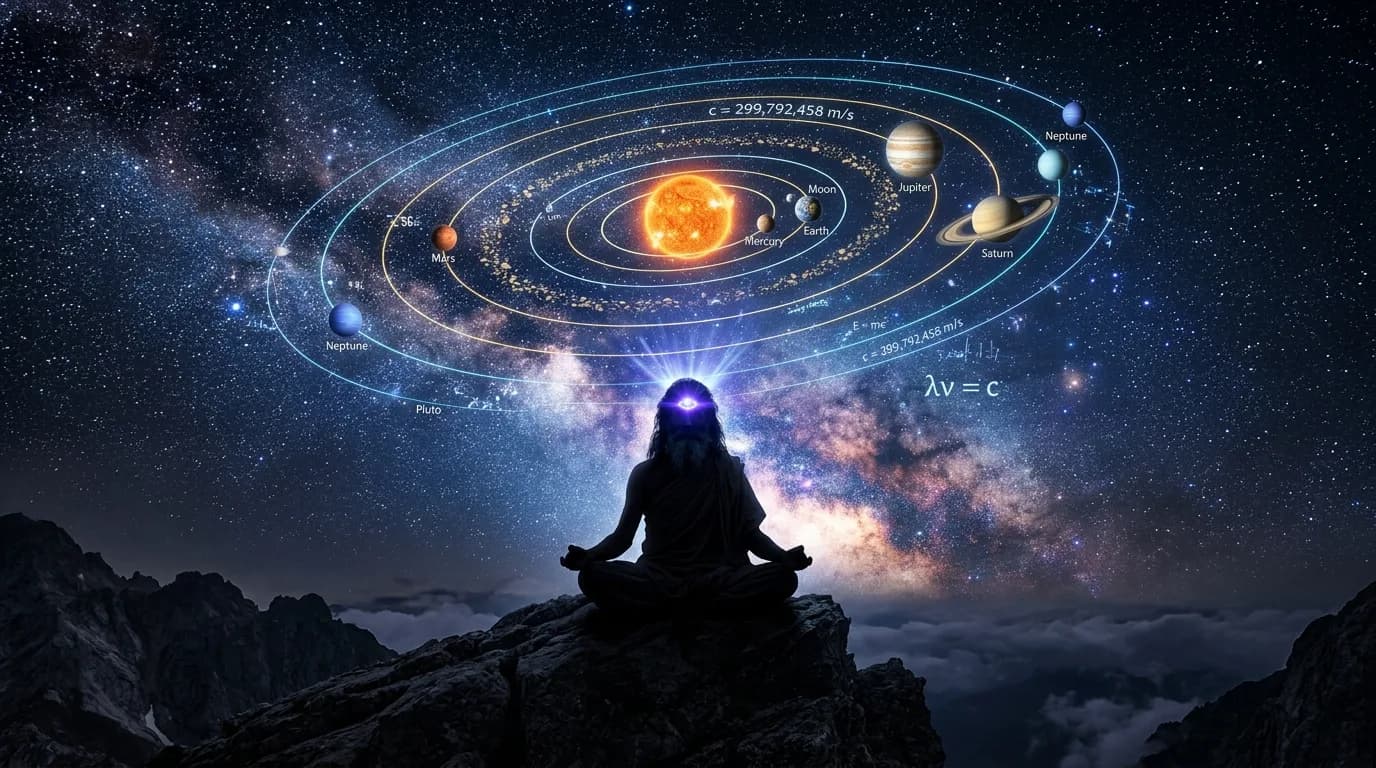
Aitareya Upanishad: The Cosmic Origin of Consciousness
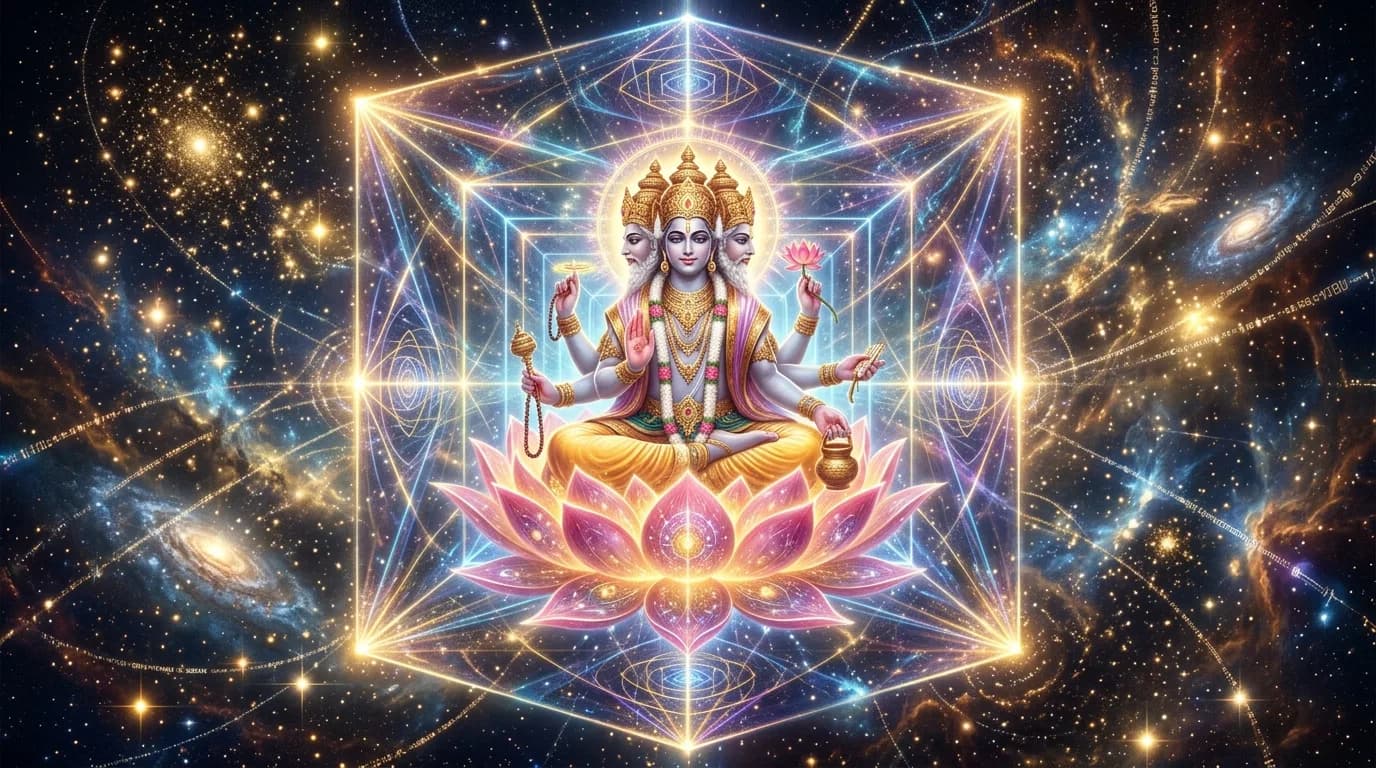
The Aitareya Upanishad, embedded within the ancient Rig Veda, presents one of the most profound, radically subjective accounts of cosmogenesis in human intellectual history. Unlike modern materialistic frameworks that begin with a chaotic void, a singularity, or foundational physical particles, this Upanishad posits a completely different starting point. It argues that the origin of all reality is pure, unconditioned Consciousness. This article deeply examines the text's actual claims, its profound philosophical architecture, and how its ancient insights into the nature of the observer resonate with modern debates in the philosophy of mind, separating genuine philosophical parallels from popular scientific overstatements.
What the Text Actually Says
The Aitareya Upanishad opens with a definitive and uncompromising statement regarding the state of existence prior to the physical universe. It states: "Om. In the beginning, all this was Atman (the Absolute Self) alone. There was no other active, blinking thing. He thought, 'Let me now create the worlds.'" (Aitareya Upanishad 1.1.1).
What follows this initial declaration is not a mechanical construction of a physical universe using pre-existing raw materials. Instead, it describes a "top-down" projection of reality emanating directly from pure awareness. The Atman does not build; the Atman projects the universe through Tapas—a term often misunderstood as physical penance, but which in this context means concentrated, foundational thought or "brooding."
Through this profound cognitive focus, the Atman first creates four distinct cosmic spheres or environments (Lokan): 1. Ambhas: The super-celestial realm of subtle waters, located beyond the visible heavens. 2. Marici: The realm of light and rays, which constitutes the intermediate space. 3. Mara: The mortal realm, representing the physical earth where death and transformation occur. 4. Apah: The subterranean waters, representing the foundational realms below.
However, the Upanishad recognizes a profound philosophical truth: environments are entirely meaningless without an experiencer to perceive them. Therefore, the Atman "draws out" a cosmic blueprint or archetype from the primordial waters, creating the Purusha (the Cosmic Person). The text then describes a fascinating, almost biological process of cosmic differentiation: the Atman "broods" over this Purusha, and like an egg hatching, the physical faculties—mouth, nostrils, eyes, ears—burst forth.
From these anatomical faculties emerge the foundational cosmic forces and deities (Devatas). From the mouth comes Speech, and from Speech comes Agni (Fire); from the eyes comes Sight, and from Sight comes Aditya (the Sun). The universe is literally constructed out of the capacities for sensory experience.
The climax of this teaching is a grand philosophical reversal. The cosmic deities (Fire, Sun, Wind, etc.) find themselves subject to hunger and thirst in the vastness of the newly created reality. They approach the Atman and ask for an abode where they can eat food—essentially, a vehicle through which they can experience reality. The Atman offers them the form of a cow, and then a horse, both of which they reject as insufficient. Finally, the Atman offers them a human body. The deities exclaim their satisfaction. Agni becomes speech and enters the mouth; Aditya becomes sight and enters the eyes.
But a body animated merely by cosmic physical forces is still just a biological machine; it lacks the subjective "I." The ultimate act of creation occurs when the Absolute Atman looks at this constructed vessel and asks, "How can this exist without me?" To actually experience the world it just projected, the Absolute Atman enters the human body through the Vidriti (the sagittal suture at the crown of the head), descending into the human form to become the localized conscious witness looking out from behind the eyes.
Key Terms Explained
To truly grasp the depth of this Upanishad, one must understand the precise Sanskrit terminology it employs, which often loses its philosophical weight when translated into simple English equivalents.
- Atman (आत्मन्): While commonly translated merely as "soul," in the context of the Aitareya Upanishad, it means the absolute, unconditioned, pre-material Consciousness. It is the foundational reality—the only true subject in existence. Everything else, including the mind and the physical universe, is its object.
- Tapas (तपस्): Often translated as "penance" or "austerity" in later Puranic literature, here it means concentrated cognitive heat or intense brooding. Creation in the Aitareya is not a physical labor; it is a profound act of mental concentration by the Atman. The physical universe is fundamentally a thought-construct.
- Purusha (पुरुष): This does not mean a biological "man" or human male. It refers to the Cosmic Archetype or the ultimate template of consciousness interacting with form. It is the macrocosmic blueprint from which the microcosm (the individual human being) is structurally derived.
- Vidriti (विदृती): This translates to the "cleft" or the dividing line, referring anatomically to the sagittal suture at the top of the skull. The Upanishad calls this specific entry point the Nandana (the place of rejoicing). It represents the exact metaphysical threshold where infinite, unbounded consciousness chose to localize itself into a finite biological vessel to experience its own creation.
- Prajnanam (प्रज्ञानम्): Supreme, foundational intelligence or pure awareness. The culmination of the entire Aitareya Upanishad is the Mahavakya (Great Saying): "Prajnanam Brahma" — Consciousness is the Ultimate Reality. It is not a byproduct of reality; it is reality.
Traditional Interpretation
The traditional understanding of this text, particularly within Classical Advaita Vedanta as expounded by the 8th-century philosopher Adi Shankaracharya, approaches this creation narrative through the sophisticated lens of Adhyaropa (deliberate superimposition).
Shankara argues that the Upanishad does not actually care about the literal, physical mechanics of how the world was manufactured. The ultimate truth of Advaita Vedanta is non-duality—that only Brahman (pure consciousness) exists, and the manifold universe is an illusion (Maya). If reality is non-dual, a literal creation of a "second thing" (the universe) is impossible.
Therefore, the elaborate creation story of the Aitareya Upanishad is understood as a pedagogical tool—a teaching method. The human intellect cannot grasp absolute non-duality directly. So, the Upanishad deliberately superimposes a creation narrative onto reality. By tracing the complex physical world back to the cosmic deities, the deities back to the Purusha, and the Purusha back to the one non-dual Atman, the text systematically deconstructs the illusion of multiplicity.
Once the student follows this chain of reasoning and understands that the exact same Atman that projected the entire universe is the exact same "I" looking through their own eyes (having entered through the Vidriti), the story of creation has served its purpose and is philosophically discarded (Apavada). What remains is not a cosmological map, but the realization of pure non-duality: Prajnanam Brahma.
How This Connects
The genius of the Aitareya Upanishad is not isolated; it is deeply woven into the broader tapestry of Sanatan Dharma, acting as a bridge between ancient ritualistic hymns and later spiritual sciences.
- The Purusha Sukta (Rig Veda 10.90): The Aitareya directly builds upon and refines this older, famous Rig Vedic hymn. In the Purusha Sukta, the universe is created through the macrocosmic sacrifice of the giant Cosmic Man (Purusha). The Aitareya Upanishad interiorizes this entire process. The grand cosmic sacrifice is no longer an external mythological event; it happens entirely within human biology. The universe is mapped perfectly onto the human sensory apparatus.
- Taittiriya Upanishad (Pancha Kosha): The entry of the Atman into the physical body connects profoundly with the Taittiriya Upanishad's doctrine of the five sheaths (Pancha Kosha). The Atman penetrating the body to experience reality is the absolute animating force that breathes life into the Annamaya Kosha (the physical body made of food) and the Vijnanamaya Kosha (the sheath of intellect).
- Tantra and Kundalini Yoga: The Upanishad's specific mention of the Vidriti at the crown of the head as the entry point of the divine is incredibly significant. This is the exact anatomical and spiritual location that later Tantric traditions and yogic sciences would identify as the Sahasrara Chakra (the thousand-petaled lotus)—the ultimate gateway where the localized, individual soul (Jiva) reunites with universal consciousness (Shiva).
Modern Research or Science
While the Upanishad is a work of ancient metaphysics, it shares a profound, strictly philosophical parallel with one of the most hotly debated topics in modern cognitive science and the philosophy of mind: the "Hard Problem of Consciousness."
Coined by philosopher David Chalmers, the Hard Problem asks how and why physical processes in the brain (moving atoms, firing neurons, chemical reactions) give rise to subjective, first-person experience (the feeling of pain, the redness of red). Modern scientific physicalism assumes that if you arrange "dead" matter in a complex enough network, consciousness magically emerges as a byproduct. Yet, there is no physical mechanism that explains how unconscious matter generates subjective experience.
The Aitareya Upanishad represents the exact opposite model, aligning closely with what modern philosophers call "Analytic Idealism" or a "Top-Down Cosmology." It posits that consciousness is not an emergent property of matter; consciousness is the fundamental primitive of nature. Matter did not create consciousness; consciousness modulated itself to project the appearance of matter. The brain does not generate awareness; it acts as a localized transceiver or filter for foundational awareness.
Furthermore, the text's assertion that the universe structurally requires an observer to validate its existence loosely resonates with the Participatory Anthropic Principle, a concept proposed by the eminent theoretical physicist John Archibald Wheeler (who coined the term "black hole"). Wheeler suggested that the universe is a participatory system that requires the act of observation to bring physical reality into a concrete state, summarized in his phrase "It from bit."
Where the Comparison Holds, and Where It Doesn't
It is crucial to maintain intellectual honesty when bridging ancient texts with modern science. The Aitareya Upanishad provides a stunningly robust philosophical framework for the primacy of consciousness that directly answers the failures of modern materialism. The conceptual parallel between the Upanishad's observer-centric universe and idealistic interpretations of the philosophy of mind is genuine and profound.
However, it must be stated explicitly: the Aitareya Upanishad is not a textbook on quantum physics, astrophysics, or neurobiology. It is a work of supreme ontology (the study of being) and metaphysics mapping the nature of awareness, not the mechanical behavior of subatomic particles.
We should not make the popular, pseudoscientific claim that the Upanishadic sages calculated quantum mechanics, nor that the text proves physical cosmological models like the Big Bang. Instead, we should accurately claim that it solved the philosophical problem of why there is an observer in the first place. It provides the metaphysical "why," while modern science attempts to map the mechanical "how."
Frequently Asked Questions
What is the main message of the Aitareya Upanishad? The central message is that the entire universe originates from, is sustained by, and ultimately is nothing but pure Consciousness (Atman). The universe was projected specifically for this consciousness to experience itself through the human form.
What does "Prajnanam Brahma" mean? It is a Mahavakya (Great Saying) that translates to "Consciousness is the Ultimate Reality" or "Awareness is Brahman." It means that the foundational intelligence of the universe is the exact same awareness looking through your eyes.
Why does the Upanishad say the cosmic forces rejected animal bodies? The text suggests that while animal forms contain consciousness, the human nervous system and physiological structure present a unique, refined vehicle capable of full self-reflection, speech, and the realization of non-duality.
What is the significance of the "Vidriti"? The Vidriti (the crown of the head) represents the precise localized threshold where the infinite, unconditioned Absolute restricted itself to become a finite, localized witness inside a human body.
Sources
- The Aitareya Upanishad: Primary text, specifically Chapter 1, Section 1 and Chapter 1, Section 3 regarding creation and the entry of the Atman.
- The Rig Veda (Purusha Sukta - 10.90): For the macrocosmic blueprint of the cosmic man.
- The Taittiriya Upanishad: For the framework of the physical and intellectual sheaths (Koshas).
- Philosophy of Mind / Cognitive Science: The "Hard Problem of Consciousness" (as articulated by David Chalmers) and Analytic Idealism.
This reflects what the text itself says; the modern-science comparisons above are interpretation, not an established finding.